
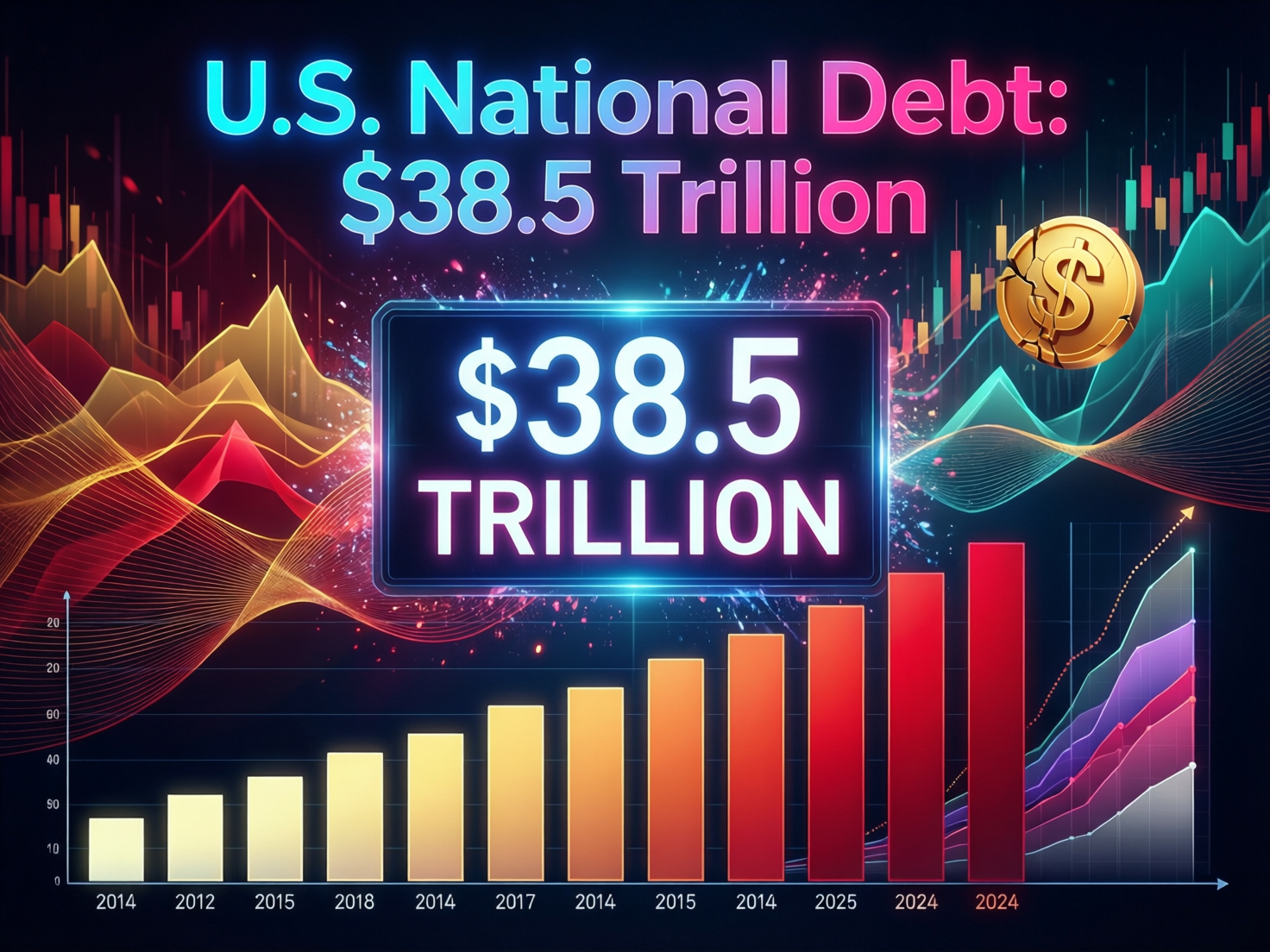

U.S. national debt $38.5 trillion: debt, GDP and market ripple effects
The U.S. national debt reaching the $38.5 trillion mark highlights deepening fiscal stress at a time of higher interest rates and tighter financial conditions. As borrowing costs climb, the government faces growing pressure to service its obligations, while investors are increasingly cautious about long-term risk. This environment is prompting a broader reassessment of traditional safe havens, with some market participants looking beyond U.S. Treasurys toward alternatives such as commodities and cryptocurrencies for diversification and inflation protection.
According to the Treasury’s public dashboard, gross federal debt now sits around $38.4–$38.5 trillion, reinforcing concerns about sustainability. Meanwhile, the debt-to-GDP ratio has remained close to 120% since late 2024, signaling that debt growth continues to outpace economic expansion. Together, these metrics underscore ongoing fiscal challenges and explain why confidence in conventional hedges is being tested across global markets.
Debt snapshot and who holds it
Treasury’s “America’s Finance Guide” shows outstanding federal debt around $38.4T and climbing. Relative to the economy, federal debt stood roughly 119–121% of GDP across Q4-2024 to mid-2025.
Ownership mix and the U.S. national debt $38.5 trillion
Most debt held by the public is owned domestically. As of mid-2025, foreign investors held about 32% of debt held by the public (~$9.1T), implying just under 70% is domestic; Japan and China remain the largest foreign holders. Peterson Foundation+1

Interest costs pass $1T and why that matters
Net interest outlays surpassed $1 trillion in FY2024 and remained around that level in FY2025, rivaling or exceeding large programs and defense. Sustained high interest bills can crowd out other spending and sensitize markets to growth, inflation and policy paths. Reuters+1
What investors are watching now
Yield curve dynamics
After a long inversion, the 10y–2y spread has moved toward/above zero, signaling a partial steepening as policy rates ease while long yields stay firmer.
Gold as a hedge
Gold finished 2025 up roughly 60%–66%, hitting record highs; elevated debt and easier-policy expectations have supported demand.
Bitcoin and risk appetite
Looser financial conditions can lift liquidity for risk assets, though bitcoin’s response has been mixed and increasingly correlated with equities.
Context & Analysis
Elevated debt loads often coincide with political pressure for easier financial conditions, but “fiscal dominance” is debated and not official policy. Even if front-end rates fall, term premiums and issuance can keep long yields higher, creating a steeper curve typically supportive of real assets like gold. Bitcoin’s reactions have varied: in 2025 it often traded with broader risk sentiment rather than purely as an inflation hedge.

Final Thoughts
Crossing the $38.5 trillion debt mark firmly establishes debt sustainability as a key market theme for 2026. Investors are likely to closely track the policy balance between potential interest-rate cuts and continued heavy debt issuance, as this mix will shape funding costs and overall market confidence. Movements in the yield curve will also serve as an important signal of how markets are pricing growth, inflation, and fiscal risk.
At the same time, asset performance gaps may widen. Defensive real assets such as gold could benefit from risk aversion and inflation concerns, while higher-beta exposures like bitcoin may see sharper swings tied to liquidity conditions and investor sentiment. Together, these dynamics will influence portfolio positioning across global markets.
FAQs
Q1. What is the current level of U.S. national debt?
A: Around $38.4–$38.5 trillion, according to U.S. Treasury tracking.
Q2. Is the debt-to-GDP ratio really above 120%?
A: Yes. It fluctuated near 119–121% across late-2024/2025, with Q4-2024 above 120%.
Q3. Who owns most of the debt?
A: About two-thirds of debt held by the public is domestic, while ~one-third is foreign, with major holders including Japan and China.
Q4. Do high debt levels force lower interest rates?
A: Not automatically. Policymakers balance inflation, growth, and financing needs; outcomes vary by economic cycle.
Q5. How could the U.S. national debt ($38.5T) affect gold?
A: If policy turns easier and real yields fall, gold can benefit; it rose ~60% in 2025.
Q6. What about bitcoin?
A: Looser liquidity can help, but bitcoin’s correlation with equities increased in 2025, so results can be mixed.
Q7. What is “steepening” of the yield curve?
A: When long-term yields rise relative to short rates; the 10y–2y spread moved toward/above zero in late-2025/early-2026.
Facts
Event
U.S. gross federal debt reaches a new high near $38.5TDate/Time
2026-01-06T00:00:00+05:00Entities
U.S. Department of the Treasury; Federal Reserve; Congress; foreign holders (Japan, China)Figures
~$38.5T gross debt; ~119–121% debt-to-GDP (late-2024/2025); >$1.0T annual net interest (FY2024–FY2025)Quotes
“Foreign holdings made up about 32% of debt held by the public as of June 2025.” Peterson Foundation summary of Treasury dataSources
Treasury Fiscal Data (fiscaldata.treasury.gov), FRED (fred.stlouisfed.org)