
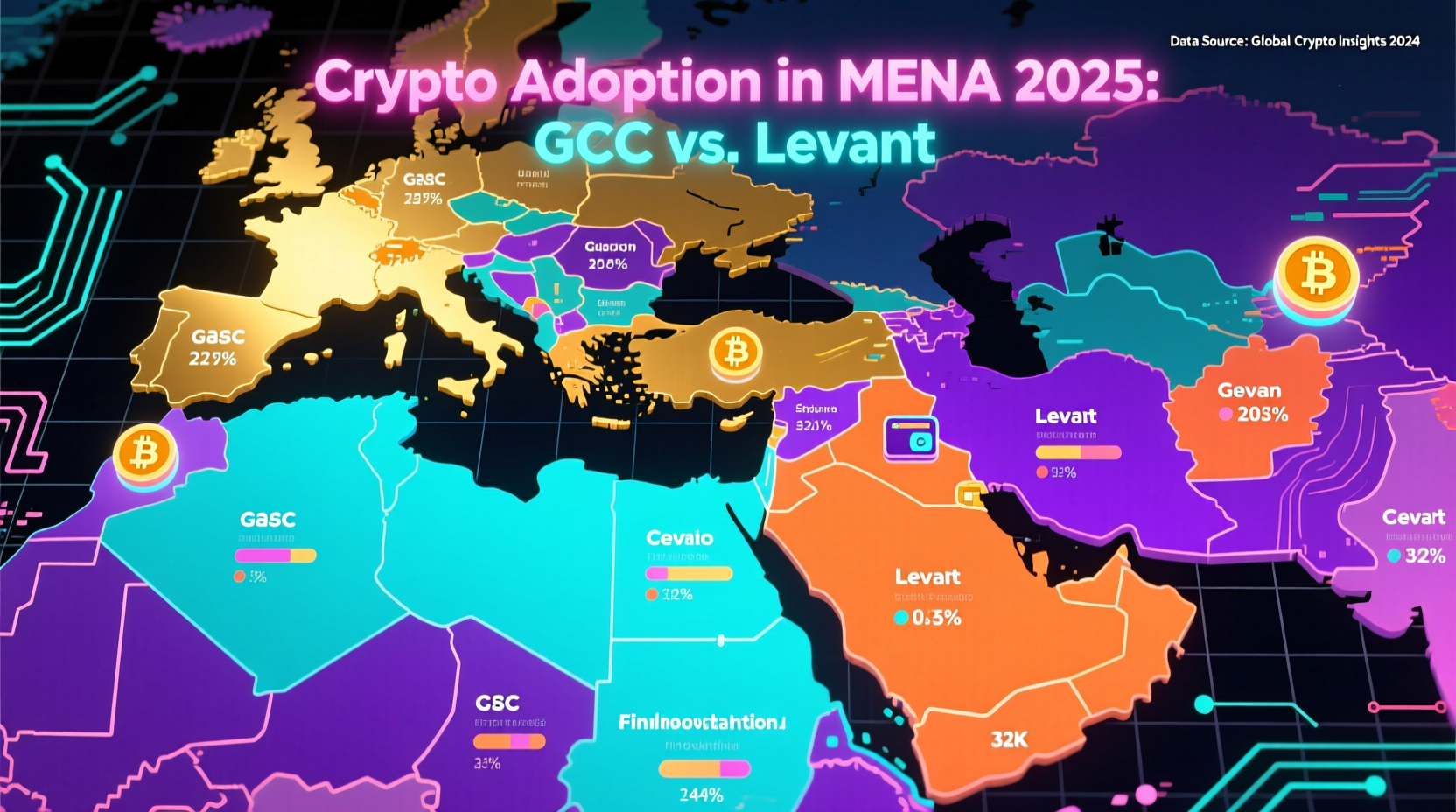

Middle East Crypto Adoption: GCC vs Levant
Middle East crypto adoption splits into two very different stories: a more regulated, institution-friendly GCC (UAE, Saudi, Bahrain, Qatar, Kuwait, Oman) and a Levant region (Jordan, Lebanon, Iraq, Palestine, Syria) where usage is driven by remittances, savings and capital flight.
For US, UK and EU firms, the practical route is usually to license in a GCC hub such as Dubai, Abu Dhabi or Bahrain, then selectively serve Levant users through compliant cross-border products and vetted local partners. Think “GCC hub first, Levant access later” rather than trying to build full operations in every market at once.
Introduction
“Middle East crypto adoption” often gets treated as a single trend line, but on the ground you’re really looking at two very different subregions: the Gulf Cooperation Council (GCC) and the Levant. The GCC (UAE, Saudi Arabia, Bahrain, Qatar, Kuwait, Oman) is moving toward regulated, institution-friendly digital asset markets, while the Levant (Jordan, Lebanon, Iraq, Palestine, Syria) leans on crypto as an escape valve for inflation, capital controls and fragile banking systems.
For analysts in New York or London, or exchanges in Frankfurt and Berlin, understanding this GCC vs Levant split is the difference between a coherent Middle East crypto strategy and a high-risk experiment. In this guide, we map adoption patterns, regulations and entry paths so US, UK, German and wider EU firms can decide where to place their bets — and how to stay compliant while doing it.
Middle East Crypto Adoption at a Glance
What “Middle East crypto adoption” actually covers
When we talk about Middle East crypto adoption in a serious way, we’re usually talking about the broader MENA region and especially two clusters: oil-rich GCC economies and more fragile Levant states. Egypt, Türkiye and Morocco are often included for comparison because they rank highly in global adoption indices and send or receive significant remittance flows into both GCC and Levant markets.
Across MENA, on-chain value received between July 2023 and June 2024 is estimated at roughly $340 billion, around 7.5% of global crypto transaction volume.The UAE, Türkiye and Saudi Arabia now anchor regional volumes, with DeFi and stablecoins growing fastest where inflation or FX pressure is most acute.
Who leads MENA crypto adoption today?
Today, the UAE, Türkiye and Saudi Arabia are the standout markets in raw volume and institutional interest.The UAE alone is estimated to have received over $30 billion in crypto in the 12 months to mid-2024 and ranks among the top 40 countries globally by value received. ( Saudi Arabia and Qatar are among the region’s fastest-growing crypto economies, with strong double- or triple-digit year-on-year growth off a smaller base, while Türkiye remains the largest single market by volume.
By contrast, Levant countries rarely top global rankings on absolute flows but show very high user penetration relative to income and banking access. Informal OTC desks in Amman and Beirut, peer-to-peer (P2P) flows and stablecoin saving habits are often under-reported in on-chain data, which makes the Levant look “smaller” than it feels to local users.
Inflation, remittances, sanctions and digital-native youth
Crypto adoption across GCC and Levant is driven by a familiar bundle: inflation, remittance dependence, sanctions pressure and a very young, smartphone-native population. In Saudi Arabia, for example, a large majority of citizens are under 30, a demographic that tends to experiment early with new financial technology.
In the GCC, relatively stable currencies (often USD-pegged) and high incomes push usage toward trading, Web3 startups and tokenisation projects. In the Levant, chronic FX shortages, banking crises (notably in Lebanon) and conflict-driven displacement make stablecoins and Bitcoin a practical hedge — especially when remittances from the GCC, Europe and North America need to bypass capital controls.
GCC vs Levant: How Crypto Adoption Really Differs
The main differences in crypto adoption between GCC and Levant countries are intent and infrastructure. The GCC is building regulated, institution-compatible digital asset markets, while the Levant uses crypto more as a survival tool for remittances, savings and capital protection.
For Western firms, that usually means.
The GCC is where you set up shop and get licensed.
The Levant is where many of your end-users sit, reached via compliant cross-border models rather than full local operations.
Main differences between GCC and Levant in one table
At a high level.
GCC
Higher per-capita income, clear or emerging VASP regimes, strong interest from Binance, Coinbase, BitOasis, Rain and traditional finance. Use cases skew toward trading, Web3 startups, tokenisation and institutional custody.
Levant
Lower incomes, banking fragility, partial bans or grey zones, and heavy reliance on informal P2P channels. Use cases are dominated by remittances, dollar-equivalent stablecoin saving and capital flight.
Your internal scorecard should treat the GCC as a “regulated growth” play and the Levant as a “high-need, high-friction” frontier where policy risk is structurally higher.

Adoption intensity: UAE, Saudi, Bahrain vs Jordan, Lebanon, Iraq
Within the GCC, the UAE (especially Dubai and Abu Dhabi) tops both adoption intensity and policy clarity, followed by Saudi Arabia and Bahrain. Saudi Arabia and Qatar are often cited as MENA’s fastest-growing markets by crypto volume, with 100%+ annual growth in recent data.Bahrain punches above its size because the Central Bank of Bahrain (CBB) licenses local exchanges like Rain and has long allowed crypto sandboxes.
In the Levant, Jordan, Lebanon and Iraq see high user penetration but fragmented infrastructure. Jordan’s Central Bank has warned against trading but tolerates tightly regulated fintech and payment startups; Banque du Liban has oscillated between caution and de-facto tolerance as the banking crisis deepened. Palestine and Syria are shaped by sanctions and conflict, with crypto often moving through informal networks that are hard for foreign firms to serve safely.
Trading and Web3 in GCC vs remittances and capital protection in Levant
In Dubai, Abu Dhabi, Riyadh or Doha, crypto is increasingly embedded in regulated trading platforms, Web3 startups, tokenisation pilots and virtual asset funds. Tokenised funds, real-world assets and stablecoins are actively explored by banks, sovereign wealth funds and fintechs, including Mastercard-powered payment experiments and Chainalysis-backed analytics hubs.
In the Levant, flows look very different. Turkish lira, Lebanese pounds and Iraqi dinars are routinely swapped into USDT or USDC as a pseudo-dollar savings account, and remittances from the GCC, UK or Germany are sometimes routed via crypto when banking rails are expensive or restricted. Crypto is less about institutional allocation and more about surviving shocks which also means a heavier presence of informal brokers and tougher KYC/AML challenges for regulated Western players.
Inside GCC Crypto Adoption
GCC crypto adoption statistics 2025 (UAE, Saudi, Bahrain focus)
By mid-2024, MENA ranked as the world’s seventh-largest crypto market, with roughly $338.7 billion in value received over 12 months and the UAE as the region’s third-largest economy by crypto volume.Saudi Arabia remains one of the fastest-growing markets in MENA, with growth estimates north of 150% year-on-year and a strong tilt toward DeFi and gaming-adjacent projects.
Bahrain, while smaller, has been an early mover in licensing VASPs such as Rain under the CBB’s regulatory framework, positioning Manama as a niche hub for Gulf-facing exchanges. Qatar and Kuwait follow, with new digital asset regimes emerging in the Qatar Financial Centre and local sandboxes for tokenisation and CBDC testing.
UAE, Dubai and Abu Dhabi as virtual asset hubs (VARA, ADGM, DIFC)
Dubai and Abu Dhabi now operate three parallel regimes for digital assets.
VARA (Dubai mainland + free zones)
A dedicated Virtual Assets Regulatory Authority that licenses a wide range of virtual asset service providers (VASPs) from brokers to custodians.
ADGM (Abu Dhabi Global Market)
A common-law free zone with its own Financial Services Regulatory Authority (FSRA), which has licensed major exchanges including Binance at global scale.
DIFC (Dubai International Financial Centre)
An established financial hub evolving its own digital asset rules and attracting tokenisation, payments and custody projects.
For a US SEC-registered or EU MiCA-regulated platform based in New York, London or Frankfurt, these hubs offer recognisable legal infrastructure, strong courts and a deep talent pool. They also integrate well with modern web platforms and stacks the same kind of headless, composable architectures Mak It Solutions uses for GCC-focused fintech and Web3 sites. (Mak it Solutions)
Saudi, Qatar, Kuwait, Oman: emerging markets, CBDC and stablecoin pilots
Beyond the UAE, Saudi Arabia, Qatar, Kuwait and Oman are experimenting with CBDCs, stablecoins and tokenised assets under central bank oversight. Saudi Arabia’s SAMA has run wholesale CBDC pilots and is funding blockchain innovation aligned with Vision 2030. Qatar’s QFC regime now explicitly covers digital assets and tokenisation.
For now, many of these markets rely on foreign or cross-border exchanges (often Dubai-based) and will likely see local champions emerge once licensing frameworks mature. For Western firms, this is a window to enter via UAE/Bahrain, gather GCC user data and only later consider local entities in Riyadh, Doha or Muscat.
Levant Crypto Adoption, Remittances and Risk
Levant countries rely more on crypto for remittances and capital protection than for institutional investment because banking systems are fragile, FX is scarce and households depend heavily on cross-border flows from the GCC, Europe and North America. Crypto particularly dollar-pegged stablecoins acts as a parallel rail for dollars and a hedge against currency collapse rather than a formal asset class.
Crypto in Jordan, Lebanon, Palestine, Syria and Iraq.
Hard numbers are patchy, but multiple surveys and on-chain studies show high Levant penetration for stablecoin wallets and P2P trading, especially in Lebanon, Jordan and Iraq. Regional MENA data suggests a strong retail bias: in many markets, 90%+ of transaction counts are sub-$10,000, consistent with household-level flows rather than institutional allocation.
At the same time, legal status is murky. Jordan’s Central Bank has banned banks from directly dealing in crypto but not necessarily individuals; Lebanon’s regulators warn of volatility while informal exchanges proliferate; Iraq has at times prohibited BTC trading yet sees growing interest among youth. For Palestine and Syria, sanctions and capital controls make crypto even more sensitive from an OFAC and FATF perspective.
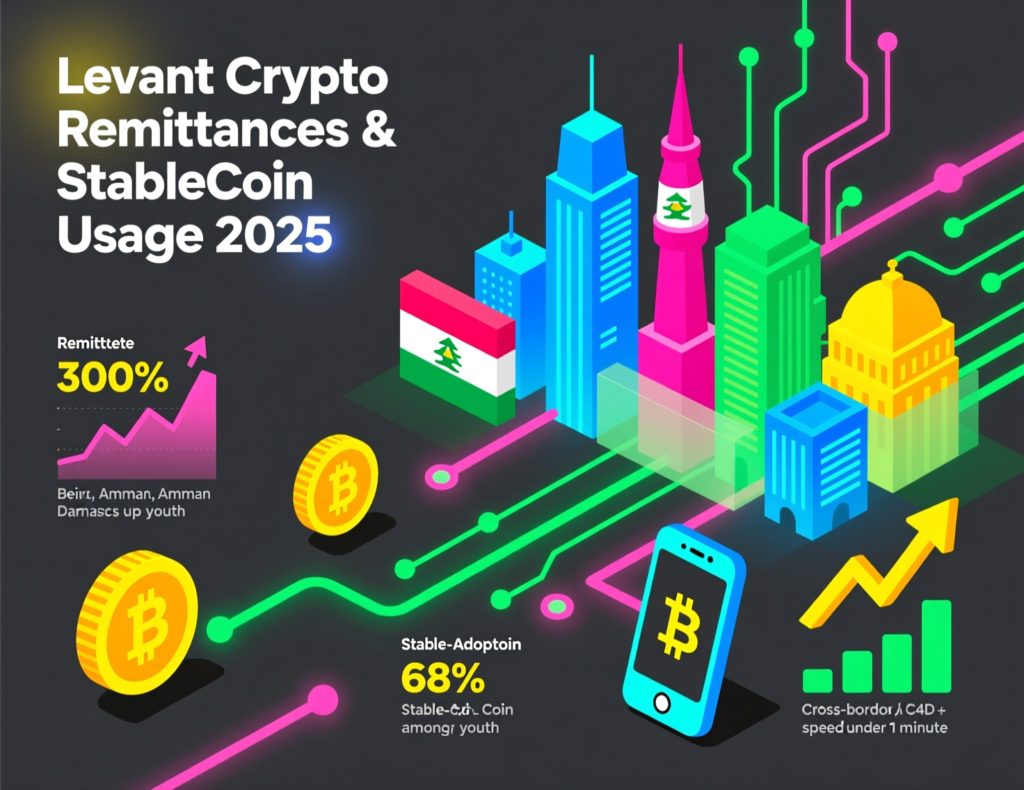
Why Levant users lean on crypto for remittances and savings
For many Levant households, a brother in Dubai or a cousin in Berlin sends money home every month. Traditional wires are expensive, slow and sometimes blocked; local banks may haircut FX at unfavourable rates or impose withdrawal limits. Stablecoin rails even if technically semi-grey can deliver near-instant USDT from a GCC exchange to an OTC desk in Amman, which then pays out local currency or physical dollars.
Crypto also fills the “mattress dollar” role in places like Lebanon, where confidence in the banking sector collapsed during the financial crisis. Rather than investing in altcoins or complex DeFi, many users simply hold USDT, occasionally swapping to BTC as a long-term store of value. This behavioural profile matters if you’re designing UX from London or New York; savings and remittance journeys often matter more than trading dashboards.
Sanctions, banking fragility and informal channels.
For a US-regulated exchange, Levant exposure is defined first by sanctions risk (OFAC lists, terrorism financing concerns) and only then by market opportunity. OFAC’s virtual currency guidance makes clear that US persons must block and report dealings with sanctioned actors and avoid facilitating evasion, including through mixers or opaque P2P networks.
Informal brokers and Telegram-based desks blur KYC/AML, Travel Rule and source-of-funds checks. Western firms typically respond by:
Serving Levant users remotely from a GCC or European hub under strict geofencing and enhanced due diligence;
Limiting products to spot trading and simple remittances;
Partnering only with banks and fintechs that can evidence robust compliance.
GCC vs Levant Crypto Regulations Compared
Licensing and VASP rules in GCC (VARA, ADGM, SAMA, CBB)
In the GCC, regulation is converging on a clear VASP model aligned with FATF Recommendations 15 and 16.
UAE
VARA, ADGM and DIFC each run licensing regimes for exchanges, custodians, brokers and other VASPs; at federal level the SCA and Central Bank regulate securities-like and payment-token activities.
Bahrain
The CBB’s crypto-asset module licenses exchanges such as Rain and sets detailed capital, custody and reporting rules.
Saudi Arabia
SAMA and the Capital Market Authority (CMA) are moving from pilots toward more formal digital asset frameworks, especially for tokenisation and custody.
For Western firms, this looks familiar: you obtain a licence, implement Travel Rule and AML systems, prove governance and risk controls and plug into local banking much closer to MiCA or UK-FCA-style supervision than the Levant’s patchwork.
Legal status and grey areas in the Levant (Jordan, Lebanon, Iraq)
Levant regulations are more fragmented.
Jordan
The Central Bank restricts banks and payment institutions from dealing in crypto, but individuals still access offshore exchanges and P2P markets.
Lebanon
Banque du Liban has issued warnings rather than a comprehensive VASP law; much activity is effectively extra-territorial, routed via Dubai, Türkiye or Europe.
Iraq
Periodic bans on trading coexist with growing retail interest and informal OTC desks.
For a BaFin-supervised or MiCA-authorised exchange in Frankfurt, this creates a dilemma: you can technically onboard Levant citizens under EU rules, but local enforcement, sanctions overlays and reputational risk may argue for a cautious or restricted approach.
How FATF, OFAC, MiCA, BaFin and GDPR/DSGVO shape each subregion
Global frameworks heavily shape both subregions.
FATF
Defines VASPs and mandates the Travel Rule, increasingly enforced in GCC hubs.
OFAC / FinCEN
Dictate how US persons handle sanctioned actors and high-risk jurisdictions, critical for flows to Syria, parts of Iraq and sanctioned entities in Lebanon.
MiCA + BaFin
In the EU, MiCA provides a harmonised regime for crypto-asset service providers, with BaFin implementing German supervision. (ESMA)
GDPR / UK-GDPR / DSGVO
Data protection rules govern how exchanges based in Berlin, Frankfurt or London store and process GCC and Levant customer data. (EUR-Lex)
In practice, GCC regulators actively align with FATF and MiCA-style expectations to remain globally connected, while Levant markets struggle to keep pace due to economic and political instability.
Best Middle East Country for a Crypto Startup
Decision criteria: market size, regulatory clarity, tax and talent
When choosing a Middle East base, crypto startups from the US, UK or EU typically rank four things:
Regulatory clarity & licensing speed
Market size and regional access (GCC + Levant + North Africa)
Tax regime and repatriation rules
Talent, infrastructure and connectivity to New York, London, Frankfurt/Berlin
Dubai (VARA/DIFC), Abu Dhabi (ADGM) and Bahrain (CBB) consistently score high across all four, which is why they appear in so many global expansion decks. Riyadh is rising fast as a financial hub, but many firms still treat it as a second-stage expansion after proving GTM from the UAE or Bahrain.
GCC vs Levant scorecard for US, UK and EU-regulated firms
For a US or FCA-authorised firm.
GCC
Strong on regulation, tax and infrastructure; some complexity navigating multiple UAE zones but generally positive.
Levant
Strong on problem/need fit but weak on legal certainty, sanctions profile and banking access.
Most serious players therefore choose a GCC base, then selectively serve Levant users if and when their risk committee is comfortable.
Dubai, Abu Dhabi, Riyadh vs Amman, Beirut as regional bases
Typical patterns Mak It Solutions sees in client roadmaps.
Dubai/Abu Dhabi
Primary licensed entity, with bilingual Arabic/English platforms, in-region hosting and data residency controls. (Mak it Solutions)
Riyadh
Local branch or JV for KSA user acquisition once licensing is clearer.
Amman/Beirut
Often used for support, research or dev teams rather than core regulated activities, to avoid direct exposure to grey-area retail flows.
Market Entry Playbook for US/UK/EU Crypto Companies
Foreign US, UK and EU crypto companies can enter GCC and Levant markets compliantly by licensing in a clear GCC regime (VARA, ADGM, CBB), aligning with FATF Travel Rule and OFAC/MiCA expectations, then extending services cross-border only where local laws allow. The safest pattern is “GCC hub first, Levant access later”, with sanctions and data protection design baked in from day one.
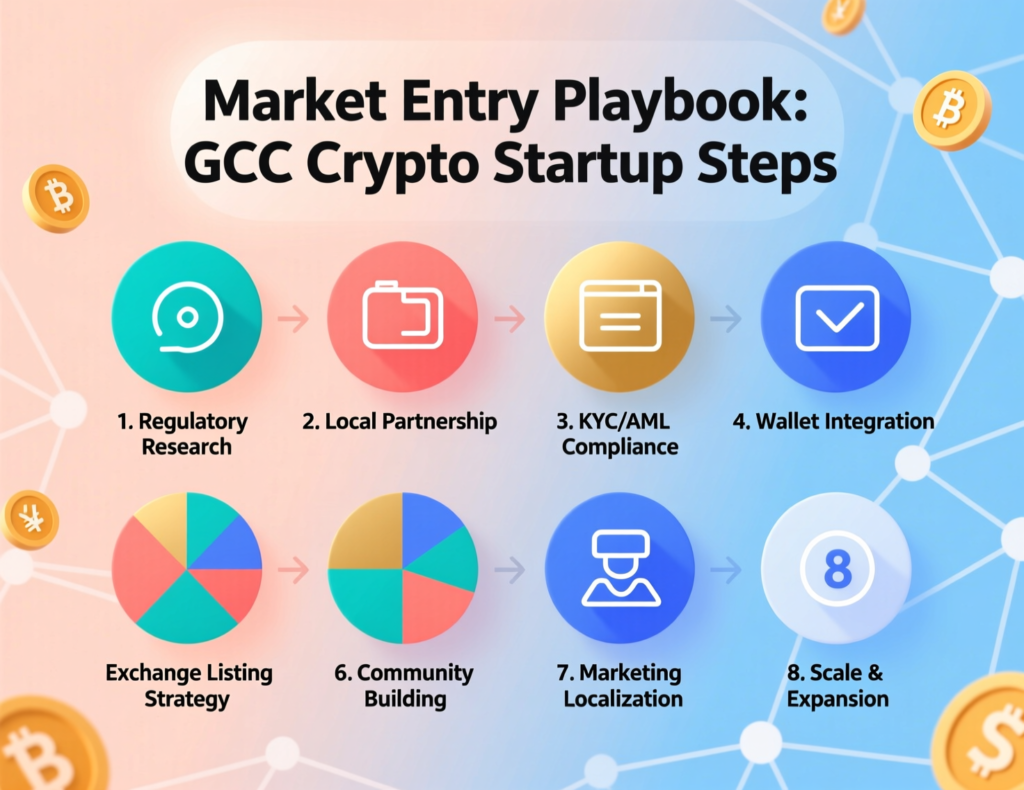
How US, UK and German-regulated exchanges localise for GCC users
Winning GCC users is less about speculative token lists and more about culturally localised product: Arabic-first UX, GCC payment methods, Sharia-sensitive marketing and in-region hosting. Many firms pair modern stacks (headless CMS, SSR/SSG architectures, Jamstack) with Arabic-first web development tailored to Saudi and UAE markets exactly the kind of patterns covered in Mak It Solutions’ guides to headless CMS and GCC web trends.
Practically, a New York or London exchange will.
Launch an Arabic/English GCC site on a separate domain or subfolder.
Host key workloads in AWS or Azure regions in the UAE, Saudi or nearby Europe.
Integrate local on- and off-ramps via banks and fintechs in Dubai, Abu Dhabi, Riyadh and Manama.
Compliance checklist
Your high-level checklist should include.
Risk-based KYC/AML aligned with FATF and local rules (VARA, ADGM, CBB, SAMA).
Travel Rule implementation via a recognised provider, for both GCC-local and cross-border transfers.
Sanctions controls tuned to OFAC’s crypto guidance, including wallet screening and IP/geolocation checks for high-risk jurisdictions.
Data protection mapped against GDPR/DSGVO and UK-GDPR even when hosting in Dubai or Riyadh.
Indexing and SEO governance so your GCC/Levant content is discoverable but compliant, using careful indexing controls across language and jurisdiction variants. (Mak it Solutions)
Partnering with local banks, fintechs and VASPs in GCC and Levant
Partnerships make or break entry.
In the GCC, align with tier-one or tier-two banks, payment gateways and local VASPs who already understand VARA/ADGM/CBB expectations.
In the Levant, consider working with regulated remittance houses or MTOs in Jordan and Iraq that can bridge on- and off-ramps safely, rather than relying on unvetted OTC desks.
Mak It Solutions often helps teams design these integrations end-to-end, from API architectures and SLA monitoring to frontend flows and multilingual content.
Middle East Crypto Adoption Trends to 2030
Stablecoins, CBDCs and tokenisation across GCC and Levant
By 2030, expect GCC markets to be dominated by stablecoins, CBDCs and tokenised real-world assets, with the UAE and Saudi leading on regulated DeFi and tokenisation pilots. Chainalysis already shows stablecoins outpacing BTC and ETH in much of MENA, especially where inflation or FX pressure is acute.
In the Levant, CBDCs from major trading partners (including GCC states and possibly the EU) could reshape remittance channels, while dollar-pegged stablecoins will likely remain a household hedge.
What Western investors should watch next in MENA
From New York, London or Berlin, key watchpoints include.
Progress of Saudi and Qatari digital asset frameworks;
The UAE’s implementation of the OECD’s Crypto-Asset Reporting Framework (CARF), expected around 2027–2028.
Early MiCA-licensed EU exchanges using Dubai or Abu Dhabi as non-EU hubs.
When to revisit your GCC vs Levant market thesis
Revisit your thesis whenever.
A major GCC regulator updates its VASP rules.
OFAC issues new designations touching Levant corridors.
EU or UK enforcement against cross-border CASPs tightens, especially around MiCA.
Given the pace of change in Middle East crypto adoption, an annual strategy refresh is the bare minimum; most serious players iterate quarterly.
To Sum Up
For now, the GCC is the rational base for regulated crypto businesses targeting Middle East crypto adoption: clearer rules, deeper capital and better infrastructure. The Levant matters most as an end-user corridor especially for remittances and dollar savings but carries higher legal, sanctions and operational risk.
How to benchmark your own Middle East crypto strategy
Benchmark your current position against three questions.
Do we have a clear GCC hub strategy (UAE, Bahrain, Saudi) with named regulators and licences?
Do we understand Levant user needs as remittance- and savings-driven, not just trading-driven?
Are our platforms, content and SEO tuned for Arabic-first GCC and Levant users in the same way they are for US, UK and EU audiences? (Mak it Solutions)
If the honest answer to any of these is “not yet”, it’s time to revisit your roadmap.
Talk to an expert / download the full Middle East crypto adoption report
If you’re weighing “UAE vs Bahrain vs Saudi” or “GCC hub vs Levant base” for your next expansion, it helps to have local, technical and regulatory context in the same room. Mak It Solutions works with fintechs, exchanges and Web3 teams across the USA, UK, Germany and wider Europe on Middle East-ready platforms, governance and growth playbooks.
If you’d like a practical GCC vs Levant entry plan covering licences, platform architecture, Arabic-first UX and SEO/AEO for Middle East audiences share your current roadmap and home-jurisdiction obligations. We’ll map a draft hub choice (Dubai, Abu Dhabi, Riyadh or Bahrain), risk posture for Levant remittances and a content/tech stack that fits your team.
You can start by booking a short consultation via Mak It Solutions and, if helpful, we can turn this article into a tailored Middle East crypto adoption report for your board or investment committee. ( Click Here’s )
FAQs
Q : Is crypto legal in all GCC countries, and how does that compare with Jordan and Lebanon?
A : No, crypto isn’t uniformly “legal” or “illegal” across the GCC; instead, countries like the UAE and Bahrain have detailed VASP licensing regimes, while Saudi, Qatar, Kuwait and Oman are still moving from pilots to fuller frameworks. In Jordan and Lebanon, regulators have typically warned against trading and restricted banks from dealing directly in crypto, but individuals still access offshore exchanges and P2P markets. For a Western firm, treat GCC hubs as regulated venues and the Levant as mixed-status territories that require enhanced legal review and conservative risk appetites.
Q : Can Levant users legally trade on GCC-based crypto exchanges like those in Dubai or Bahrain?
A : In practice many Levant users do open accounts with GCC-based exchanges, but their legality depends on both the exchange’s licensing and the user’s home-country rules. A Dubai or Bahrain exchange may be fully licensed under VARA or CBB, but a user in Jordan, Lebanon or Iraq might still face local restrictions or tax/reporting obligations. Western firms should clearly disclose jurisdictional limits, apply robust KYC/AML and, where necessary, restrict onboarding from countries where local law is hostile or sanctions risk is high.
Q : How does EU MiCA apply if a German or EU-regulated exchange onboards users from the Middle East?
A : Under MiCA, an EU-authorised crypto-asset service provider must meet EU standards for governance, disclosures, asset safeguarding and complaint handling, regardless of where customers live. Onboarding users from GCC or Levant states doesn’t remove MiCA obligations; instead, it adds another layer of local law, sanctions and data-protection requirements. German or EU exchanges should therefore map Middle East user journeys against MiCA, BaFin guidance, GDPR/DSGVO and local rules in the UAE, Saudi, Bahrain or Jordan before scaling marketing.
Q : What are the biggest sanctions and OFAC risks when sending crypto remittances to the Levant?
A : The main risks are interacting with wallets or intermediaries linked to sanctioned entities, terrorist organisations or embargoed jurisdictions, especially in parts of Syria, Iraq and Palestine. OFAC expects US persons and many globally active institutions to screen wallets, IP addresses and counterparties, block prohibited transactions and report blocked virtual currency within defined timeframes.To manage this, regulated firms should avoid informal OTC brokers, use Travel Rule-enabled rails and maintain strong on-chain analytics and sanctions monitoring.
Q : How do stablecoins and CBDCs change the outlook for Middle East crypto adoption by 2030?
A : Stablecoins are already central to MENA flows and will likely remain the dominant asset class, particularly for remittances and savings in the Levant and trading in the GCC. CBDC pilots in Saudi, the UAE and Qatar could eventually provide regulated, programmable settlement layers that coexist with or partially displace some stablecoin use cases. By 2030, expect a hybrid environment where regulated stablecoins, tokenised bank money and CBDCs coexist, with GCC institutions leading adoption and Levant households using whatever rails are cheapest, safest and most accessible at the edge.