


Solar-Powered Bitcoin Mining in the Middle East Guide
Solar-powered bitcoin mining in the Middle East means colocating mining facilities with large desert solar farms (often with battery storage or gas-backed microgrids) so rigs run on cheaper, more predictable power than fossil-heavy grids. For US, UK, German and wider EU investors, it can deliver attractive ROI and a stronger ESG story if projects are structured around Gulf regulations, Western compliance rules and country-specific political and energy risks.
Put simply: you’re turning surplus Middle East solar into a flexible digital asset, but your returns depend as much on law, contracts and governance as on bitcoin’s price chart.
Introduction
Solar-powered bitcoin mining in the Middle East sits where three trends collide: cheap desert solar, volatile bitcoin cycles and a world where AI Overviews and generative search are reshaping how capital discovers niche opportunities. Rising energy costs and halving cycles make pure grid-powered mining hard to justify in New York, London or Frankfurt, while Gulf states are racing to deploy solar at utility scale.
For the right US, UK, German and EU investors, solar-powered bitcoin mining in the Middle East can be a capital-efficient way to monetise stranded energy and improve ESG scores if you respect the regulatory, political and infrastructure realities on the ground.
What Is Solar-Powered Bitcoin Mining in the Middle East?
Solar-powered bitcoin mining in the Middle East means deploying bitcoin mining hardware next to high-irradiance solar parks in countries like the UAE, Oman, Saudi Arabia or Iran, usually with battery storage or backup gas to smooth power supply. These projects aim to turn cheap midday solar sometimes even curtailed by the grid into a 24/7 mining operation with lower carbon intensity than coal or oil-fired power.
Several academic and industry studies suggest that, under favourable assumptions and in Middle East conditions, solar bitcoin mining can achieve payback in roughly 3–5 years.
How Solar-Powered Crypto Mining Works in Practice
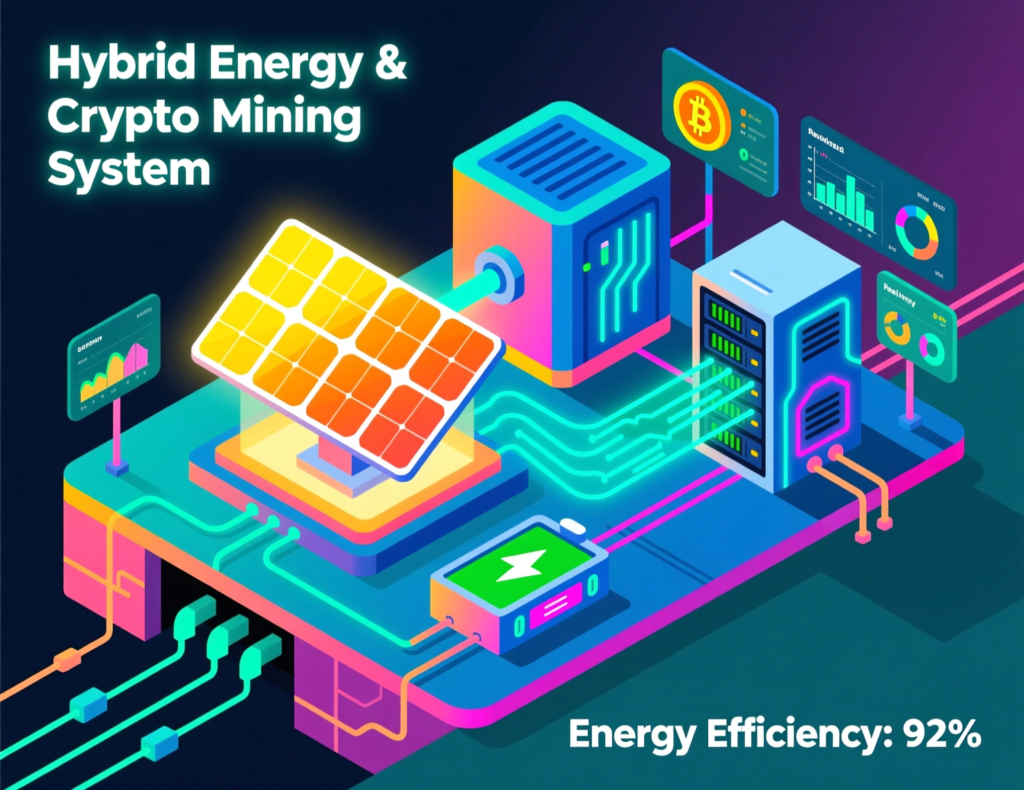
In practice, a photovoltaic bitcoin mining facility looks a lot like a compact, solar-powered data center:
Solar generation
Utility-scale PV arrays generate DC power, converted via inverters to AC for mining rigs.
Hybrid solar and battery storage for crypto mining –
Batteries or other storage smooth out cloud cover and evening ramps so your hashrate doesn’t crash every time the sun dips.
Grid-tied vs off-grid
Some sites are fully off-grid, focused on stranded energy monetisation with bitcoin; others are grid-tied, using curtailed renewable power for mining when wholesale prices go negative.
Integration with data centers
Mining halls increasingly sit alongside AI or cloud data centers, sharing cooling, security and power infrastructure especially in UAE and Saudi “digital park” projects.
Architecturally, it’s essentially a specialised data center design problem an area where partners like Mak It Solutions already work with Middle East teams on web platforms, cloud back-ends and monitoring dashboards for large-scale infrastructure. (Mak it Solutions)
Why the Middle East Is a Natural Fit for Solar Mining
The Gulf combines world-class solar resources with growing grid constraints and ambitious diversification plans:
Renewable energy capacity in the broader Middle East grew by around 57% between 2022 and 2023, one of the fastest rates globally.
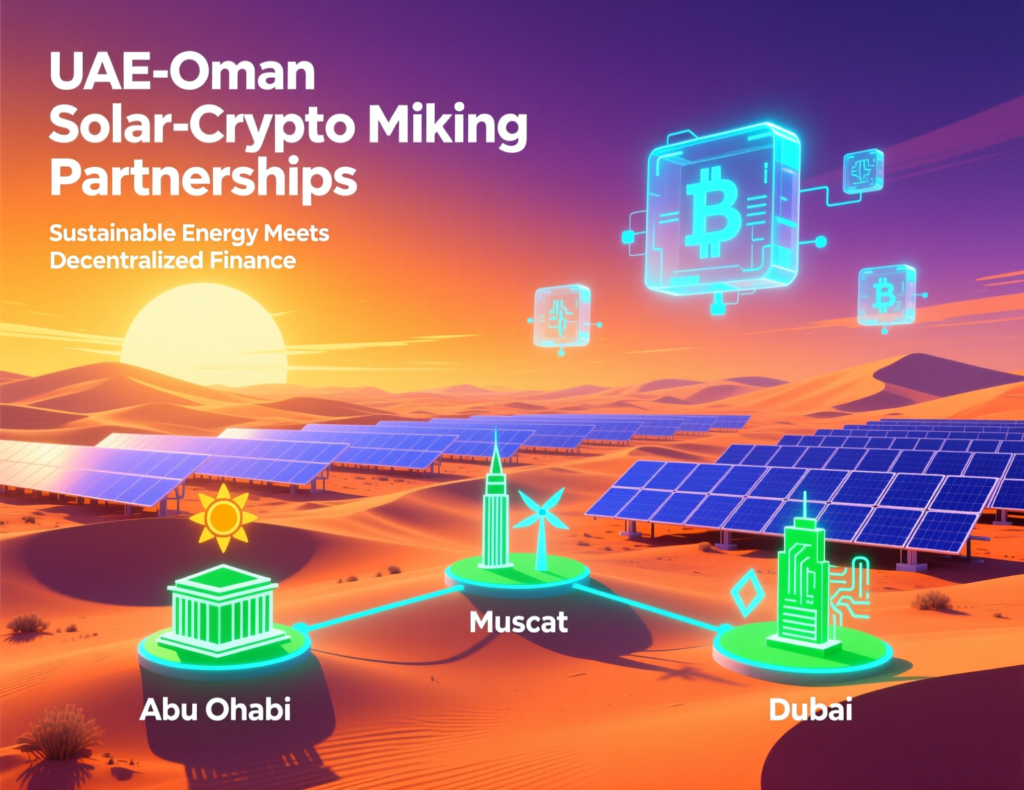
Desert solar farms powering data centers are central to strategies in Abu Dhabi, Dubai, Riyadh and Muscat, often backed by sovereign wealth capital.
Curtailment (wasted solar when the grid can’t absorb power) and remote sites make bitcoin mining an attractive “buyer of last resort” for electrons.
For investors in New York, London or Frankfurt used to relatively mature grids, this is a structural arbitrage: you’re helping monetise power that might otherwise be wasted.
Pros and Cons vs Conventional Mining Setups
Pros
Lower levelised cost of electricity (LCOE) versus many US/European grids
Better ESG profile versus coal or heavy fuel oil-powered mining
Potential to co-locate with emerging AI/data center campuses
Access to free zones and investment vehicles in UAE and Oman
Cons
Higher upfront capex for solar, storage and desert-ready data centers
Complex, evolving regulation across GCC, Iran and neighbouring markets
Political and enforcement risk (e.g., sudden crackdowns on unlicensed mining)
Cross-border tax, KYC/AML and securities considerations for Western investors
Why the Middle East Is Emerging as a Solar Bitcoin Mining Hub
Solar bitcoin mining in the Middle East is taking off because power is cheaper, solar pipelines are enormous and policymakers are experimenting with new digital/energy models. Clean energy is still a minority share of total Middle East energy investment, but that share is growing quickly and creating surplus daytime generation that bitcoin can tap.
Key Countries and Hubs: UAE, Oman, Iran, Saudi Arabia, Qatar
UAE (Abu Dhabi, Dubai, Ras Al Khaimah)
Offers clearer virtual asset frameworks via the Virtual Assets Regulatory Authority (VARA) in Dubai and FSRA/DFSA in ADGM/DIFC, plus mega-solar projects that can serve mining and AI data centers together.
Oman (Muscat, special economic zones)
Actively marketing itself as a bitcoin mining hub linked to renewable projects and industrial parks, with several public announcements around large-scale mining powered by solar and gas hybrids.
Iran (Tehran and provinces)
Historically attractive due to subsidised power; academic work from Tehran-based researchers indicates that solar-based bitcoin mining in Iran can be profitable with ROI around 3.5 years, although sanctions and regulatory risk are high.
Saudi Arabia & Qatar (Riyadh, NEOM, Doha)
Vision 2030 and national digital strategies are pushing giant desert solar farms and data center regions, where bitcoin is just one of several load options alongside AI and cloud workloads.
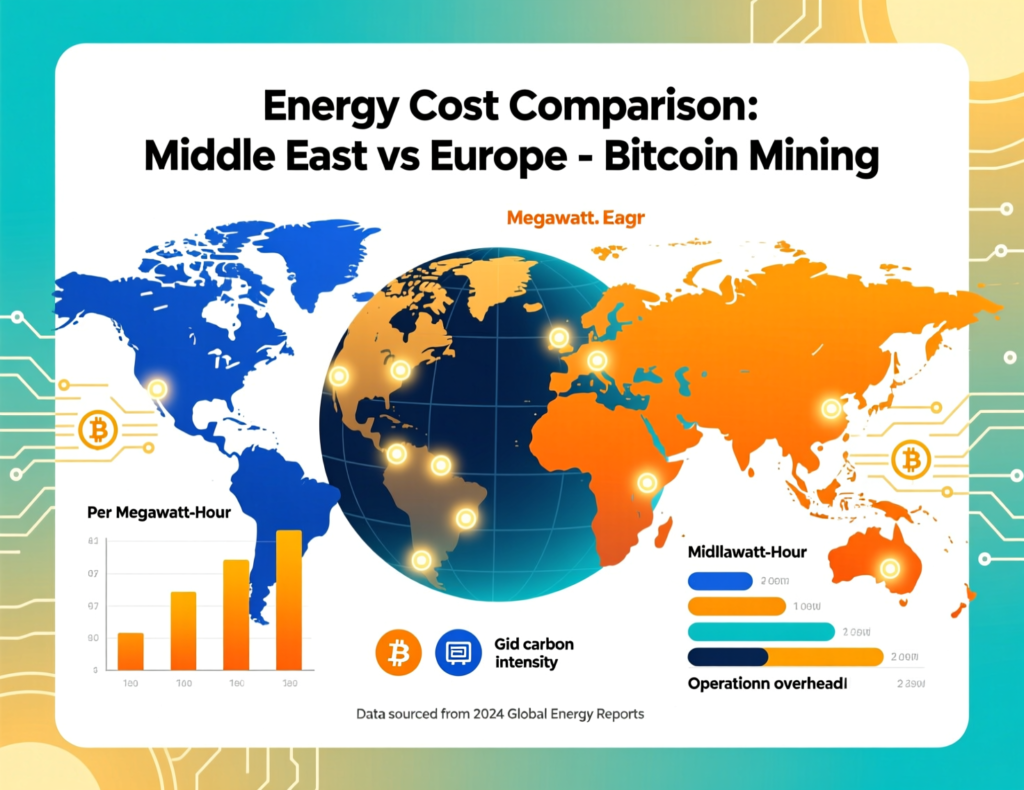
Comparing Energy Economics.
Bitcoin mining consumes roughly 0.5% of global electricity, and up to 2.3% of US electricity depending on the estimate, so every cent on power costs matters.
In parts of the Middle East, solar LCOE is among the lowest in the world, especially for utility-scale projects backed by state-owned entities.
In Germany or the UK, miners often face higher grid tariffs, carbon pricing and tighter planning rules especially after the energy shocks of 2022–2023.
For an investor in London or Munich, the core story is simple: move your energy-intensive workload closer to cheap, sunshine-rich electrons, while structuring everything to comply with FCA, BaFin and ESMA expectations.
How AI, Data Centers and Bitcoin Compete for Power
AI data centers are now competing directly with bitcoin mining for substation capacity and long-term power purchase agreements (PPAs). Recent research suggests AI data centers could consume tens of gigawatts by 2025, rivaling or exceeding bitcoin’s electricity use, particularly in the US.
In practice
Gulf utilities decide whether a megawatt goes to a hyperscale AI cluster, a sovereign cloud region or a mining farm.
Investors from New York or Zurich increasingly see mining as one configurable “load” within a broader digital infrastructure portfolio.
That’s why many serious players treat a solar mining project more like a data center plus power play, not a pure crypto bet exactly the kind of stack Mak It Solutions helps architect across cloud, analytics and web dashboards. (Mak it Solutions)
ESG, Sustainability and Policy Around Renewable Energy Bitcoin Mining
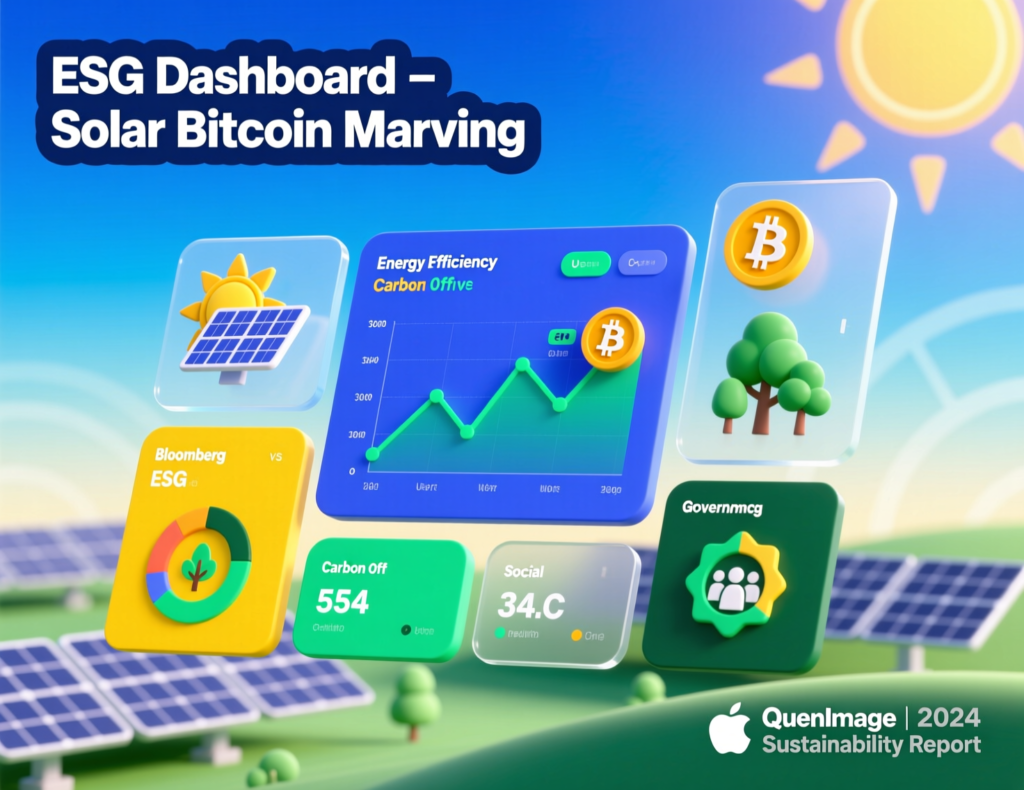
Renewable energy bitcoin mining can sharply reduce carbon intensity compared to coal or oil-powered operations, but it doesn’t make climate or reputational questions disappear. For ESG-focused investors in the US, UK and EU, the key question is whether solar-powered bitcoin mining in the Middle East fits frameworks like the EU Taxonomy, MiCA sustainability rules and UK climate disclosures or risks being labelled greenwashing.
Carbon Footprint of Renewable vs Fossil-Fuel Bitcoin Mining
Recent research indicates
Globally, the share of sustainable energy in bitcoin mining has grown to around 50–52% by 2025, up from prior estimates around 25–40%.
Studies show that while bitcoin mining can incentivise additional renewable capacity, emissions still depend heavily on the underlying grid mix and backup fuels used.
In a Middle East solar context, carbon intensity can be extremely low at midday but higher at night if you lean on gas-backed microgrids. Your ESG story therefore needs hourly, plant-level data, not generic “green” claims something a well-designed analytics stack (for example, built on headless dashboards and modern cloud reporting) can surface for auditors. (Mak it Solutions)
ESG Frameworks and EU/UK/US Rules Investors Must Track
If you’re in New York, London or Frankfurt, you’ll need to map Middle East projects to:
EU frameworks
EU Taxonomy, the Green Deal and the Markets in Crypto-Assets Regulation (MiCA), which adds sustainability disclosure obligations for crypto-asset issuers and service providers from June and December 2024.
UK
FCA climate and TCFD-style disclosures for listed vehicles, plus expectations under UK-GDPR when you operate data centers or handle user data.
US
SEC ESG disclosure trends, state-level bitcoin mining rules and, where relevant, sector regulations like HIPAA or PCI DSS if you co-host other workloads.
The good news: a large portion of this is data and reporting plumbing areas where experienced software partners can align your monitoring, logging and reporting with Western ESG and compliance standards from day one. (Mak it Solutions)
Greenwashing, Social Perception and NGO Scrutiny
IMF papers and NGO reports increasingly scrutinise whether “green” finance is truly funding decarbonisation or just relabelling high-intensity activity.
Use independent lifecycle assessments, not marketing decks.
Disclose hourly emissions and curtailment data where possible.
Position the project as part of a broader energy transition, not an end in itself (for example, helping make large solar projects bankable by providing off-take for excess power).
Framed correctly, a solar-powered bitcoin mining farm in Abu Dhabi or Oman can look more like an innovative grid-balancing asset than a pure speculative play.
How Profitable Is Solar-Powered Bitcoin Mining in the Middle East?
Solar-powered bitcoin mining in the Middle East can be profitable when you combine low-cost solar, access to curtailed power and disciplined capex but returns are highly sensitive to BTC price, network difficulty, fees and regulation. Academic work from Iran and early commercial projects in the Gulf point to payback periods in the 3–6 year range for well-structured projects, but this is not guaranteed or investment advice.
Core Cost Drivers: Capex, Opex and Financing Structure
Key line items
Capex
Solar farm EPC, land/lease, the photovoltaic bitcoin mining facility (racks, containers, switchgear), and potentially hybrid solar + gas microgrids and battery storage.
Opex
Operations staff, maintenance, cooling, cleaning (dust is a serious cost driver in desert conditions), network connectivity and hosting fees.
Financing
Mix of equity, project finance, export credit and vendor financing; some EU/German engineering firms may offer structured finance for equipment.
The more your structure looks like a conventional energy or data-center project (with PPAs, SLAs and robust contracts), the easier it is for institutional capital and ESG funds in Germany or the wider EU to get comfortable.
Curtailment, Power Pricing and Monetising Stranded Energy
The best projects don’t just chase cheap power; they monetise power that nobody else wants:
Curtailment is common when solar output exceeds grid demand or transmission capacity.
Bitcoin miners can act as controllable load, soaking up this surplus and shutting down when the grid needs power back.
In Pakistan, for example (outside the Middle East but regionally relevant), authorities have explored allocating 2,000 megawatts of surplus capacity to bitcoin mining and AI data centers to monetise stranded energy illustrating the broader model.
Your ROI is often determined less by headline power price and more by how well your contracts capture curtailment and off-peak pricing.
Modelling Returns with Solar Bitcoin Mining Profitability Calculators
Most serious investors use solar bitcoin mining profitability calculators that combine.
BTC price, network difficulty, transaction fees and halving schedule
Solar yield (kWh/kWp), degradation and curtailment assumptions
Capex, opex and financing schedules
From New York or London, you should insist on sensitivity analyses showing what happens if BTC falls 40%, difficulty spikes or a local regulator tightens rules. Treat the calculator output as a scenario tool, not a promise, and have an advisory partner pressure-test the numbers or even build custom analytics on top of them.
Designing and Licensing a Solar Bitcoin Mining Farm in the UAE and Gulf
Designing and licensing a solar bitcoin mining farm in the UAE and wider Gulf is mainly a structuring and compliance puzzle: you need the right free zone vehicle, VARA/ADGM/DIFC alignment, energy contracts and an infrastructure design suited to desert conditions. For US, UK and German investors, partnering with local operators plus a tech team that understands GCC digital standards is usually safer than going solo.
Legal Structures, Licences and Free Zones
Key options include
Dubai
Entities set up in DMCC, DSO or other free zones, with virtual asset supervision from VARA for relevant activities; “mining” itself may fall under broader technology or data-center categories rather than a specific mining licence.
Abu Dhabi (ADGM)
FSRA provides digital asset frameworks, and Abu Dhabi has also imposed targeted bans (for example, on mining on agricultural land), highlighting the need for location-specific legal advice.
Oman, Qatar, Saudi Arabia
Each has its own free zones, industrial cities and incentives; some are more comfortable with data centers than crypto per se, so you may structure as an “energy-intensive computing facility” first.
US and UK investors often route capital via SPVs in neutral jurisdictions, then into local entities, balancing tax efficiency with transparency. Mak It Solutions has already worked with clients navigating Vision 2030-style public–private tech projects in the region experience that translates directly into mining/data-center joint ventures. (Mak it Solutions)
Data Center and Infrastructure Design in Desert Conditions
Desert bitcoin mining farms must handle.
Extreme heat
High-efficiency cooling, hot-aisle/cold-aisle designs and possibly immersion cooling for mining rigs.
Dust and sand
Filtration, regular cleaning cycles and ruggedised enclosures.
Water constraints
Avoiding water-intensive cooling methods where possible; AI and bitcoin mining already draw scrutiny for water use.
Patterns from IoT in desert agriculture solar, edge computing, dust-hardened enclosures carry over neatly into mining/data-center design. (Mak it Solutions)
Partnership Models for US, UK, German and EU Investors
Common structures.
Service contracts
Local operators handle licensing, facilities and on-the-ground operations; Western investors fund capex and receive a share of mined BTC or revenue.
Joint ventures
Between a GCC energy company, a German engineering firm and an EU-based ESG fund, with clear off-take and governance rules.
Managed hosting
You buy rigs; a UAE or Oman data center hosts, powers and maintains them.
These arrangements often need robust digital platforms for example, custom portals or dashboards that show live hashrate, energy use and ESG metrics, built on modern web stacks Mak It Solutions already deploys for Middle East enterprises. (Mak it Solutions)
Compliance, Cross-Border Risk and Investor Protection
For institutional investors, the main board question is: “Can we show regulators that we understand and manage the risks?” Cross-border mining touches securities law, AML/KYC, data protection and energy policy in at least two jurisdictions home (US/UK/EU) and host (UAE/Gulf).
How Western Regulators View Overseas Crypto Mining Investments
US (SEC/CFTC)
Focus remains on whether an investment structure constitutes a security, plus disclosure duty around ESG and climate risk for listed vehicles.
UK (FCA)
Examines how firms market crypto-related products to retail vs professional clients and whether climate/ESG claims are substantiated.
Germany/EU (BaFin, ESMA)
MiCA harmonises crypto-asset rules, and supervisors are paying close attention to sustainability disclosures and cross-border operational risk.
The more your structure resembles a transparent infrastructure investment with clear risk factors (rather than a vague “bitcoin income share”), the better.
Data, Privacy and Operational Standards for Mining Data Centers
If your mining farm doubles as a data center or shares infrastructure with one, you must think like a critical infrastructure operator:
GDPR/DSGVO and UK-GDPR for any EU/UK personal data processed.
SOC 2, ISO 27001, PCI DSS if payment, financial or healthcare-related systems share the estate similar to how NHS or large US hospital networks demand rigorous controls.
This is largely about software, logging and governance exactly where a structured partner can implement monitoring dashboards, access control and incident workflows.
Political, Energy and Enforcement Risk in the Middle East
Risks include.
Changes to energy subsidies or export policies, which can alter power prices overnight.
Localised crackdowns on unlicensed crypto mining, as seen in different ways in GCC states and Iran
Contract/off-take disputes if you rely on a single industrial counterparty.
Risk management here is less about code and more about contracts, diversification and governance but your digital systems should still log evidence of compliance and performance.
Who Should Invest and How to Get Started from the US, UK or EU
Solar-powered bitcoin mining in the Middle East is not a universal fit. It suits investors who understand both energy and digital infrastructure, can take political and regulatory risk, and have appetite for bitcoin volatility.
Fit Check for US, UK, German and EU Investor Profiles
Potentially good fits.
HNW individuals and family offices with existing crypto or energy exposure
Energy companies exploring new monetisation models for renewables
Data-center operators looking to flexibly balance loads (AI vs mining)
ESG funds willing to engage deeply with evidence-based climate and impact metrics
Less ideal.
Capital that needs daily liquidity or low volatility
Institutions without mandate for alternative assets or emerging markets exposure
Step-by-Step Approach to Partnering with Middle East Mining Farms
A simple entry playbook.
Opportunity scan
Map candidate countries (UAE, Oman, Saudi, Qatar, Iran) and narrow to 1–2 jurisdictions that match your risk tolerance and ESG framing.
Technical and ESG diligence
Validate solar yield, grid conditions, cooling design and ESG claims; benchmark against independent studies and local energy transition plans.
Choose hubs and partners
Shortlist free zones (for example, DMCC, ADGM), local operators and engineering firms; run structured RFPs.
Negotiate PPAs and hosting
Align on power pricing, curtailment rights, uptime and ESG data-sharing in clear contracts.
Structure Western-compliant vehicles
Work with legal and tax advisers in New York, London or Frankfurt to create SPVs or funds aligned with SEC/FCA/BaFin expectations and MiCA, where applicable.
Build monitoring and governance
Implement dashboards, alerts and reporting pipelines so boards and LPs can see performance, emissions and risk metrics in real time.
How Our Team Supports Strategy, Design and Regulatory Navigation
Mak It Solutions doesn’t sell mining hardware or power; we help you design, build and govern the digital layer:
Feasibility and discovery sprints for data platforms, ESG analytics and control panels
Architecture for cloud, APIs and web dashboards that work across Gulf and European contexts
Integration with compliance workflows (audit logs, reporting exports, access control)
If you’re already planning digital initiatives for Vision 2030-style programmes or Middle East web platforms, it’s straightforward to extend those architectures to cover a mining/data-center project too. (Mak it Solutions)
Key Takeaways
Why Middle East
Exceptional solar resources, expanding clean energy investment and growing curtailment create economic space for mining-as-flexible-load.
Why solar
Solar and hybrid storage can cut the carbon intensity of mining and improve ESG optics versus coal or oil-heavy grids if backed by hard data, not slogans.
Why now
MiCA, ESG disclosure rules and AI’s rising energy appetite are forcing boards to rethink how digital infrastructure, energy and climate fit together.
Who it suits
Sophisticated US, UK, German and EU investors comfortable with infrastructure risk, cross-border regulation and bitcoin volatility.
How to proceed
Treat projects as energy-plus-data infrastructure, build strong digital and governance foundations and partner with teams experienced in GCC tech ecosystems. (Mak it Solutions)
Downloadable Checklist / Consultation.
If you’re considering a Middle East solar mining allocation, your next step shouldn’t be buying rigs it should be running a structured diligence checklist. That means validating the energy story, regulatory path, ESG narrative and the data platform that holds it all together. Mak It Solutions can work with your legal and energy advisers to design the digital architecture, ESG reporting stack and dashboards that make a cross-border mining investment intelligible to boards, LPs and regulators in New York, London, Frankfurt or Zurich.
If you’d like help turning a vague “solar bitcoin idea” into a concrete, modelled and governable project, the Mak It Solutions team is happy to collaborate. Share your current concept country shortlists, partners or early financial models and we can map out the data, cloud and dashboard architecture you’ll need. From there, you can brief lawyers, energy consultants and operators with a clear technical blueprint rather than a blank page, whether your capital is coming from the US, the UK, Germany or the wider EU. ( Click Here’s )
FAQs
1. Is solar-powered crypto mining in the Middle East safer than building a mining farm in the US or Europe?
“Safer” depends on which risks you care about. In the US or Europe you usually have clearer rule of law, mature grids and more stable property rights, but also higher energy prices, stricter planning rules and potential political pushback on bitcoin mining. In the Middle East, you may access very low-cost solar and strong state partners, but you also face higher political, subsidy and enforcement risk if policies change. The safest setup for many investors is a diversified portfolio and robust contracts, not an all-or-nothing bet in one region.
Q : How can US or UK investors structure a tax-efficient SPV for a UAE or Oman bitcoin mining project?
A : Most US and UK investors use a holding SPV in a neutral or treaty-friendly jurisdiction, which then owns equity in a UAE or Oman operating company that signs the power and hosting agreements. Tax and regulatory treatment depends on whether the structure is seen as a passive holding vehicle, an operating business or a fund, so you need cross-border tax advice before committing. From a technology perspective, you should still centralise reporting hashrate, power, emissions so that SPV directors can meet SEC/FCA disclosure and governance expectations without scrambling for data each quarter.
Q : What are the main red flags to watch for when evaluating a Middle East renewable energy bitcoin mining proposal?
A : Common red flags include unrealistic ROI claims, lack of detailed power contracts (especially around curtailment rights), vague descriptions of regulatory status (“fully licensed” without naming the regulator) and no independent technical or ESG assessments. Be wary if there is no clearly identified free zone, no mention of VARA/ADGM/DIFC for UAE projects, or if the operator cannot produce engineering drawings and load calculations for the photovoltaic bitcoin mining facility. A high-quality proposal should also include detailed monitoring and governance plans, not just marketing slides.
Q : Can German or EU ESG funds invest in Middle East solar bitcoin mining without breaching EU Taxonomy rules?
A : In principle, yes but only if the project’s real-world emissions profile, governance and social safeguards can be evidenced and mapped against EU Taxonomy technical screening criteria and MiCA sustainability disclosures. That means robust lifecycle carbon analysis, granular metering of solar vs backup power and clear policies on AML/KYC, data protection and labour. Many funds may treat mining as a “transition” or “other” allocation rather than taxonomy-aligned green, but with the right data and structuring, allocations can still fit within broader ESG mandates.
Q : What is the best way for smaller investors to partner with established Middle East solar crypto mining companies rather than going solo?
A : Smaller investors typically join pooled vehicles or managed hosting programmes run by established operators with existing Gulf facilities. Instead of funding an entire farm, you commit capital to a slice of capacity or a tranche of mining rigs, with the operator handling licensing, operations and maintenance. The key is to look for providers who offer transparent dashboards, audited financials and clear legal agreements not just hashrate promises on a website. Partnering through a professional SPV or fund, backed by solid data and contracts, usually beats trying to negotiate a direct PPA as a small player.