

Peer to Peer Bitcoin Trading in Arab Countries
Peer to peer bitcoin trading in the UAE and wider Arab world has become a bridge between global crypto liquidity and everyday banking realities in Dubai, Riyadh, Cairo or Casablanca. Whether you’re based in the region or sending money in from the US, UK or Germany, P2P can offer better FX, local payment methods and flexible routes but only if you stay on the right side of regulation and manage risk properly.
At its core, peer to peer bitcoin trading lets you buy or sell BTC (or stablecoins like USDT) directly with another person, while a platform holds the crypto in escrow until payment is confirmed. In Arab countries, that usually means working through regulated exchanges or well-known global platforms that support AED, SAR, EGP, MAD and other regional fiats, plus bank-grade KYC and dispute tools.
Peer to peer bitcoin trading lets buyers and sellers swap bitcoin directly with each other using escrow on a platform instead of sending money to a central exchange. In Arab countries, P2P marketplaces like Binance P2P, Bybit and regional exchanges (BitOasis, Rain) match local payment methods (AED, SAR, EGP, MAD and more) with bank-grade KYC, dispute tools and risk checks so you can trade more safely where local law allows it.
Important
This guide is educational only. It is not financial, legal, tax or Sharia advice; always check local laws and speak with qualified professionals before trading or sending money across borders.
Best P2P bitcoin trading platforms in Arab countries
If you just want the shortlist: in late 2025, many Arab users and expats gravitate to Binance P2P, Bybit, OKX, KuCoin and Bitget for global liquidity, plus BitOasis and Rain for locally licensed on- and off-ramps in the GCC. These peer to peer bitcoin trading options cover AED, SAR, EGP, MAD and other regional fiats, but features and legal status vary by country, so you must always confirm what’s allowed where you live.
Snapshot: top P2P bitcoin platforms for Arab users in 2025
LocalBitcoins is shut down and Paxful is in the process of winding down operations, so most traders in the Arab world now use exchange-hosted P2P marketplaces or locally regulated brokers.
Here’s an at-a-glance view (information can change, so treat this as a starting point, not legal or product advice)
| Platform | Typical Arab coverage* | Key fiats (MENA) | Arabic UI | Typical min trade** | KYC level for P2P |
|---|---|---|---|---|---|
| Binance P2P | UAE, Saudi, Egypt, many other MENA states ([Binance][2]) | AED, SAR, EGP, MAD, plus 10+ others ([Binance][3]) | Yes | ~10–20 USD equiv. | ID + selfie (Intermediate) |
| Bybit P2P | Strong in UAE, wider MENA via USDT pairs ([Bybit][4]) | AED, SAR, QAR, others (via USDT) | Yes | ~10 USD equiv. | ID verification required |
| OKX P2P | KSA, wider MENA; AED pairs just removed in 2025 ([OKX][5]) | SAR, USD, EUR, others | Yes | ~5–10 USD equiv. | KYC Tier 1+ |
| KuCoin P2P | Many Arab users via USD/USDT/stablecoins | USD, EUR, AED/SAR via merchants | Partial | ~5–20 USD equiv. | Basic KYC minimum |
| Bitget P2P | Growing presence in GCC & North Africa | AED, SAR, MAD, EGP (via merchants) | Limited | ~10 USD equiv. | Basic/Intermediate |
| BitOasis | 15-country MENA footprint, strong in UAE/GCC ([BitOasis][6]) | AED, SAR, BHD, QAR, KWD, OMR | Yes | Often ~100 AED/SAR | Full KYC |
| Rain | Bahrain-based, licensed by CBB & ADGM ([Rain][7]) | BHD, AED, SAR, USD | English + Arabic | Often ~50–100 USD | Full KYC |
*Actual coverage and legality depend on your residency and local rules.
*“Typical” values are indicative only; each merchant sets their own limits.
If you’re a US, UK or German resident sending money to family in the Arab world, you’ll usually pair a global exchange account (e.g. Binance.com, Bybit) with regional payment rails (like AED bank transfers in Dubai or SEPA from Berlin) while keeping an eye on both home-country tax rules and MENA regulations.
For high-value flows or corporate use cases, teams sometimes work with consultants like Mak It Solutions to design compliant, cloud-native fintech stacks on AWS, Azure or local GCC clouds, similar to how GCC CIOs approach multi-cloud strategy and data localization.
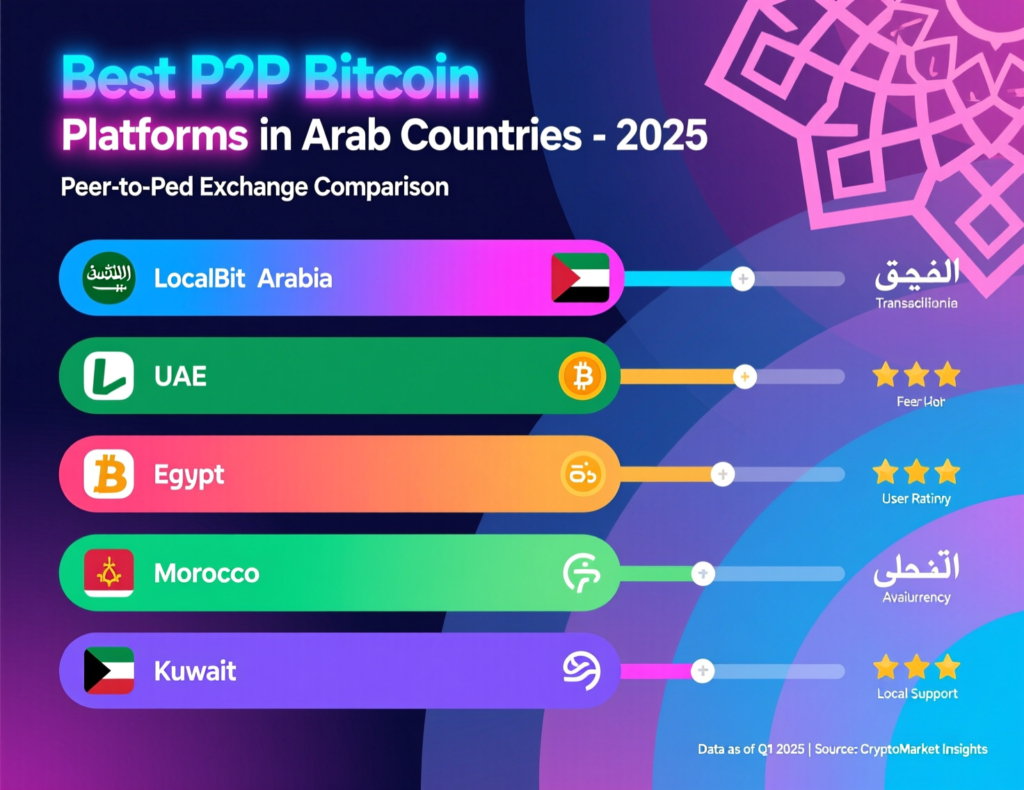
Global exchanges serving the Middle East (Binance, OKX, KuCoin, Bybit)
Global exchanges are attractive because they combine large P2P orderbooks, cheap spot trading and fiat on-/off-ramps in a single app.
Fees & spreads
Maker/taker fees on spot are usually ≤0.1%, but in P2P the real “fee” is the spread that merchants charge above or below mid-market. Competitive pairs like BTC/USDT and USDT/AED on Binance or Bybit in Dubai can be very close to mid-market; thinner markets in smaller countries can be 3–5% or more.
Escrow design
Platforms lock the seller’s BTC or USDT in escrow the moment you place an order, then auto-release once the seller confirms they received your bank transfer or cash.
Dispute handling
If something goes wrong, you can open a dispute, upload proof (bank statements, chat logs) and wait for an operator to decide so long as you kept everything on-platform.
Payment methods
In MENA, Binance P2P alone supports AED, SAR, EGP, MAD, JOD, KWD, LBP, QAR and more, often via specific banks like Al Rajhi, ADCB or Arab Bank.
For US residents, access to global P2P is constrained: you may have to use Binance US or other US-compliant platforms and then send stablecoins to a relative’s account in Dubai or Riyadh rather than trading directly against AED/SAR. UK and German users generally have fewer access issues but must comply with FCA crypto-promotion rules in the UK and BaFin / MiCA regimes in the EU, especially when moving euro liquidity in from London, Berlin or Munich.
Regional platforms and OTC desks (BitOasis, Rain and others)
Local platforms can win when you care most about regulation, Arabic support and banking rails.
BitOasis has secured a full Virtual Asset Service Provider (VASP) license under Dubai’s VARA regime and serves 15 MENA countries, offering AED pairs and local support.
Rain is licensed by the Central Bank of Bahrain and has a virtual asset brokerage and custody license in Abu Dhabi, making it a strong fit for GCC residents who want a regulated experience.
P2P vs OTC desks
A P2P orderbook lists many small offers from individual merchants and retail traders. You choose a counterparty, lock crypto in escrow and pay them directly.
An OTC desk typically quotes a single price for a large ticket size (for example, a UAE-based family office buying 50 BTC via a desk in Abu Dhabi Global Market). Settlement may be account-to-account at the same bank or via institutional rails, with relationship-driven pricing and heavier KYC/AML.
For regulated institutions in Dubai, Abu Dhabi or Manama, OTC plus compliant custody, SOC 2 controls and data-residency-aware cloud hosting often matter more than saving a few basis points in P2P spreads—areas where Mak It Solutions’ cloud and security teams already advise GCC CIOs on broader digital strategies.
What is peer to peer bitcoin trading and how does it work in Arab countries?
Peer to peer bitcoin trading means you deal directly with another person instead of depositing money into a central exchange orderbook. The platform just matches you, locks the seller’s BTC into escrow, and releases it when the seller confirms they’ve received your bank transfer, cash or other agreed payment reducing but not eliminating counterparty risk. In Arab countries, P2P trading is shaped by local laws, FX rules, Sharia views and bank policies, which differ significantly between, say, Dubai, Riyadh and Cairo.
P2P vs centralized exchanges vs OTC desks
Think of three broad options.
A centralized exchange (CEX) is like a stock market: you wire cash or use a card, then trade on an orderbook (BTC/USDT, BTC/USD etc.). Liquidity is deep but you trust the exchange to hold your funds.
A P2P marketplace is like a classifieds site with escrow. The platform helps you find a seller who accepts your payment method (e.g. bank transfer in AED from Dubai or Faster Payments in GBP from London) and freezes their bitcoin until they confirm payment.
An OTC desk is closer to a private broker for large trades, typically used by HNWIs, funds or corporates.
Many Arab users and expats prefer P2P because:
Their local bank in Riyadh, Cairo or Casablanca may not allow card or wire transfers to foreign crypto exchanges.
P2P supports local payment methods and sometimes cash-in-person for those who want more privacy (where lawful).
Merchants sometimes offer better FX rates than traditional remittance to Egypt, Morocco or Jordan though spreads can widen during volatility.
How P2P bitcoin escrow, release and dispute systems work
The basic lifecycle looks like this
Post or pick an offer
A seller lists “Sell 0.05 BTC for AED via local bank transfer”. A buyer clicks “Buy” and enters the amount.
Crypto is locked in escrow
The platform freezes the seller’s BTC, so they can’t withdraw it or send it elsewhere during the trade.
Buyer pays in fiat
The buyer sends AED, SAR or EGP using the agreed method and clicks “I’ve paid”.
Seller confirms & escrow releases
Once the seller sees the money in their account, they confirm, and the platform releases BTC to the buyer’s in-app wallet.
Dispute if needed
If someone lies, uploads fake screenshots, or a transfer is delayed, a dispute is opened and support reviews evidence.
Binance, OKX and Bybit all follow a similar model: internal hot wallets hold the locked funds, and internal tools plus compliance teams decide disputes.
Common P2P payment methods in the Middle East
Across the GCC and wider Arab world you’ll see
Local bank transfers
For example, a US expat in Dubai sending AED via ADCB or Emirates NBD to buy BTC from a Binance P2P merchant.
Instant payment schemes
Emerging “faster payments” in the GCC and SEPA Instant in the EU make Euro-to-exchange transfers from Berlin or Munich nearly instant, which then feed P2P trades into MENA.
Cash-in-person
Still used in some cities (e.g. Casablanca or Amman) but with higher personal-safety and legal risks; never do this where it conflicts with local law.
Mobile wallets & fintech apps
In some markets, local wallets or neo-banks work as P2P payment methods.
Cross-border SEPA + P2P
A German user might wire EUR from a Berlin bank via SEPA to a compliant exchange, buy USDT, then use P2P to sell that USDT for Moroccan dirhams where allowed.
Similarly, a UK resident in London might buy BTC on a regulated UK-friendly exchange, then send crypto to a relative’s account in Egypt or Jordan, where that relative cashes out locally via P2P assuming both ends stay within the law and understand local banking and central-bank warnings.
How to buy bitcoin P2P in UAE, Saudi Arabia, Egypt and other Arab countries
If you’re a beginner, the safest way to approach peer to peer bitcoin trading is to pick a regulated or well-established platform, complete KYC, enable strong security, then start with a small test trade using on-platform chat and escrow only. In the UAE and some GCC states, this can be relatively straightforward on licensed players like BitOasis or Rain; in others (like Saudi Arabia or Egypt), regulators have issued warnings or partial bans, so you must proceed with extreme caution or avoid trading altogether.
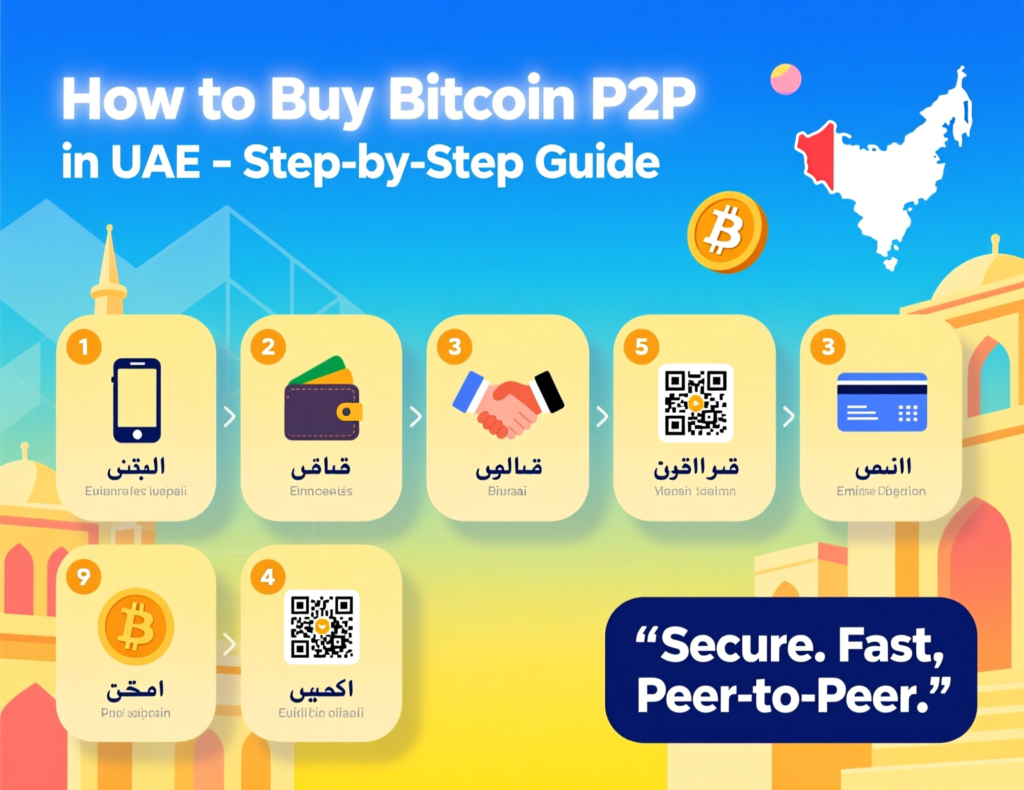
Before you start: accounts, KYC and wallet security
Checklist
Choose a reputable platform
Look for exchanges listed in VARA’s public register in Dubai, licensed under ADGM/FSRA in Abu Dhabi, or supervised by the Central Bank of Bahrain.
Complete KYC
Most P2P bitcoin exchanges require at least ID and selfie before enabling P2P; full KYC unlocks higher limits and gives you more weight in disputes.
Enable 2FA and device security
Use app-based 2FA, strong passwords and an up-to-date OS on your phone.
Set up a self-custody wallet
For longer-term storage, move BTC off the exchange into a wallet where you control the keys.
Understand local tax and legal rules
For example, US persons must report worldwide gains to the IRS; UK users may owe CGT; German residents face specific holding-period rules; and some Arab states treat retail crypto trading as banned or very high-risk.
If you’re building or scaling a P2P or remittance-style app as a business, it’s smart to design the wallet architecture, KYC flows and data pipelines with compliance in mind from day one similar to how Mak It Solutions designs secure data platforms and ETL/ELT pipelines for regulated clients in Europe and the Middle East.
Step-by-step example
Example flow (where legal and compliant)
Create and verify your account
Sign up on Binance or OKX, upload your passport or Emirates ID and finish face verification.
Switch to P2P and select BTC/AED (or USDT first)
In Dubai or Abu Dhabi, choose “P2P”, then filter for BTC/AED or USDT/AED. If AED pairs are limited (as on OKX after its 2025 change), you might trade via USDT and a USD/EUR on-ramp instead.
Filter for trusted merchants
Sort by rating and completion rate. Avoid zero-trade accounts, especially for large orders.
Check price, limits and payment method
Look at min/max amounts and confirm your bank (e.g. ADCB, Emirates NBD, Al Rajhi) is accepted.
Place the order and pay
Enter the amount (for example, 1,000 AED), start the trade, pay exactly the shown amount from your bank app, and keep proof.
Confirm and wait for escrow release
Mark as paid, then wait for the seller to confirm. Never cancel after you’ve paid.
Move BTC to self-custody for long-term holding
Once BTC arrives, send it to your own wallet if you’re not actively trading.
Variations
“Buy bitcoin P2P in UAE from the USA”
A user in New York buys USDT on a US-compliant exchange, sends it to Binance, and uses P2P to sell USDT for AED to a Dubai account, effectively funding a local family account while still needing to respect US tax rules and UAE banking laws.
“From UK to Saudi Arabia using P2P USDT”
A London-based worker uses Faster Payments to top up a UK-regulated exchange, buys USDT, then sends it to a relative’s wallet who uses a P2P platform in Riyadh to sell USDT for SAR, mindful that Saudi authorities still issue strong warnings about crypto trading.
Country snapshots
UAE / Dubai / Abu Dhabi
Dubai’s VARA and Abu Dhabi’s ADGM/FSRA have created some of the region’s most advanced virtual-asset frameworks, attracting exchanges like Binance, Crypto.com, BitOasis and Rain.In the year ending June 2024, the UAE received about US$30 billion in digital assets, making it a top MENA hub for crypto flows. Platforms often offer Arabic-language interfaces, local AED rails and on-ramp/off-ramp options aligned with GCC data-localization requirements.
Saudi Arabia
Saudi Arabia treats crypto cautiously. The central bank and finance ministry have repeatedly warned that virtual currencies are not legal tender, and there is no fully fleshed-out retail crypto law yet.Some platforms still serve residents for spot and P2P trading, but users face higher regulatory and banking risk accounts can be frozen if banks suspect prohibited activity.
Egypt, Morocco, Jordan
The Central Bank of Egypt has issued multiple warnings and banking-law provisions against dealing in cryptocurrencies, with potential fines and enforcement for violations.Morocco has had a long-standing ban on crypto use, though draft legislation is in progress as the country explores CBDCs and more formal regulation. Jordan’s regulators have also issued cautionary statements. In practice, some residents still use P2P or offshore exchanges, but this can be legally risky and is outside this guide’s scope.
Is P2P bitcoin trading safe in Arab countries? Risks, scams and protection steps
Peer to peer bitcoin trading can be relatively safe only if you use reputable platforms, complete KYC, follow strict safety checklists and respect local law. The main risks are scams, chargeback fraud, frozen bank accounts and regulatory uncertainty, especially in countries that officially discourage or restrict crypto. If you stick to on-platform escrow, verified merchants and sensible trade sizes, you can reduce but never fully remove these risks.
Main risks in P2P bitcoin trading: scams, fraud and account issues
Common problems include
Fake payment proofs
Scammers send doctored screenshots instead of real transfers.
Chargeback fraud
In some countries, buyers use reversible methods (like card payments or certain wallets), later dispute the transaction and recover funds while keeping your BTC.
Off-platform communication
Moving to WhatsApp or Telegram increases the chance of being phished or socially engineered, and platforms cannot help if a trade never started on their side.
Identity theft
Sharing ID documents outside official KYC flows may expose you to SIM-swap or account-opening fraud.
Frozen accounts
Banks in the UAE, Saudi Arabia or Egypt may freeze accounts they suspect are used for prohibited or unreported crypto trading.
Mini-examples
“Car buyer” scam in Dubai
A fraudster tells their bank they were scammed on a car purchase, then initiates a chargeback on a transfer you thought was final. You lose funds and potentially face investigation.
“Over-payment” scam in Egypt
A buyer sends more EGP than required, then pressures you to refund the difference to a different account before the first payment clears.
Safety checklist: how to avoid scams and chargeback fraud
Some practical safeguards.
Trade only via on-platform chat and escrow; never agree to “direct deals” to save fees.
Match full legal name and IBAN with what appears in the platform’s KYC profile.
Prefer irreversible payment methods (standard bank transfers) over cards or high-risk e-wallets, especially for large trades.
Never release bitcoin until funds are fully settled and visible in your account—not just “pending”.
Avoid logging in or authorising trades over public Wi-Fi.
Start with small amounts and build relationships with few, well-rated merchants.
Keep your own log of trades for tax and audit trails.
These steps significantly reduce chargeback risk and help you make better use of bitcoin escrow services in the Arab world, but they don’t override local AML, sanctions or tax obligations. FATF standards and local implementations expect VASPs to monitor suspicious flows, so assume your activity can be traced and reported where required.
How escrow, ratings and support teams protect Arab users
Platform-level protections typically include
KYC / merchant vetting
High-volume P2P merchants usually undergo enhanced verification and ongoing monitoring.
Ratings & completion scores
These crowd-sourced metrics help you identify reliable partners.
Dispute windows & evidence uploads
You can file disputes within a fixed time, upload statements and rely on support teams to arbitrate.
Sanctions & AML checks
Exchanges screen users and transactions against global watchlists.
Binance, OKX, KuCoin and Bybit pair these controls with Arabic-language support and regional entities (for example, Binance under ADGM, OKX Middle East Fintech FZE in the UAE), while BitOasis and Rain foreground their local licensing and regulatory alignment in Dubai and Bahrain.
Legal, regulatory and tax rules for P2P bitcoin trading in UAE, Saudi Arabia and the wider Arab world
Crypto regulation in the Arab world is evolving fast: the UAE is building a clear licensing framework, while other countries maintain bans or issue strong warnings. For peer to peer bitcoin trading, the safest mental model is: assume everything is heavily regulated, some things are restricted or banned, and you must check your own situation with a qualified professional. Nothing here is legal or tax advice.
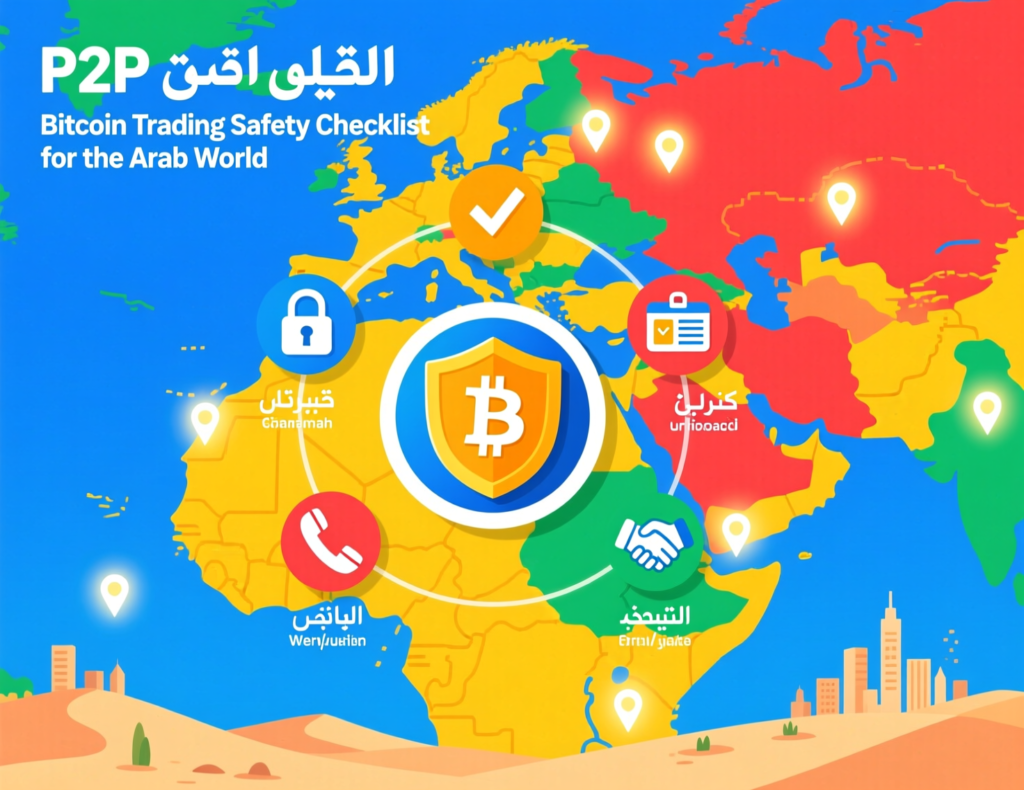
UAE: VARA, SCA, FSRA, DIFC and ADGM what they mean for P2P traders
Key players
VARA (Dubai)
Regulates virtual asset services in Dubai (except DIFC), including exchanges and brokerages.
SCA (UAE federal)
Oversees securities & commodities; publishes guidance for virtual asset markets across the UAE.
ADGM / FSRA (Abu Dhabi)
Runs a detailed virtual-asset framework, recently updated for staking and other digital-asset activities.
DIFC
Has its own regulatory environment (DFSA) for financial services in Dubai’s financial free zone.
For everyday P2P users
UAE residents often access P2P inside licensed exchanges (e.g. BitOasis, Rain, Binance’s ADGM-licensed platform) rather than unregulated offshore sites.
Regulated entities must comply with AML, Travel Rule, data-protection and consumer-protection obligations, similar in spirit to FATF and MiCA frameworks.
If you’re a fintech or SaaS builder targeting VARA/ADGM compliance, involving architects who understand cloud regions, data localization and logging like the teams behind Mak It Solutions’ GCC cloud and data-localization guides can save painful re-work later.
Saudi Arabia, Egypt, Morocco and other Arab states: grey zones, warnings and access limits
In many Arab states, regulation is more restrictive:
Saudi Arabia
Cryptocurrencies are not legal tender and remain subject to repeated central-bank and ministry warnings, with cryptocurrency activity effectively treated as high-risk and discouraged.
Egypt
The Central Bank of Egypt and other regulators have banned or heavily discouraged crypto trading and issuing, supported by Banking Law No. 194 of 2020.
Morocco
The Office des Changes has long banned crypto transactions, though draft crypto-asset law and CBDC exploration are in progress.
Some platforms may geo-block access, and local ISPs or banks may restrict transfers. In such environments, the most risk-aware choice is often not to trade at all until a clear legal regime exists.
Cross-border rules for US, UK and German residents using P2P with Arab exchanges
When you live in USA, UK, Germany or the wider EU and use P2P linked to Arab countries, you’re exposed to two rulebooks: your home country’s tax and reporting regime, and the host country’s virtual-asset framework.
Important elements
FATF standards on virtual assets and VASPs drive KYC, Travel Rule compliance and suspicious-activity reporting worldwide.
The OECD Crypto-Asset Reporting Framework (CARF) and upgraded CRS are designed to let tax authorities automatically share crypto-asset data across borders.
The EU’s MiCA regulation sets common standards for crypto-asset issuers and service providers; Germany’s BaFin implements these alongside local banking and securities laws.
The UK’s FCA oversees crypto-asset financial promotions and AML registration; US regimes vary by agency
GDPR/DSGVO and UK-GDPR still apply when exchanges process your personal data, including wallet addresses tied to identity.
On top of this, Sharia-compliant crypto products are emerging in some Islamic markets, but scholarly views differ on whether and when bitcoin trading is permissible especially for speculative purposes. Always seek guidance from both qualified religious authorities and licensed legal/tax professionals before designing a cross-border P2P strategy.
When does peer to peer bitcoin trading make sense vs other options?
P2P bitcoin trading sits between traditional remittance and fully centralized exchanges: it can be cheaper and more flexible than Western Union or high-fee bank wires, but riskier and more complex than buying bitcoin or stablecoins in a fully regulated market like London or Frankfurt. In practice, P2P fits best when you need local payment methods, better FX or access in partially banked markets, and you’re prepared to manage extra operational and regulatory risk.
Bitcoin trading vs Western Union, bank wires and remittance apps
Traditional options like Western Union or bank wires from New York, London or Berlin to Cairo, Amman or Casablanca are straightforward but can be expensive and slow, with FX spreads and fixed fees eating into small transfers.
By contrast, a P2P route might look like:
Sender buys USDT in the US, UK or Germany,
Sends it to a relative’s account in Dubai, Riyadh or Cairo,
Relative uses P2P to sell USDT for local fiat at a competitive rate.
With MENA crypto transaction volume estimated around US$330–350 billion between mid-2023 and mid-2024 (around 7–8% of global volume), it’s clear that many people already treat crypto as a parallel remittance rail.Meanwhile, official remittances to MENA were about US$55 billion in 2023, down 15% year-on-year, partly because flows shifted to unofficial channels some of which likely include crypto
The trade-off: P2P may cut fees and improve FX rates for routes like “P2P bitcoin trading vs Western Union fees to Morocco”, but it adds volatility risk, compliance complexity and the chance of dealing with the wrong counterparty.
P2P vs spot exchanges, cards and crypto payment apps
In fully regulated markets (e.g. UK, much of the EU, some US states), it’s often easier to:
Use a centralized exchange with direct GBP/EUR/USD deposit,
Spend via a crypto card or instant off-ramp app,
Or wire funds directly through a low-cost neo-bank.
P2P becomes more compelling when:
Banks block crypto exchanges,
You need local rails (e.g. SAR in Riyadh, MAD in Casablanca),
Or you want to use stablecoins for cross-border remittances, then convert them locally via P2P merchants.
For builders, this often means combining crypto rails with modern app and web experiences areas where Mak It Solutions already helps teams choose between mobile apps vs mobile-first web, or pick frameworks like React Native or Flutter to ship secure, cross-platform fintech UIs.
Example journeys for US, UK and German expats using P2P with Arab countries
US expat in Dubai paying rent
An engineer in Dubai Marina gets paid partly in USD into a New York account, buys USDT on a US exchange, sends it to Binance’s ADGM-licensed platform, and sells USDT via P2P for AED to pay rent while reporting gains to the IRS and staying within UAE regulations.
UK worker sending money to family in Egypt
A nurse in Manchester buys BTC on a UK-regulated platform, transfers it to a relative in Alexandria, who chooses a legal method (if any) to convert or hold it, mindful of Egypt’s restrictive stance.
German freelancer billing a client in Riyadh
A designer in Berlin invoices a client in Riyadh in EUR stablecoins; after payment, the freelancer swaps to BTC or EUR via a European exchange, while the Saudi client considers local rules before any on-ramp/off-ramp steps.
In all three cases, the smart move is to research compliant platforms, follow a strict safety checklist, start with tiny test trades and document everything for tax and compliance. If you’re designing your own product or internal toolchain around similar flows, a specialist partner like Mak It Solutions can help with backend APIs, cloud architecture and data-governance controls that hold up under regulator scrutiny.
Key Takeaways
Peer to peer bitcoin trading in Arab countries is tightly linked to local laws, bank policies and global AML/TAX frameworks; in the UAE the environment is relatively structured, while in Saudi Arabia, Egypt and Morocco it remains restricted or high-risk.
Global players like Binance P2P, Bybit, OKX, KuCoin and Bitget offer liquidity and many payment methods, while BitOasis and Rain add region-specific licensing, Arabic support and local banking rails.
Safety depends on escrow discipline, KYC, payment-method choice and avoiding off-platform deals; never treat P2P as “risk-free” or anonymous.
US, UK and German residents must consider FATF rules, OECD CARF/CRS, MiCA, FCA/BaFin guidance and domestic tax obligations when sending value into MENA via P2P.
P2P can beat Western Union or traditional remittance on fees and flexibility, especially when combined with stablecoins, but it introduces volatility, legal and operational risk.
For businesses building P2P-style or remittance-adjacent products, it pays to invest early in secure cloud architectures, data-localization awareness and compliant app design, areas where Mak It Solutions already has deep experience across the US, UK, Germany and the GCC.
If you’re a founder, product lead or financial institution exploring P2P, crypto remittances or digital-asset on-/off-ramps in the Arab world, you don’t have to puzzle out the tech and compliance story alone. Mak It Solutions can help you architect cloud-native trading or remittance platforms, design secure mobile and web front-ends, and align your data flows with GCC, EU and UK regulations.
Reach out via the Mak It Solutions contact page to book a no-obligation consultation and get a scoped, realistic roadmap for your next project.
FAQs
Q : Can I use P2P bitcoin trading in Arab countries without full KYC verification?
A : Most major P2P platforms require at least basic KYC (ID + selfie) before you can post or take offers, and locally regulated exchanges in the UAE, Bahrain or Abu Dhabi typically require full verification. In theory you may find smaller, offshore P2P sites that allow lighter checks, but trading there can expose you to higher fraud risk, AML flags and potential legal issues. For US, UK and EU residents, avoiding KYC to use P2P is usually a red flag for regulators and can create serious tax and reporting problems later.
Q : Which payment methods are safest for P2P bitcoin trades in the UAE and Saudi Arabia?
A : In the UAE, standard AED bank transfers between reputable banks are generally considered the most balanced option, because they’re traceable, relatively fast and align better with exchange compliance teams though you must still follow bank terms. In Saudi Arabia, regulators continue to warn against crypto trading, so even bank transfers can trigger reviews or freezes if tied to prohibited activity. In both countries, avoid reversible methods (like card payments or some wallets) for high-value trades and never accept off-platform payment arrangements that bypass escrow.
Q : How does Binance or OKX P2P escrow protect buyers and sellers in the Middle East?
A : On both Binance and OKX, when a buyer starts a P2P order, the platform locks the seller’s bitcoin or stablecoins in escrow, preventing them from withdrawing those funds during the trade. The buyer then sends AED, SAR or another fiat to the seller using the agreed method and marks the payment as done. If the seller confirms receipt, escrow automatically releases the crypto; if not, the buyer can open a dispute and provide bank statements or other evidence for support to review. This does not remove all risk, but it stops the simplest “run away with my coins” scams and gives both parties a structured dispute process.
Q : What tax obligations might US, UK or German residents have when using P2P bitcoin to send money to family in Arab countries?
A : In most high-income countries, tax authorities treat crypto as a taxable asset, not as “just money”, so you may trigger capital-gains or income-tax events when buying, selling or swapping coins even if your goal is simply remittance. The OECD CARF and expanded CRS will increasingly let tax offices share data on cross-border crypto activity, while frameworks like MiCA, FCA guidance and FATF standards push exchanges to report more information. Practically, this means US, UK and German residents using P2P with Arab exchanges should keep detailed records, use tax software or advisors and assume that unreported gains are risky.
Q : What should I check on a P2P merchant’s profile before trusting them with a large bitcoin trade?
A : Before placing a large order, look at completion rate, trade count, account age and recent feedback, and avoid merchants with many cancellations or complaints. Confirm that their verified name matches the bank account name and IBAN you are paying, and beware of anyone who asks to move to WhatsApp or Telegram or suggests off-platform deals. For big tickets, consider splitting the amount across several smaller trades or using a regulated OTC desk instead. Combining these checks with a strong personal safety routine and clear documentation of each trade dramatically reduces the odds of being caught in the common P2P bitcoin scams seen in the UAE, Saudi Arabia, Egypt and elsewhere.