

Best Crypto Tax Free Countries: GCC Guide for Investors
Some GCC countries, especially the UAE and Bahrain, currently have no personal income tax, so many residents pay 0% local tax on personal crypto capital gains. However, US, UK and German investors can still be taxed by their home country unless they change tax residency properly and comply with exit, reporting and transparency rules.
If you’ve watched your IRS, HMRC or German Finanzamt bills climb while your portfolio swings wildly, it’s natural to start Googling “crypto tax free countries”. Maybe a friend in Dubai is talking about 0% tax on Bitcoin, or a Telegram group is hyping “move to the Gulf and never pay capital gains again”.
The reality is more nuanced. Yes, several countries including the UAE and Bahrain currently have no personal income tax, which often means 0% local tax on personal crypto capital gains. ([PwC Tax Summaries][1]) But your home-country rules, tax residency tests, economic substance, and frameworks like FATCA, FBAR, MiCAR and the OECD Crypto-Asset Reporting Framework (CARF) can still pull you back into the net.
None of this is legal or tax advice. It’s an educational roadmap so US, UK, German and EU investors can ask the right questions before they try to use GCC residency to optimise not evade crypto tax. You should always coordinate with a US/UK/DE-aware advisor who understands UAE, Bahrain and wider GCC rules.
What Do We Really Mean by “Crypto Tax Free Countries”?
A “crypto tax free country” usually means a jurisdiction where local residents pay 0% local tax on personal capital gains, including crypto. It does not mean your original country stops taxing you automatically, or that there are no reporting rules.
What “tax free” actually means for crypto gains
A crypto tax free country is usually one where residents pay 0% local tax on personal capital gains, but you may still owe tax to your home country if you remain tax resident there. That’s the key distinction most YouTube thumbnails skip.
Broadly, there are three situations.
0% local tax rate
Countries like the UAE and Bahrain have no general personal income tax, so most personal capital gains including from Bitcoin or Ethereum are not taxed locally.
“No law yet” or unclear rules
Some smaller “crypto havens” simply haven’t fully updated their tax codes. That doesn’t mean gains are magically tax free forever, and global standards like CARF are closing those gaps.
Targeted exemptions or regimes
Germany, for example, allows tax-free disposal of crypto held as a private asset after a one-year holding period, but shorter-term trades are taxable.
“Tax free” almost never means “off the radar”. Many investors focus on offshore crypto tax planning but forget that global transparency is catching up quickly.
Types of crypto tax: income, capital gains, wealth and business taxation
Before comparing the best crypto tax free countries, it helps to have a simple framework:
Capital gains tax (CGT)
Tax on profit when you sell or swap coins or tokens. For long-term investors in New York, London or Berlin, this is usually the main pain point.
Income tax
Rewards from staking, yield farming, mining, airdrops or getting paid in crypto can be taxed as income in the US, UK, Germany and EU.
Wealth or net worth tax
Some countries tax your overall wealth (including crypto) annually.
Business and corporate tax
If you run an exchange, prop desk, Web3 startup or fund, profits are usually taxed as business income even if CGT on personal portfolios is 0%.
So a 0% CGT headline doesn’t mean zero tax on staking rewards, NFTs held in a company, DeFi protocol revenue or VAT on services.
When your home country can still tax you after moving
Moving to a zero-tax country does not automatically disconnect you from IRS, HMRC or German tax obligations.
Most systems use tax residency tests based on:
Days in/out of the country (often 183-day rules)
Centre of vital interests / ties (home, family, work, companies, bank accounts)
Habitual abode and patterns over several years

Key examples
United States (IRS)
The US taxes citizens and green card holders on worldwide income, even if they live in Dubai or Doha, and expects digital asset income to be reported on the annual return plus foreign asset forms like FBAR/FATCA where thresholds are met.
United Kingdom (HMRC)
The Statutory Residence Test decides if you’re UK-resident. If you’re still UK-resident, your crypto disposals are normally within CGT scope even if executed from Abu Dhabi or Manama.
Germany (Finanzamt / BaFin context)
German tax residency and the “centre of vital interests” concept mean simply renting an apartment in Dubai is not enough; ties in Frankfurt or Munich can keep you taxable in Germany until cut properly.
If you move residency for crypto tax reasons, plan the exit as carefully as the arrival.
Global Overview of Crypto Tax Free Countries in 2025
Across the world, investors are scanning for crypto-friendly jurisdictions while regulators roll out tougher reporting rules like CARF and MiCAR.
Snapshot: leading crypto tax free countries worldwide
In 2025, popular “crypto tax free countries” often mentioned by Nomad Capitalist–style blogs and tools like Koinly include.
United Arab Emirates (UAE)
No personal income tax; Dubai and Abu Dhabi are major hubs.
Bahrain
Zero personal income tax and no local tax on capital gains.
Selected Caribbean states
Cayman Islands, Bahamas and others, generally with no personal income tax, but varying residency and substance rules.
European options
Germany (for >1-year private holdings), Portugal-style regimes (which have tightened over time), and some special expat schemes.
Asia hubs
Singapore and Hong Kong, which historically have had favourable treatment for long-term capital and territorial taxation.
Treat this as a starting list, not a definitive map. Rules change sometimes fast. Oman, for example, is now moving towards introducing personal income tax for high earners, which shows how Gulf policies can evolve.
How GCC compares to Europe, Caribbean and Asia
The GCC’s main edge versus Europe, Caribbean and Asia is the combination of.
0% personal income / CGT in key states (UAE, Bahrain)
Modern banking and payments, particularly in Dubai and Abu Dhabi
World-class connectivity easy flights to London, New York, Frankfurt, Zurich and Singapore
High-end lifestyle international schools, English-speaking service environment, and diverse expat communities
Against that, Europe offers MiCAR-backed regulatory clarity and EU-wide market access, while Caribbean structures can feel more like “offshore brass plates”, which many banks and tax authorities now scrutinise heavily.
For serious portfolios, substance matters: a real home, local spend, in-person time and, where relevant, genuine business activity. This is where Dubai, Abu Dhabi, Doha and Manama increasingly outperform older offshore centres.
Legal vs. illegal crypto tax reduction
You can legally reduce crypto tax by changing tax residency and respecting exit rules; hiding assets or misreporting is tax evasion.
Legal planning typically involves.
Becoming clearly non-resident in your high-tax country
Establishing genuine residence in a 0% or low-tax jurisdiction
Respecting any exit tax or deemed disposal rules
Fully reporting under frameworks like FATCA, CRS/CARF and local AML laws
Illegal evasion covers things like:
Not reporting offshore exchanges or wallets
Falsifying residency days or addresses
Using sham structures with no substance
The OECD and IMF estimate that tens of billions of dollars of tax revenue are at stake globally from crypto, and enforcement intensity is rising quickly.
Crypto Tax Free Countries in the GCC: Where Does the Gulf Stand?
The GCC is not a single tax system, but a cluster of states with similar economic models and very different details.
GCC member countries and how they tax personal crypto gains
Here is a very high-level view for individuals holding crypto personally.
United Arab Emirates (UAE)
No general federal personal income tax; no specific personal CGT on crypto so far. Federal corporate tax applies to businesses from 2023 onwards.
Bahrain
No personal income tax; capital gains and income not paid in Bahrain are generally not taxable; VAT applies on certain goods/services.
Qatar
No tax on employment income for individuals; other income can be taxed under the income tax law; crypto is still a grey area in practice.
Saudi Arabia
No tax on employment income; Zakat and income tax apply to business activities and non-resident companies. Crypto regulation is evolving.
Kuwait
No personal income tax, but corporate tax for foreign entities and certain sectors.
Oman
Historically no personal income tax; a 5% personal income tax for high earners is scheduled from 2028, showing the region can change direction.
Regulation of virtual assets also varies, with Dubai’s VARA, Abu Dhabi’s ADGM and Bahrain’s Central Bank crypto frameworks generally leading on clarity and licensing.
Which GCC countries currently offer 0% tax on personal crypto gains for residents?
For individuals focused on the best crypto tax free countries in the GCC.
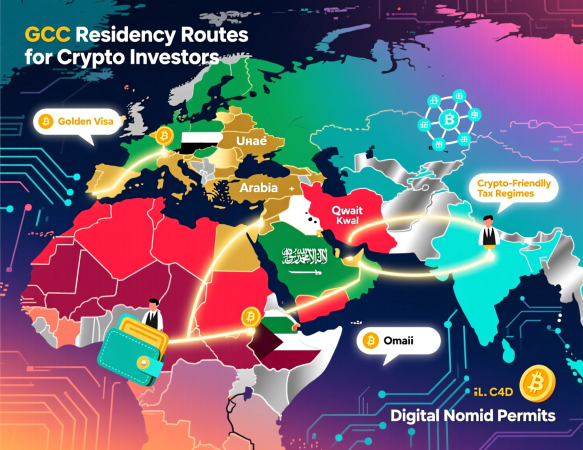
UAE and Bahrain are the headline 0% personal CGT jurisdictions in the GCC today, because they have no broad personal income tax and no standalone tax on personal crypto capital gains.
Corporate tax, VAT and licensing can still apply if your crypto activity is structured as a business, fund, exchange or prop desk.
US, UK and German investors may still be taxed at home until they change tax residency and comply with exit and reporting rules.
For many investors in London, New York, Berlin or Zurich, that combination 0% local CGT plus strong financial infrastructure is what makes Dubai, Abu Dhabi and Manama stand out among crypto tax havens.
Lifestyle, visas and banking across Dubai, Abu Dhabi, Doha and Manama
Dubai and Abu Dhabi (UAE), Doha (Qatar) and Manama (Bahrain) all offer.
Residency routes via employment, company ownership or investment
International schools popular with US, UK, German and wider EU families
Widespread English usage, especially in business and banking
Easy access to global hubs like London, New York, Frankfurt and Singapore
The planned GCC-wide tourist visa will further reinforce the region as a single lifestyle zone, letting you base yourself in Dubai but weekend in Doha or Riyadh more easily.
At this stage, choosing between Dubai Marina, Abu Dhabi’s Saadiyat Island, Doha’s The Pearl or a villa in Manama is less about tax and more about fit: family needs, sector, budget and risk appetite. This is exactly where personalised advice on the “best fit” country becomes crucial.
UAE & Dubai: 0% Capital Gains Hub for Global Crypto Investors
Is crypto really tax free in Dubai and the wider UAE?
For most tax-resident individuals, the UAE currently does not tax personal crypto capital gains, but this doesn’t override tax owed in your original country.
The current position for individuals in Dubai, Abu Dhabi or Ras Al Khaimah is:
No federal personal income tax, so trading or cashing out crypto is typically not taxed locally when done personally.
A federal corporate tax at 9% applies to many business profits, including companies trading or building in Web3, once thresholds are met.
Local regulators like VARA (Dubai) and ADGM (Abu Dhabi) license exchanges, brokers, custodians and service providers to meet global AML and investor-protection standards.
So yes, “tax free bitcoin countries” headlines are grounded in reality for many individuals but only if the right residency and reporting boxes are ticked.
“Dubai crypto tax free”: myth vs reality for US, UK and German investors
For US, UK and German investors, “Dubai crypto tax free” can be dangerously oversimplified.
US citizens in Dubai
The IRS still taxes worldwide income. Living in Dubai may change the rate you pay (e.g., using foreign tax credits or FEIE for earned income), but capital gains on BTC sold while you hold a US passport are generally still within US scope.
UK investors moving to Dubai
You usually need to become clearly non-resident under the Statutory Residence Test and may need one or more full tax years outside the UK before triggering very large disposals. Using UK bank accounts or companies carelessly can pull gains back into the UK net.
German investors (zahlt man in Dubai Steuern auf Krypto als Deutscher?) Germany’s one-year rule for private holdings can give you a tax-free path even before you move, but if you are still German-resident when selling, Dubai residency alone doesn’t help. Once you are firmly non-resident and established in the UAE, disposals may fall outside German scope if ties are genuinely severed.
In short: Google and YouTube content tend to talk about location; real planning has to focus on residency, timing and substance.

UAE crypto tax: 0% capital gains, but what about companies and licenses?
Many investors eventually ask whether to use:
A personal portfolio held on global exchanges
A UAE free-zone company (DMCC, ADGM, DIFC, RAKEZ etc.) for active trading or Web3 building
A regulated entity under VARA or ADGM for exchanges, custodians, funds or DeFi protocols
Broadly.
Personal holding
Simpler, no UAE tax on gains for most individuals, but less defence if your home authority argues you’re effectively running a trading business.
Company structures
Can help with banking, investors and B2B contracts, but bring corporate tax, reporting, substance and possibly licensing.
This is often the moment where a structuring call or written opinion from a US/UK/DE + GCC-aware advisor is worth its cost many times over.
Using GCC Residency and Structures to Optimise Crypto Tax
For many high-value holders in New York, London or Berlin, the play is not just to move, but to combine new residency with the right structure.
Residency routes for crypto investors in UAE, Bahrain and the wider GCC
Common options across Dubai, Abu Dhabi, Manama, Doha, Riyadh and beyond include:
Investor / entrepreneur visas
For starting or investing in a local company.
Golden Visa (UAE)
Long-term residency for significant investors, property owners or highly skilled professionals.
Employment visas
For senior roles at Web3, fintech or tech companies based in the GCC.
Family sponsorship
Once one family member secures status.
To be credible for tax purposes, you typically need:
A real lease or property
Local utilities, mobile and spend
Physical presence well beyond visa minimums
Otherwise, EU or UK authorities may treat the move as a sham residency.
Setting up a crypto company in Dubai free zones.
Different zones suit different use cases.
DMCC
Popular for proprietary trading, holding companies and Web3 startups.
DIFC
English-law financial centre; often used for funds, asset managers and institutional structures.
ADGM
Strong for fintech, digital assets and institutional clients; early mover in crypto regulation.
VARA-regulated entities
Required for many virtual asset service providers operating out of Dubai.
Bahrain plays a similar role for some investors through the Central Bank of Bahrain’s crypto framework, especially if they prefer a smaller, quieter base than Dubai.
Banking, exchanges and compliance stack for GCC-based crypto investors
Most investors combine a local GCC bank account with compliant global exchanges and robust reporting back to their home country.
In practice, that may look like.
Local banking in Dubai, Abu Dhabi or Manama for fiat on/off-ramp and proof of substance.
Using large global exchanges (and sometimes regional platforms) with full KYC/AML and clear reporting.
Making sure any platform handling EU or UK users respects GDPR / UK-GDPR, MiCAR, PSD2/Open Banking, PCI DSS and security frameworks like SOC 2 important for both founders and whales using those platforms.
Ensuring proper CARF / CRS reporting, as dozens of jurisdictions (including the UAE) have committed to implement the Crypto-Asset Reporting Framework by around 2027 2028.
Operational setup is no longer just “open a bank, open Binance”; it’s a full compliance stack that has to stand up under IRS, HMRC or BaFin scrutiny.
How US, UK and German Tax Authorities Treat Crypto Gains Realised in the GCC
Changing where you live does not automatically change who can tax you.
US investors: IRS, FATCA, FBAR and reporting UAE/Bahrain crypto accounts
Living in Dubai doesn’t stop the IRS taxing you as a US citizen, but it can change how much you pay and how gains are sourced.
Key points
Crypto is treated as property, so selling or swapping in the UAE triggers US tax events if you’re still a US person.
FATCA and FBAR rules can require you to report foreign bank accounts and sometimes foreign exchanges if values cross thresholds.
Some US investors use timing, loss harvesting and long-term holding to reduce the effective rate, but there is no “Dubai exemption” in the Internal Revenue Code.
UK investors: non-residence, split-year treatment and HMRC crypto rules
For a London-based founder moving to Dubai
You must stop being UK-resident under the Statutory Residence Test, potentially using split-year treatment in the departure year.
Once non-resident, you can often realise gains on non-UK assets outside UK scope but mis-steps like keeping a trading company in Manchester or routing disposals via a UK bank can re-expose you.
HMRC’s crypto manual confirms that UK residents are generally subject to CGT on crypto disposals, with rates that can reach into the 20–24% range and with a shrinking annual exemption.
German and wider EU investors
For German residents in Frankfurt, Berlin or Munich.
Private crypto disposals are often tax-free after one year of holding; sell sooner and gains are taxed at your personal income rate, subject to small exemptions.
If your activity looks like a commercial business, trade tax and more complex rules kick in. BaFin licensing is relevant mainly for service providers rather than individuals.
At EU level, MiCAR is creating a harmonised framework, especially for exchanges and stablecoin issuers; moving to the GCC won’t shield you if your platform still serves EU users without compliance.
For EU investors who become genuinely non-resident and base themselves in Dubai or Manama with clear substance, the GCC can still be a legitimate pivot in long-term planning but only with precise timing and documentation.
Practical Roadmap & Risk Checklist Before You Relocate for Crypto Tax
Relocating for tax is more like a multi-quarter product launch than a weekend hop to the beach.
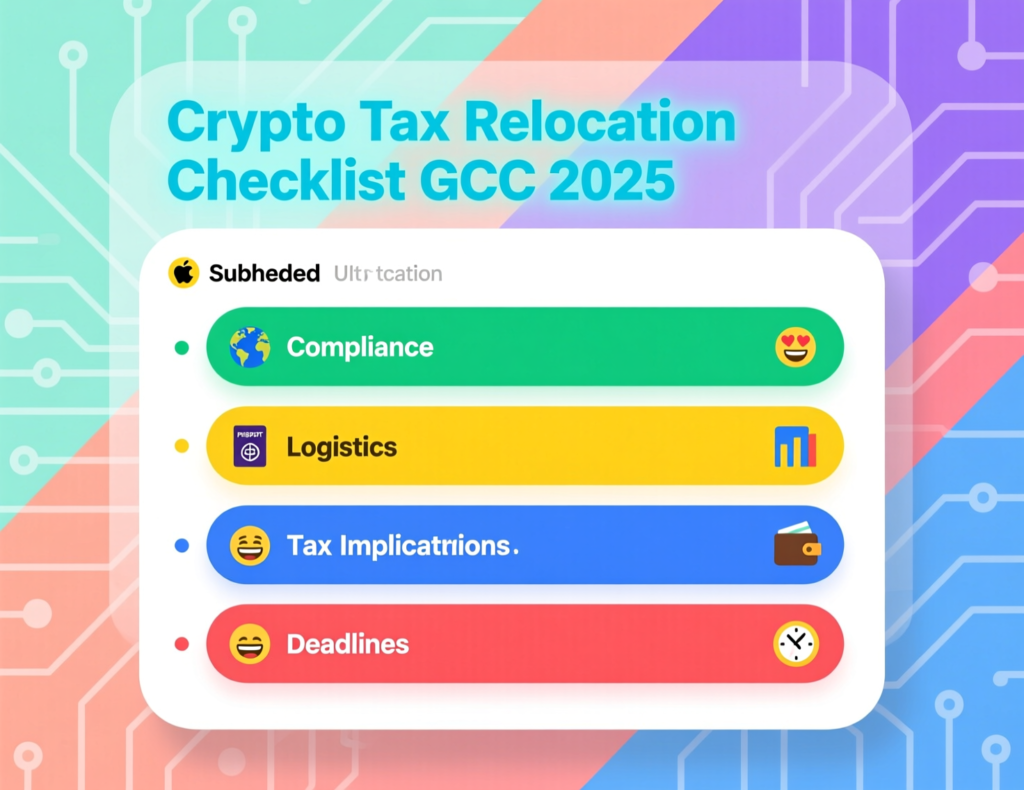
Step-by-step checklist before choosing a GCC base
The safest way to use a 0% tax country is to plan your move several months ahead, become clearly non-resident, then realise major gains.
A practical roadmap might look like this
Audit your current tax position
Residency, open years, unrealised gains, CFC/existing company structures.
Model your crypto gains
What happens if you sell in New York, London or Berlin vs after a clean break?
Choose your jurisdiction
Dubai vs Abu Dhabi vs Manama vs Doha, based on lifestyle, visas and business needs.
Plan your exit
Understand exit tax, deemed disposals or anti-avoidance rules in the US, UK or Germany.
Select your visa route
Investor, Golden Visa, employment or family sponsorship.
Lock in substance
Lease or buy property, open local bank accounts, move family and personal effects.
Track day counts
Keep accurate travel logs for both your old country and your new GCC base.
Trigger disposals only after residency is clear
Time large sales for when you’re safely out of the old net.
Set up your compliance stack
Banking, exchanges, CARF/CRS, local accounting, GDPR-aware data handling.
Review annually
Laws and your own life change; treat your plan as a living document.
Red flags where “0% crypto tax” can backfire
Warning signs regulators in the US, UK, Germany and the EU increasingly look for include.
Day-count failures
Spending more time in London, Frankfurt or New York than you admit.
Sham residency
A “mailbox in Dubai” but school fees, properties and companies still anchored in your old country.
Undeclared foreign accounts
Ignoring FBAR, FATCA, CRS or CARF reporting.
Aggressive promoter schemes
Overly complex offshore crypto tax planning with little real substance.
Academic and policy research already shows high levels of crypto tax non-compliance, with some studies suggesting that fewer than 1% of investors correctly report their crypto taxes and around half of surveyed users misunderstanding their obligations.
When to speak to a specialist advisor
You should talk to a US/UK/DE + GCC-aware specialist before you book flights, not after a big exit. Look for advisors who:
Understand IRS, HMRC, BaFin and EU rules and UAE/Bahrain practice
Can model scenarios for selling before vs after a move
Are comfortable with on-chain data, tools like Koinly or TokenTax, and exchanges’ export files
Bring to the call
A portfolio breakdown (coins, protocols, holding periods)
Your residency and travel history for the last 3–5 years
Target countries (Dubai, Abu Dhabi, Doha, Manama, Riyadh, Kuwait City or Muscat) and your desired timeline
At that point, you’re not “buying a passport to a crypto tax haven”; you’re commissioning a structured crypto tax strategy with guardrails.
Key Takeaways
UAE and Bahrain currently offer 0% local tax on personal crypto gains for most residents, but home-country rules (IRS, HMRC, Finanzamt) can still apply until residency is properly broken.
Legal optimisation hinges on residency, timing and substance, not just an address; day counts, family ties and existing companies are all critical.
US, UK and German investors face very different constraints US citizens remain fully taxable worldwide, while UK and German rules focus more on residence and holding periods.
Free zones like DMCC, DIFC and ADGM, plus Bahrain’s CBB regime, give serious builders regulated environments but introduce corporate tax and compliance duties.
Global transparency is tightening via MiCAR, CARF and CRS; offshore crypto tax planning without full reporting is increasingly high risk.
If you’re seriously considering Dubai, Abu Dhabi or Bahrain as your crypto base, you don’t need another hype thread you need a clear, written plan. Mak It Solutions already helps clients in the US, UK, Germany and across the EU build compliant, data-driven platforms and analytics stacks.
Reach out to request a scoped consultation: we’ll help you map your current position, model GCC scenarios and design the data, reporting and technology foundations you’ll need to keep both regulators and future investors comfortable.( Click Here’s )
FAQs
Q : Can I keep my existing Binance or Coinbase account if I move to Dubai or Bahrain for crypto tax reasons?
A : In most cases you can keep using exchanges like Binance, Coinbase or Kraken after moving to the UAE or Bahrain, subject to each platform’s regional policies. The key issues are KYC address updates, correct tax residency selection in your profile, and making sure you still download full transaction histories for IRS, HMRC or German reporting if required. Many investors pair their existing global exchanges with one or two GCC-friendly platforms and a local bank account for fiat on- and off-ramps.
Q : Do I need to sell my crypto before leaving my home country or after I become tax resident in the UAE?
A : It depends entirely on your home-country rules, your residency date and your holding periods. Some UK and German investors may benefit from waiting until they are clearly non-resident before making large disposals, while others with long-held positions might already have favourable treatment at home. US citizens generally remain taxable regardless of where they sell. A common approach is to model both scenarios — sell before leaving versus sell after establishing UAE residency and then sequence trades to minimise overall risk and tax.
Q : How long do I need to live in a GCC country before my home country stops taxing my crypto gains?
A : There’s no single global rule. The UK relies on the Statutory Residence Test, Germany on domestic residence and centre-of-life concepts, and the US on citizenship regardless of where you live. For many investors this means spending at least one full tax year clearly non-resident, with limited ties and carefully tracked day counts, before realising major gains. You also need to consider exit taxation, anti-avoidance rules and treaty positions. That’s why planning 6–18 months ahead is usually safer than making last-minute moves.
Q : Is it better to hold my coins personally or through a GCC company for 0% crypto tax?
A : Holding coins personally in a 0% income tax jurisdiction is often simplest and can keep local tax at zero for pure investment portfolios. However, if you run a trading desk, fund, exchange or Web3 SaaS product, a GCC free-zone company may be more appropriate for banking, investors, liability protection and licensing, even though corporate tax might apply. The right answer depends on whether your activity looks like passive investment or an organised business, and on how your home country views company structures and controlled foreign corporations.
Q : What documents will banks and immigration ask for if my wealth comes mainly from crypto?
A : Expect to provide more detail than a typical salaried expat. Banks and immigration authorities in Dubai, Abu Dhabi, Doha and Manama increasingly ask for exchange statements, on-chain reports from tools like Koinly or TokenTax, tax returns, source-of-funds letters and sometimes legal opinions. They want to see that your crypto was acquired legitimately, reported properly where required, and doesn’t raise AML or sanctions concerns. Preparing a clean “crypto dossier” before you start applications usually makes account opening and visa processing smoother.