


Blockchain in Dubai Real Estate: Investor Guide 2025
Blockchain in Dubai real estate means using blockchain, smart contracts and tokenization alongside the Dubai Land Department’s digital land registry to record and settle property deals more quickly and transparently than traditional paper-based processes. For international investors from the US, UK, Germany and wider EU, it enables fractional, on-chain access to Dubai property and crypto-funded purchases, but still within a regulated framework governed by DLD, RERA, VARA and home-country securities and tax rules.
Dubai has spent the last decade positioning itself as a global testbed for blockchain in real estate. From a digital land registry and smart title deeds to pilot tokenized projects and a dedicated virtual assets regulator (VARA), blockchain in Dubai real estate is no longer a buzzword it’s live infrastructure investors can actually use.
In this guide, you’ll see how blockchain changes Dubai property deals versus traditional transactions, what tokenized real estate looks like, how crypto-funded purchases really work, and how US, UK, German and broader EU rules overlay your Dubai exposure. You’ll also get a practical, step-by-step path from first platform login to having your ownership recorded with the Dubai Land Department (DLD).
What is blockchain in Dubai real estate?
Blockchain in Dubai real estate is the use of distributed ledgers, smart contracts and tokenization to support or automate parts of the property lifecycle from KYC and sale contracts to title deeds and fractional ownership. In practice, Dubai runs a blockchain-backed registry that records key real estate contracts and connects them to utilities and government systems, while new programs allow selected projects to be tokenized for fractional, on-chain investment.
For investors in New York, London or Frankfurt, that translates into faster verification, less manual paperwork and the ability to access Dubai property through digital tokens, while still relying on the official DLD registry as the source of legal truth.
How blockchain changes traditional property transactions in Dubai
Traditionally, a Dubai property deal involved manual document checks, multiple broker interactions, paper sale agreements and in-person signatures at DLD or trustee offices, with settlement and title transfer taking days or weeks. With blockchain-enabled workflows, key steps move onto smart contracts: KYC/AML, offer acceptance, deposit handling and completion can be captured on-chain, while digital title deeds are synchronized to the DLD systems once all conditions are fulfilled.
Instead of emailing PDFs back and forth, parties interact with a secure platform that timestamps and verifies each action. Brokers and trustees still exist, but they work through digital dashboards; investors see real-time status instead of chasing updates. Settlement can compress significantly especially for cash deals because verification, compliance checks and document generation are largely automated.
Land registry, smart contracts and digital title deeds
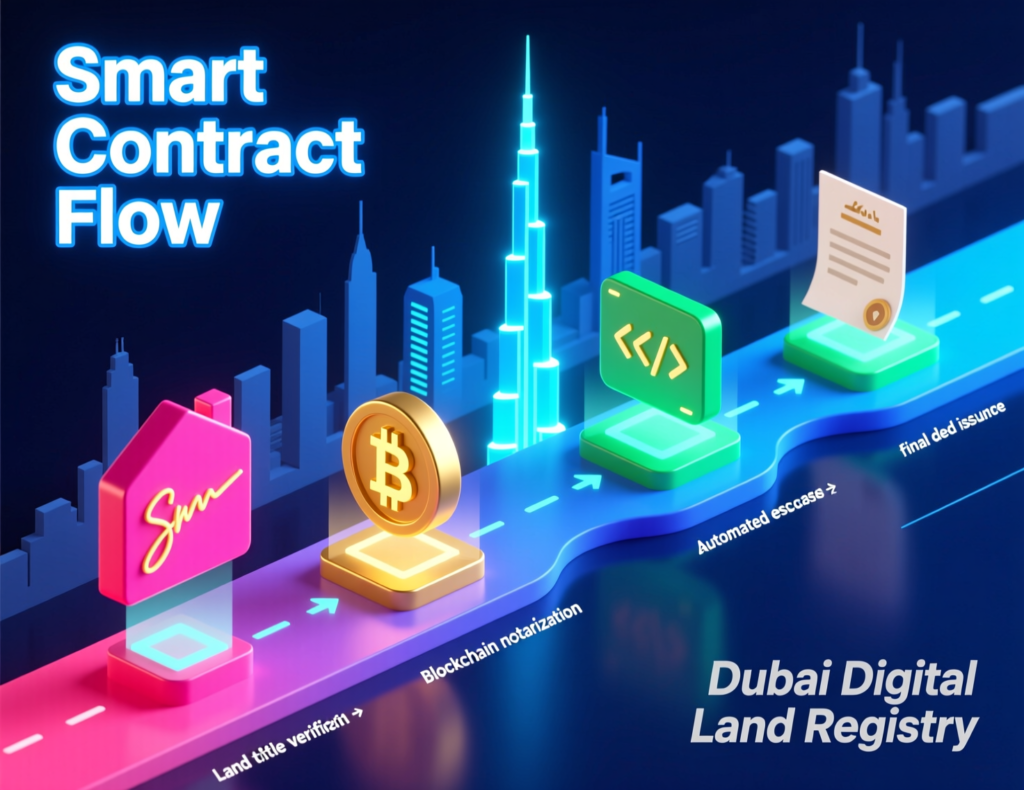
Dubai’s digital land registry is the backbone. DLD has built a blockchain-based database that records real estate contracts and links them to utilities and government services, with a strategy to digitize leases, sales and other property interactions end-to-end.
On top of this, smart contracts for property sale can encode payment milestones, handover conditions and penalties. When a buyer completes KYC/AML and funds are received via approved channels, the smart contract can trigger an update to the DLD system and issue a digital title deed. In tokenized projects, the “real” property sits in DLD’s registry, while investors hold blockchain tokens that map legally and technically to that underlying asset.
Dubai’s Smart City & real estate blockchain strategy
Blockchain in Dubai real estate is part of a broader Smart City roadmap to run most government transactions on blockchain and reduce fraud and administrative friction. DLD’s tokenization initiative and digital title program position it as one of the first real estate registries globally to adopt blockchain at scale, with pilots for fractional ownership and token-based investment completed in 2025.
RERA (the Real Estate Regulatory Agency) and VARA (the Virtual Assets Regulatory Authority) add regulatory oversight for developers, brokers and virtual asset service providers, aiming to cut fake listings, escrow misuse and unlicensed token sales.
Tokenized real estate in Dubai & new investment models
Tokenized real estate in Dubai means that ownership interests in a property or project are represented as digital tokens on a blockchain, typically under a security token offering (STO) structure. These tokens are designed to correspond to a share in a special-purpose vehicle (SPV) or unit in a fund that owns the DLD-registered asset, not to freehold title entries themselves.
Globally, real estate tokenization is still small but growing fast recent research puts the 2024 market around USD 3.5 billion, with projections above USD 19 billion by 2033.
What is tokenized real estate in Dubai?
In a Dubai context, tokenized real estate often combines.
A DLD-registered property or off-plan project.
A legal wrapper (SPV/fund) that holds the asset.
A token issuance, usually through a VARA-licensed platform, which sells security tokens to investors under documented terms.
Each token represents a claim on cash flows (rent, profit share) and a share of exit proceeds, not direct co-ownership on the DLD title. US or UK investors may interact via a regulated platform in their home market, while the underlying structure in Dubai remains compliant with DLD, RERA and VARA rules.
Fractional ownership and Dubai real estate investment tokens
Fractional ownership in Dubai via blockchain allows investors to buy smaller tickets often in the low-thousands AED or low four-figure USD range into properties in Downtown Dubai, Dubai Marina, Business Bay or Palm Jumeirah, instead of paying full apartment prices. Minimum investment levels around AED 1,000–2,000 are increasingly common on regulated platforms
Yield models vary: some tokens target rental income from completed units; others focus on capital gains from off-plan Dubai projects on blockchain, where investors fund construction and share in uplift at completion. German (BaFin-sensitive) investors may prefer structures where tokens clearly qualify as securities with prospectuses, while UK investors might use FCA-regulated platforms with UK-GDPR compliant data handling.
For US investors, SEC rules on private placements, accredited investor status and secondary trading are critical; many token offerings restrict US participation or rely on Regulation D/Reg S exemptions.
Comparing real estate tokenization platforms for Dubai
When you compare “best blockchain platforms for Dubai real estate,” you’re really assessing three layers.
Regulation and licensing
Is the platform or its partners licensed as a Virtual Asset Service Provider (VASP) under VARA? Are there registrations or no-action positions with the SEC (US), FCA (UK), BaFin (Germany) or within MiCA-governed EU states?
Custody and settlement
Who holds the tokens, and how are private keys secured? Are there qualified custodians, insurance and clear rules if a custodian fails?
Governance and link to DLD
Is there a clear legal mapping from each token to DLD-registered assets, including how decisions (sale, refinance) are made and how proceeds are distributed?
For US, UK and EU investors, a key question is whether your home regulator treats the token as a security or collective investment scheme. In many cases, the answer is yes so you should expect prospectus-level documentation, KYC/AML aligned with FATF standards and ongoing reporting obligations.
Buying property in Dubai with crypto & blockchain, step by step
International investors can use blockchain as a workflow layer to move from KYC to DLD title in a more automated, transparent way, even if the final settlement still occurs in UAE dirhams (AED). In almost all compliant structures today, direct wallet-to-wallet crypto settlement does not itself create a valid DLD title; the crypto must be converted into AED through a licensed VASP or payment partner before registration.
Below is a simplified step-by-step path that applies to many US, UK, German and EU investors.
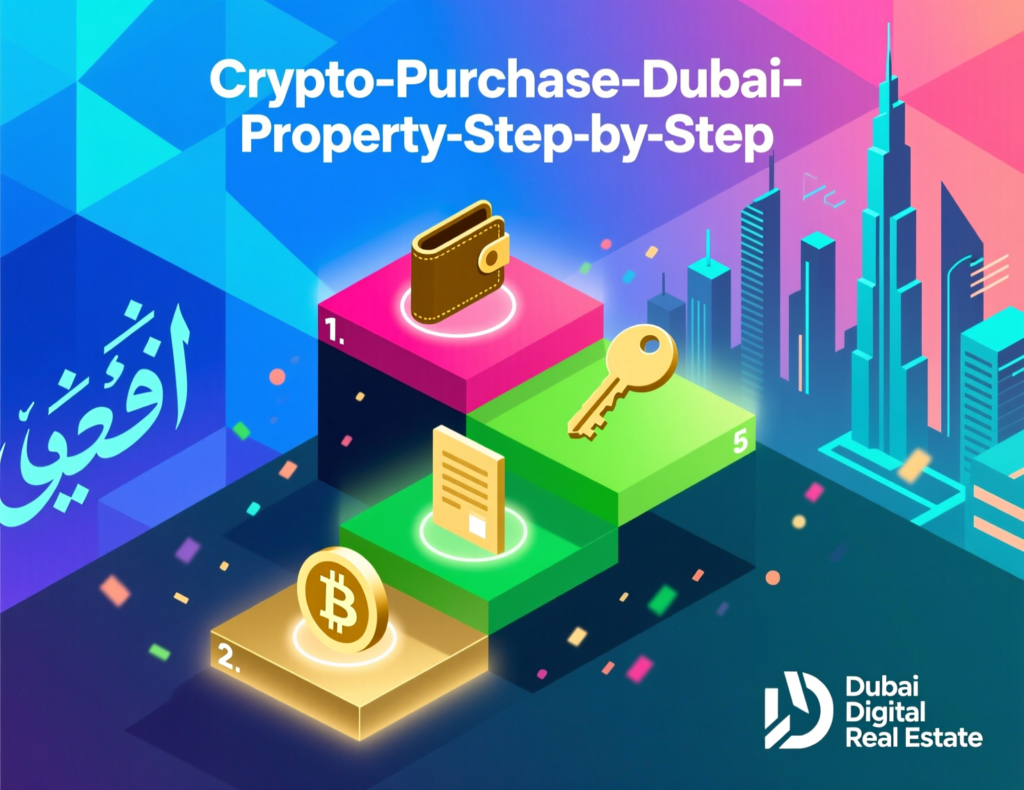
Step-by-step blockchain property transaction in Dubai for international investors
Choose a regulated platform or developer
Pick a VARA-aligned platform, real estate tokenization portal or crypto-friendly developer with clear links to DLD and RERA.
US investors should check SEC filings or exempt-offering notices; UK investors should look for FCA authorization; Germans should check BaFin registers.
KYC/AML onboarding
Complete digital KYC/AML, providing passport, proof of address and source-of-funds.
Standards generally follow FATF guidance on virtual assets, so expect enhanced checks if you’re moving large sums or using crypto.
Select asset structure (direct vs tokenized)
Direct purchase
you buy a standard unit in a tower in Dubai Marina or Business Bay; blockchain is mainly used for workflow and digital title.
Tokenized
you buy security tokens representing fractional ownership in an SPV that holds the property.
Funding via fiat or crypto
You send USD, GBP or EUR to an escrow account, or transfer Bitcoin/Ethereum/stablecoins to a licensed exchange or payment processor.
Crypto is converted into AED before the DLD-recognized transaction; you receive confirmation in both fiat and on-chain transaction records.
Smart contract signing and escrow
A smart contract generates the sale agreement, captures your payment milestones and locks funds in escrow when conditions are met.
You and the seller sign digitally (often with in-person verification done once, or via notarized PoA from your home country).
DLD registration and digital title deed
Once all conditions are satisfied, the platform submits the transaction to DLD; the official record is updated and a digital title deed is issued to your name or SPV.
In a tokenized structure, your SPV/fund interest is linked to tokens in your wallet; legal agreements define how that mapping works.
Ongoing management and reporting
Rental income can be distributed in AED, USD/EUR or sometimes stablecoins, and reported for tax in the US, UK or Germany based on your residency rules.You keep both platform statements and on-chain proofs for your accountant or tax advisor.
The precise steps differ slightly for US, UK, German and EU investors, but the pattern regulated platform, strong KYC/AML, AED settlement and DLD-backed title is consistent.
Paying for Dubai real estate with Bitcoin, Ethereum or stablecoins
You can pay for Dubai property using Bitcoin, Ethereum or stablecoins, but regulators currently expect that crypto to be converted into AED before the property is registered. Law firms in Dubai confirm that legally recognized real estate transactions are settled in AED through licensed VASPs or payment companies; direct crypto wallet-to-wallet settlement is not sufficient for title registration.
In practice
Some developers quote prices in BTC/ETH/USDT equivalents.
You transfer crypto to a partner exchange or gateway (often licensed under VARA); they handle conversion to AED and transfer to escrow.
You pay network fees plus a spread on the FX/crypto conversion; volatility risk is usually on the buyer until AED is locked in.
Smart contracts, escrow and title transfer on DLD systems
Smart contracts automate parts of the sale and escrow process but do not replace DLD’s land registry. The “on-chain” record captures offers, deposits, milestones and token allocations; the “off-chain” DLD record remains the sole authoritative source of land and unit ownership in Dubai.
In a mature setup
Escrow
Smart contracts release funds to the seller only when DLD (or the platform) confirms that registration is complete.
Notary and compliance
Checks are digitally logged, with auditable trails for regulators in both Dubai and your home country.
Secondary trading
Tokens can be traded on regulated venues, but underlying title updates may be batched or handled at SPV level, not for every token trade.
Regulations, compliance & tax for blockchain in Dubai real estate
Nothing here is legal, tax or financial advice treat it as a map of the landscape and always consult qualified advisers in both Dubai and your home jurisdiction.
Dubai combines DLD and RERA rules for property with VARA’s law for virtual assets, while US, UK and EU regulators overlay their own securities and AML regimes on top. MiCA in the EU, FATF standards globally and home-country tax rules all apply, even if the building is in Dubai.
DLD, RERA, VARA and AML/KYC for crypto buyers
At the local level.
DLD runs the land registry, approves tokenization pilots and issues digital title deeds.
RERA regulates developers, brokers and off-plan projects, including escrow requirements and marketing rules.
VARA, created under Dubai Law No. 4 of 2022, licenses and supervises VASPs (exchanges, custodians, broker-dealers).
UAE AML/KYC rules are aligned with FATF standards, so blockchain real estate platforms must verify customer identities, screen against sanctions and apply Travel Rule-style data sharing when moving virtual assets. This applies whether you’re funding from Austin, London or Munich.
How Dubai rules interact with US, UK and EU regulations
When you invest from abroad, “home country” rules don’t switch off at Dubai’s borders. In many cases, a tokenized Dubai real estate product is seen as a security or collective investment scheme in the US, UK or EU, triggering.
US (SEC/CFTC)
Registration or exemption under securities laws, custody rules and possible CFTC oversight for certain derivatives.
UK (FCA / UK-GDPR)
Authorization for firms promoting or operating token platforms, plus strict treatment of your data.
EU/Germany (BaFin, MiCA, GDPR/DSGVO)
Licenses for token issuance and trading; MiCA-based rules for certain asset-referenced tokens; strong data protection and localization expectations.
In short: expect to comply with both Dubai’s regime and your own regulator’s view of the product.
Tax snapshots for US, UK and German investors
Again, talk to a tax professional but at a high level.
US investors
The IRS taxes worldwide income; Dubai rental income and token distributions are typically reportable as foreign income, and token disposals may trigger capital gains. “Legal considerations for US investors in Dubai tokenized real estate” usually center on PFIC rules, foreign reporting (Forms 8938/3520/5471) and how your SPV or fund is structured.
UK residents
The UK taxes residents on worldwide income (with some remittance-basis nuances). Rental yields from Dubai, plus gains on tokens, generally fall into UK tax returns. “UK tax implications of Dubai blockchain property investments” often hinge on whether you hold assets personally or via a company and how remittances to the UK work.
German investors
Germany typically taxes global income, with specific rules for foreign real estate and crypto tokens; holding periods, classification as private vs business assets and any double-tax treaties matter. “Wie deutsche Anleger in tokenisierte Immobilien in Dubai investieren können” is as much a tax structuring question as a tech one.
Risks, scams & due diligence in Dubai blockchain property deals
Blockchain doesn’t remove risk it just changes its shape. For US and European investors, the biggest threats are not only price moves, but also governance, regulatory and data-protection failures.
Main risks of blockchain in Dubai real estate for US & European investors
Key risks include
Market and FX volatility
Dubai prices can move fast, and AED-pegged funding versus USD/GBP/EUR adds another layer. Fitch has even flagged the possibility of a double-digit (up to c.15%) price correction after years of strong growth and record supply forecasts.
Regulatory uncertainty
Token rules are evolving (especially under MiCA and SEC crypto enforcement), so today’s compliant structure may need updates.
Platform failure
If a tokenization platform or custodian collapses, you need clear legal rights to the underlying DLD-registered asset.
Token–title mismatch
Poorly designed schemes may sell “tokens” that don’t map cleanly to enforceable ownership or profit rights.
Jurisdictional disputes
Cross-border insolvencies, sanctions or tax audits can complicate enforcement and exits.
Due diligence checklist for tokenized and crypto-based projects
Before wiring funds.
Verify licensing (VARA, SEC/FCA/BaFin where relevant).
Review smart contract audits and open-source code where available.
Confirm custody setup (cold storage, multi-sig, insurance).
Understand governance (voting rights, board composition, related-party deals).
Check escrow arrangements and DLD/RERA registration status.
Ask for proof of insurance (professional indemnity, cyber).
Ensure there’s a documented link to DLD ideally with DLD-issued tokenization certificates or project listings.
How to verify platforms and developers from the US, UK, Germany and EU
From abroad, treat every platform as a financial-service provider.
Search SEC, FCA, BaFin and local EU registers for the company name.
Look for FATF-aligned AML policies, not just marketing buzzwords.
Read offering documents and risk factors, not only the pitch deck.
Check how they handle GDPR/DSGVO and UK-GDPR obligations, especially around on-chain vs off-chain data.
For German investors, confirm whether the product falls under BaFin’s security-token guidance and if a prospectus or information sheet has been approved.
Why Dubai is becoming a global hub for blockchain real estate
Dubai is becoming a leading hub for blockchain-based and tokenized real estate because it combines record-high property transaction volumes with a dedicated virtual assets regulator and a government-backed land registry that’s actively experimenting with tokenization.
For investors in New York, London or Frankfurt, that means a jurisdiction where both the real estate and crypto sides of the deal are part of a coherent, long-term strategy instead of ad-hoc pilots.
Regulation, innovation zones and investor demand
Several drivers matter
Pro-innovation regulation
VARA’s tailor-made regime for VASPs and the Dubai VA Law create a clear on-ramp for exchanges and tokenization providers.
Innovation zones
Free zones like DMCC host hundreds of crypto firms already, providing talent and infrastructure close to Dubai’s property hotspots.
Massive real estate activity
Dubai’s real estate transactions hit around AED 761 billion in 2024, with roughly 226,000 deals and around 20% year-on-year growth in value, underlining intense foreign investor participation.
Examples of blockchain-enabled and crypto-friendly projects in Dubai
Recent milestones include.
DLD’s Real Estate Tokenization Project and the first Property Token Ownership Certificate, with projects selling out rapidly on VARA-licensed platforms. Partnerships between DLD and major exchanges like Crypto.com to explore digitized investment flows and crypto-enabled real estate transactions.
Developers experimenting with tokenization of large portfoliosN DAMAC’s partnership with MANTRA, for example, aims to tokenize at least USD 1 billion in real-world assets, including Dubai property.
Across Downtown Dubai, Dubai Marina, Palm Jumeirah and Business Bay, you’ll now find off-plan Dubai projects on blockchain, crypto-friendly payment options and token-based co-investment schemes.
Outlook 2025–2030: the future of tokenized Dubai property
By 2030, it’s realistic to expect.
More regulated STOs, with DLD-linked tokenization frameworks and MiCA-aligned offerings in Europe.
Wider cross-border settlement, where investors onboard in London or Berlin, fund in GBP/EUR or stablecoins and settle into AED/DLD titles through seamless, regulated pipelines.
Stronger links between global RWAs and Dubai platforms, where portfolios span data centres, residential towers and hospitality assets across regions.
Is blockchain in Dubai real estate right for you?
Whether blockchain in Dubai real estate is right for you depends on your risk appetite, ticket size and regulatory comfort. It suits investors who are comfortable with both property cycles and digital asset frameworks, and who can work with cross-border tax and compliance specialists.
Matching strategies to investor profiles (US, UK, Germany, wider EU)
US investors (New York, Austin, SF)
Often better suited to institutional-grade STOs, funds or managed accounts that handle SEC compliance and reporting.
UK investors (London, Manchester)
May blend direct ownership of Dubai apartments with smaller allocations to tokenized portfolios via FCA-regulated platforms.
German and EU investors (Frankfurt, Paris, Amsterdam)
Frequently focus on BaFin/MiCA-aligned structures, clear prospectuses and strong GDPR/DSGVO protections, sometimes via EU-domiciled funds holding Dubai assets.
If you prefer stability and simplicity, a standard freehold unit with a modern, blockchain-enabled workflow (digital land registry Dubai, smart contracts for property sale) might be enough. If you’re comfortable with higher complexity, tokenized structures can offer diversification and lower minimum tickets.
Questions to ask your advisor, platform or Dubai developer
Bring a checklist like this to your lawyer, tax advisor or chosen platform.
How exactly do tokens map to the DLD title or SPV shares?
Which regulators oversee the platform (VARA, SEC, FCA, BaFin, others)
Where is my data stored, and how is GDPR/DSGVO or UK-GDPR handled
Who holds my assets (custodian, bank, VASP), and what happens if they fail?
How are rental income, token yields and exits taxed in my home country?
What is the exit strategy (secondary trading, direct sale, buy-back)
From research to your first blockchain-backed Dubai property
A practical path could look like this: shortlist two or three regulated platforms, run basic due diligence, speak to a cross-border tax advisor, then run a small pilot allocation before scaling. For some investors, that might be a fractional position in a tokenized Dubai Marina apartment; for others, a direct acquisition in Business Bay processed entirely through a digital, smart-contract-driven workflow.
If you’re a proptech, SaaS or investment platform building in this space, Mak It Solutions can help design and implement the underlying web, mobile, cloud and analytics stack so that your blockchain real estate products stay secure, compliant and scalable across the US, UK, Germany and the wider EU. For example, you can combine multi-cloud architectures, DevSecOps pipelines and secure analytics on top of tokenization rails to satisfy both VARA and home-regulator expectations.
If you’re exploring blockchain in Dubai real estate whether as an individual investor, family office or proptech platform you don’t need to navigate the tech and compliance details alone. Mak It Solutions works with teams in the US, UK, Germany and across Europe to design secure tokenization architectures, multi-cloud backends and data analytics for real estate and virtual assets.
Share your roadmap or platform idea, and we’ll help you scope a practical, regulation-aware blueprint for your next Dubai blockchain real estate initiative. ( Click Here’s )
FAQs
Q : Do I need to visit Dubai in person to complete a blockchain-based property purchase?
A : In many cases you don’t need to be physically in Dubai for the whole process, but you may need at least one in-person verification or a properly notarized power of attorney. Most KYC/AML onboarding, document signing and payment flows can be handled digitally through regulated platforms that integrate with DLD and RERA systems. Always confirm with your broker, platform and legal advisor what your home country and UAE rules require for remote transactions.
Q : Which Dubai districts are most active for tokenized or crypto-friendly real estate projects?
A : Crypto-friendly and tokenized projects tend to cluster where international demand is strongest Downtown Dubai, Dubai Marina, Palm Jumeirah and Business Bay, plus selected villa communities. These areas already attract buyers from New York, London and Frankfurt, and developers there are more likely to experiment with tokenization, security token offerings and crypto payment options. Availability still varies project by project, so always verify current terms directly with the developer or platform.
Q : Can foreigners get a mortgage on a blockchain-recorded or tokenized property in Dubai?
A : Traditional mortgages on standard freehold units are widely available to foreigners, but lending on tokenized structures is still emerging. Many banks focus on conventional DLD-registered properties and treat the blockchain workflow as a back-office efficiency, not as collateral. For tokenized SPV or fund interests, financing is more likely to come from specialized lenders or margin facilities offered by platforms, and terms can be stricter. Expect to provide detailed documentation and, in some cases, accept all-cash investment for tokenized deals.
Q : How are rental income and yields handled for fractional, tokenized Dubai properties?
A : For fractional, tokenized structures, rental income usually flows into an SPV or fund account, then gets distributed to token holders according to a formula in the legal docs and smart contracts. You might receive AED, USD/EUR or even stablecoin payouts to your wallet or bank account, along with periodic statements. From a tax perspective, your home authority (IRS, HMRC, German Finanzamt, etc.) will typically treat this as foreign rental or investment income, so keep records and consult a qualified advisor.
Q : What documents should I keep for my tax authority after investing in Dubai blockchain real estate?
A : Keep the same kind of records you would for a traditional foreign property, plus blockchain-specific evidence. That usually means: sale and subscription agreements, DLD title deeds or SPV share certificates, platform statements, bank and exchange records showing fiat/crypto flows, and on-chain transaction IDs. Many investors also keep annual valuation reports and audited SPV accounts. Having a clean paper and digital trail makes it much easier to handle audits or queries from US, UK, German or other EU tax authorities.