
Is Islamic Coin (ISLM) Halal? Guide for US & EU Investors
Islamic Coin (ISLM) is the native cryptocurrency of the Shariah-focused HAQQ Network. It is structured around an independent Shariah Board, a Shariah Oracle that screens apps and tokens, and a built-in charitable endowment (Evergreen DAO) so it can operate as a halal digital asset when used within its guidelines.
For investors in the US, UK and EU, Islamic Coin is typically accessed via regulated exchanges that list ISLM, then withdrawn to wallets supporting the HAQQ Network. You remain responsible for following local licensing, tax and reporting rules in your own jurisdiction.
Important note
nothing in this guide is personal investment advice or a religious ruling. Always consult qualified financial and Shariah advisors in your own jurisdiction before acting.
Introduction
Islamic Coin (ISLM) is the native cryptocurrency of the HAQQ Network, a Shariah-compliant Layer-1 blockchain designed first for the global Muslim community and anyone who wants ethics-first Web3 finance. ISLM powers payments, staking and governance on HAQQ, and a portion of each issuance is automatically directed to an Evergreen DAO that funds social impact and community projects worldwide.
With over 2 billion Muslims worldwide and Islamic finance assets projected to reach around USD 5.5 trillion in 2024, demand for Shariah-aligned digital money is accelerating.
For many Muslims, the core question is simple: is Islamic Coin (ISLM) halal? The project is designed to be halal, backed by an independent Shariah Board, a formal fatwa and on-chain tools that help filter out clearly non-compliant activity. Whether you personally treat it as halal will still depend on the scholars and fiqh approach you follow.
Why “halal crypto” matters for US, UK, German and wider European investors
For Muslims in New York, London, Frankfurt, Paris or Amsterdam, conventional crypto raises tough questions.
Is staking just interest with extra steps?
Is memecoin trading a form of maysir (gambling)?
How do you avoid haram sectors when everything is pseudonymous?
Projects like Islamic Coin try to solve this by embedding Shariah rules at protocol, app and governance level instead of leaving every decision purely to individual conscience. For regulators such as the SEC, FCA or BaFin this is still “crypto,” but for Muslim investors it can be a way to align Web3 participation with religious ethics.
What this guide will cover: Shariah compliance, HAQQ, regulation and how to buy ISLM
In the rest of this guide, you’ll see.
What HAQQ and Islamic Coin actually are, in plain language
How the Shariah framework, fatwa and Shariah Oracle work
The mission and Evergreen DAO model
How to buy Islamic Coin (ISLM) legally in the US, UK, Germany and the broader EU
Key tokenomics, regulatory regimes and risks
How ISLM compares to other “halal crypto” options
By the end, you should be able to answer for yourself: is Islamic Coin (ISLM) a good fit for my values, risk tolerance and legal environment?
What Is Islamic Coin (ISLM) and the HAQQ Network?
Islamic Coin (ISLM) is the native digital currency of the HAQQ Network, an ethics-first, Shariah-compliant Layer-1 blockchain secured by Proof-of-Stake validators. ISLM is used to pay transaction fees, participate in staking and take part in on-chain governance, while the protocol channels a share of new issuance into a community endowment for long-term impact projects.
HAQQ Network
HAQQ is a high-throughput PoS blockchain built with the Cosmos SDK and running an Ethereum-compatible virtual machine, so developers can reuse existing Solidity smart contracts and tools.
Its key design goals include:
Shariah compliance by design via a Shariah Oracle that whitelists halal dApps and screens contracts for riba (interest), excessive uncertainty (gharar) and gambling-like structures.
Interoperability compatibility with Ethereum tooling plus IBC (Inter-Blockchain Communication) to connect with other Cosmos chains.
Ethical Web3 finance supporting halal DeFi, tokenised sukuk, real-world assets and payment rails for Muslim-friendly fintechs from Dubai to London.
If you’re a US or EU investor, you can think of HAQQ as a specialised Ethereum-like chain, but with added ethics and compliance logic around what can run on it.
ISLM as the native currency of HAQQ.
ISLM is the gas and governance token of HAQQ.
Transaction fees every transfer, DeFi interaction or smart-contract deployment on HAQQ is paid in ISLM.
Staking users can delegate ISLM to validators, helping secure the network and earning rewards from block inflation and fees, within a Shariah-vetted framework.
Governance ISLM holders vote in the Evergreen DAO and protocol proposals, shaping upgrades, treasury usage and ecosystem grants.
Ecosystem payments from paying for halal DeFi products to top-ups in HAQQ Wallet or card products, ISLM is the base currency.
Islamic Coin vs generic cryptocurrencies (Bitcoin, ETH and others)
Compared with Bitcoin or Ethereum, Islamic Coin differs in three important ways:
Ethics-first design HAQQ explicitly targets Islamic digital finance; BTC and ETH are neutral rails that can be used for halal or haram purposes.
Shariah screening the Shariah Oracle and Shariah Board vet ecosystems and dApps before they are labelled halal, unlike generic chains where everything is permissionless.
Philanthropic allocation 10% of each ISLM issuance goes to the Evergreen DAO, a community endowment for social impact, which has no direct equivalent in Bitcoin or base-layer ETH.
For Muslim-friendly cryptocurrency investors, that mix of utility plus structured charity is a big part of the appeal.
Shariah Compliance
Islamic Coin is designed to follow Islamic finance rules by avoiding interest-based returns, excessive uncertainty and speculative gambling. A dedicated Shariah Board has issued a fatwa on the project, and HAQQ’s Shariah Oracle only allows certified halal dApps onto an approved whitelist so users can transact in crypto while staying closer to Shariah principles.
Islamic finance basics.
Classic Islamic finance prohibits.
Riba interest or guaranteed returns on money
Gharar excessive uncertainty or ambiguity in contracts
Maysir gambling or zero-sum speculation
Many crypto activities clash with these principles: high-leverage perpetual futures, interest-bearing lending pools, casinos or meme-token pump-and-dumps.
AAOIFI standards, widely followed by Islamic banks, push products towards asset-backing, risk-sharing and real economic activity. Islamic Coin tries to import that mindset into Web3: instead of interest-bearing lending, the roadmap emphasises profit-sharing structures and asset-based sukuk on HAQQ.
Shariah Board, fatwa and Shariah Oracle on HAQQ
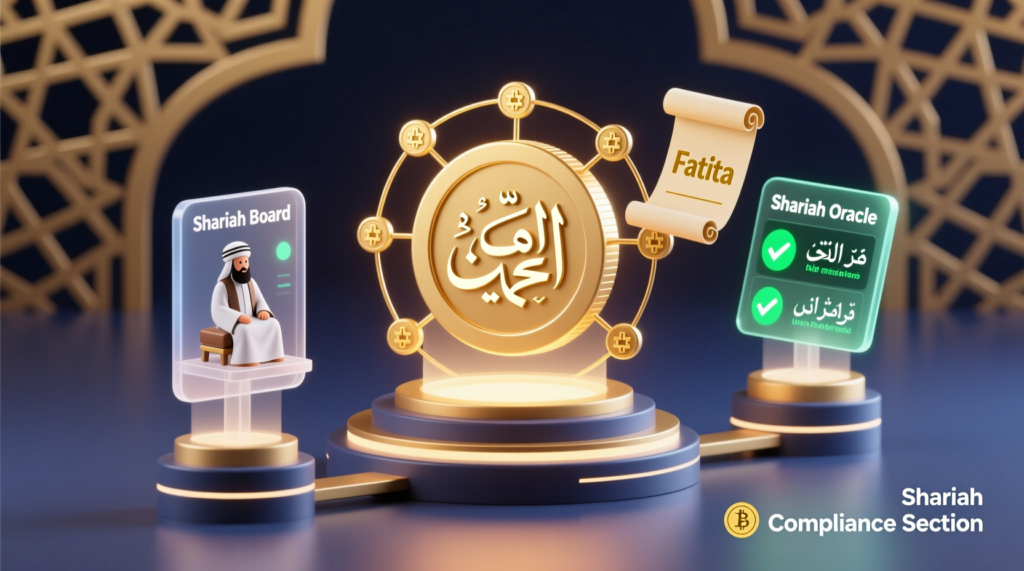
Islamic Coin works with an independent Shariah Board of recognised scholars who review the whitepaper, tokenomics and protocol design. Their formal fatwa (religious opinion) sets boundaries for what is considered halal in this ecosystem.
On the technical side, HAQQ’s Shariah Oracle is an on-chain registry that:
Whitelists dApps and tokens that pass Shariah screening
Blocks or flags contracts that involve interest-based lending, excessive leverage or haram sectors
Gives wallets like HAQQ Wallet a machine-readable list of “approved” apps
This model doesn’t guarantee every possible use is halal, but it materially lowers the risk of stumbling into clearly non-compliant DeFi.
How Islamic Coin screens use cases, revenue and DeFi activity
The Shariah framework focuses on three dimensions.
Use cases prioritising payments, investments and philanthropy over casino-style products.
Revenue sources excluding haram industries (e.g. alcohol, gambling, adult content) and interest-based lending income.
DeFi mechanics favouring profit-sharing, asset-backed tokens and transparent risk models instead of opaque yield-farming loops.
As an investor in Berlin or Manchester, you still need to check whether your personal scholarly view aligns with the project’s Shariah Board. But compared with a generic chain, HAQQ gives you more structured tools to stay inside a Muslim-friendly cryptocurrency universe.
Mission, Community and the Evergreen DAO
A portion of each ISLM issuance is reserved for the Evergreen DAO, a community-governed endowment that funds charitable and impact-driven projects. This effectively “bakes in” zakat-style giving at protocol level, so growth in network activity can translate into ongoing support for Muslim communities and ethical initiatives worldwide.
Why Islamic Coin was created for the global Muslim community
Islamic finance has grown to well over USD 3.5 trillion in assets and is forecast to surpass around USD 6–7 trillion by the late 2020s, driven by demand from markets like the GCC, Malaysia and Indonesia.
Yet most of that infrastructure is still Web2 and bank-centric. Islamic Coin’s mission is to:
Provide Muslims from Kuala Lumpur to New York with digital-age money aligned with Shariah
Make ethical Web3 finance accessible via HAQQ Wallet and partnerships with Islamic neobanks and fintechs
Support governments and institutions exploring Shariah-compliant tokenisation and payments.
The Evergreen DAO.
Evergreen DAO is structured as a non-profit endowment governed by the HAQQ community and guided by Shariah principles. In broad terms.
10% of each ISLM issuance is automatically allocated to the DAO treasury
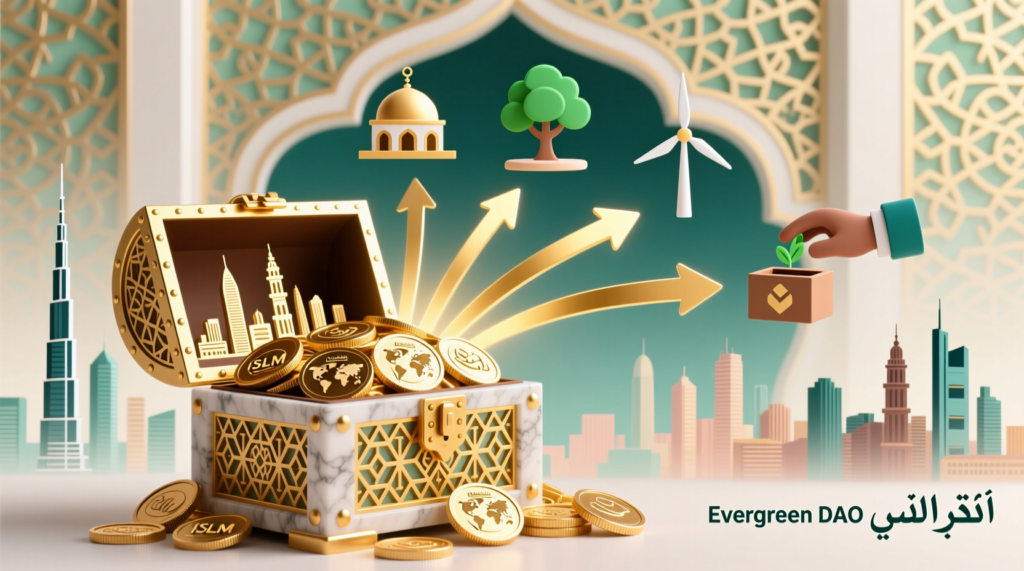
Funds can be deployed into charitable grants, impact investments and ecosystem support (e.g. bug bounties, security audits, halal DeFi infrastructure)
Governance aims to align with zakat and waqf concepts, favouring sustainable social good over short-term hype
This is one reason some Muslims see ISLM not just as a halal digital asset but as a way to systematise ongoing sadaqah using blockchain rails.
Zakat, waqf and funding ethical startups in Dubai, London, Frankfurt and beyond
In practice, you could imagine.
A zakat platform in Dubai routing donations through HAQQ’s Fairshare dApp, with transparent on-chain disbursements to charities in Riyadh or Jakarta .
An Islamic VC in London using ISLM-denominated funds to back halal fintech and Open Banking-integrated startups
A BaFin-regulated platform in Frankfurt using Evergreen grants to co-fund green sukuk or ethical real-world-asset tokenisation for German and French investors.
None of this replaces traditional zakat calculation or local charity, but it shows how an Islamic fintech blockchain can complement existing structures.
How to Buy and Store Islamic Coin (ISLM) in the US, UK, Germany and EU
For Muslims and ethics-minded investors in the US, UK and EU, the basic flow is similar: you use a regulated exchange in your region, complete KYC checks, fund your account through compliant banking channels, buy ISLM and then (ideally) move it to a secure non-custodial wallet that supports the HAQQ Network.
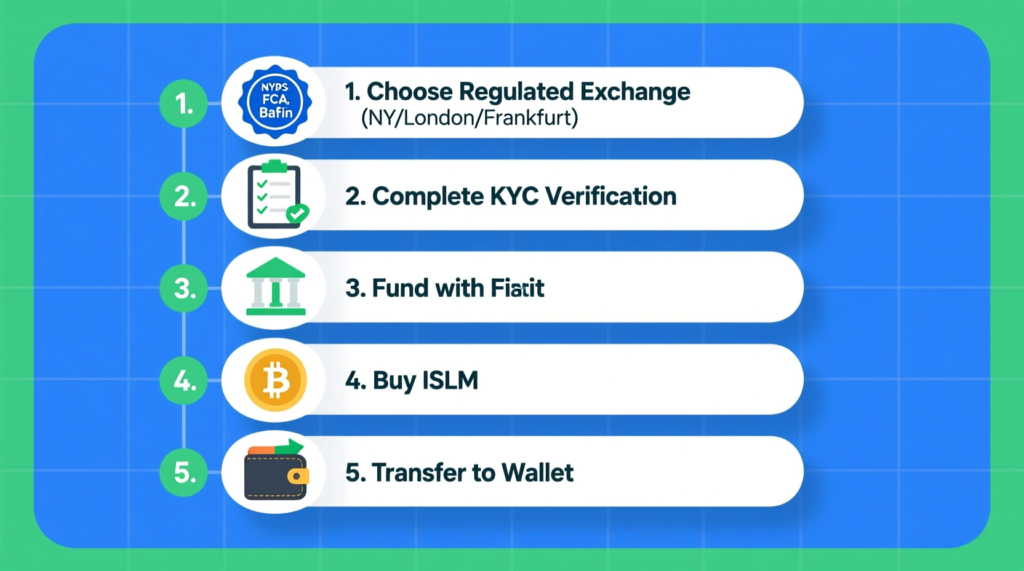
Where to find ISLM: centralized exchanges, DEXs and regional availability
Islamic Coin is listed on several centralised exchanges and can also trade on DEXs that support the HAQQ Network or bridged versions of ISLM. Listings change frequently, so always:
Prefer regulated venues in your jurisdiction (SEC/CFTC/FinCEN-registered or state licensed in the US; FCA-registered in the UK; BaFin/MiCA-authorised in the EU).
Check whether the platform offers ISLM spot markets against USD, EUR or GBP, or via pairs like USDT/USDC.
Verify that the exchange’s own operations (margin, lending, staking) align with your Shariah view before using them.
Buying Islamic Coin in the US, UK, Germany and wider Europe
United States (e.g., New York, Austin, San Francisco)
Choose a centralised exchange with strong US compliance (SEC/CFTC/FinCEN touchpoints, robust AML/KYC).
Complete KYC using your SSN and government-issued ID, then fund via ACH, wire or card.
Search for Islamic Coin / ISLM spot markets; place a limit or market order.
Record all trades for IRS reporting and capital-gains tracking (for example, via Form 8949).
This is what most “how to buy Islamic Coin (ISLM) legally in the US” queries boil down to. regulated venue → KYC → buy → track tax.
United Kingdom (London, Manchester & beyond)
Use an FCA-registered cryptoasset exchange or custodian; double-check the FCA register and the new financial-promotion rules for crypto (PS23/6).
Deposit GBP via Faster Payments or Open Banking rails.
Buy ISLM on available GBP or USDT pairs.
Keep records for HMRC capital gains and income, and be aware of the UK Travel Rule when sending or receiving from other platforms.
So if you’re searching “where to buy Islamic Coin (ISLM) in the UK on FCA-regulated exchanges,” the practical answer is: only on UK-authorised platforms that actually list ISLM, not on random offshore sites.
Germany and wider EU (Frankfurt, Paris, Amsterdam, etc.)
Look for exchanges authorised as Crypto-Asset Service Providers under MiCA, supervised by BaFin or other national regulators.
Fund EUR accounts via SEPA or local rails.
Trade into ISLM on EUR or USDT pairs where available.
From around late 2024 onwards, CASPs are expected to operate under MiCA licences, with stronger rules on disclosures, complaints handling and safeguarding.
If you’re specifically searching “schariakonforme Kryptowährung Islamic Coin ISLM in Deutschland”, the realistic path is: find a MiCA- or BaFin-regulated exchange that lists ISLM and then confirm both regulatory and Shariah credentials.
Storing ISLM safely
Once you own ISLM, you have two main storage options.
Custodial storage leaving coins on the exchange or with a regulated custodian that may hold certifications like SOC 2 and PCI DSS.
Non-custodial self-custody using HAQQ Wallet or compatible wallets where you control the private keys.
For many Shariah-conscious users, self-custody feels closer to true ownership, but it comes with responsibility:
Store seed phrases offline, in at least two secure locations.
Consider hardware-wallet support where possible.
Ensure any cloud backups or third-party services you use comply with GDPR/UK-GDPR/DSGVO if you’re in the EU or UK.
Think of wallet setup the way you’d treat a high-value mobile app or fintech account: Mak It Solutions’ own mobile app development services emphasise secure authentication and UX; your HAQQ wallet deserves the same quality bar.
Tokenomics, Regulation and Risk
Islamic Coin’s design tries to sit at the intersection of Shariah-compliant finance and modern crypto regulation: halal screening and charitable allocation are built into protocol economics, while trading and custody increasingly happen on licensed platforms under MiCA, FCA and US oversight.
ISLM supply, staking and rewards in a halal framework
ISLM’s tokenomics (always check the latest docs) generally include.
A capped or pre-defined maximum supply, with scheduled emissions across ecosystem, community, investors and the Evergreen DAO.
Staking rewards paid from new issuance and transaction fees, which project scholars characterise as compensation for network security and risk-sharing rather than interest on idle capital.
A 10% share of each issuance directed to the Evergreen DAO, which functions more like a perpetual waqf-style endowment than a private profit pool.
From a Shariah perspective, the argument is that staking is closer to mudarabah/musharakah-type partnership than to a fixed-interest deposit. As always, Muslims should discuss this reasoning with scholars they trust.
The regulatory landscape
Regulation doesn’t (yet) distinguish “halal” crypto from everything else. Instead, ISLM is treated like any other cryptoasset.
EU / Germany
MiCA introduces an EU-wide framework for crypto-asset issuers and service providers, focusing on transparency, authorisation and market-abuse controls. BaFin is Germany’s MiCA supervisor and will oversee CASPs operating under the new regime.
UK
The FCA’s crypto financial-promotion rules (PS23/6) apply to any firm marketing cryptoassets to UK consumers, with strict standards for risk warnings and Consumer Duty compliance.
US
Multiple agencies oversee different aspects: the SEC and CFTC on securities/commodities, FinCEN on AML/KYC, and the IRS on taxation. Rules are fragmented but compliance expectations are rising quickly.
For an ISLM holder in New York, London or Frankfurt, the bottom line is the same: use platforms that genuinely operate under these regimes, and keep your own tax and reporting clean.
Volatility, Shariah drift, exchange risk and changing rules
No matter how ethical the mission, ISLM remains a volatile cryptoasset. Key risks include.
Price volatility
ISLM can swing sharply with market cycles and liquidity across exchanges.
Shariah drift
Future fatwas or scholar opinions could change if tokenomics, governance or DeFi practices evolve.
Exchange/custody risk
Even regulated platforms can fail or be hacked; self-custody introduces user-error risk instead.
Regulatory change
MiCA, FCA or US rules could tighten around staking, self-hosted wallets or Islamic finance structures.
If your risk tolerance is low, you may decide Islamic Coin is best treated as a small, educational allocation rather than a core portfolio holding.
Comparing Islamic Coin with Other Halal Crypto Options
Islamic Coin vs generic “halal crypto coin” projects
There are now multiple coins branding themselves as “Islamic” or “halal,” but substance varies wildly. Compared with many small-cap, Muslim-branded tokens, Islamic Coin tends to stand out for
A fully-fledged Layer-1 HAQQ Network rather than just a token on someone else’s chain
A clearly documented Shariah Board and fatwa
The 10% Evergreen DAO allocation baked into issuance
A focus on infrastructure (wallets, cards, sukuk, DeFi) rather than pure marketing
When comparing options, treat them like any fintech vendor: look for documentation, governance, security audits and Shariah references not just a logo with a crescent moon.
Islamic Coin vs non-Shariah-screened coins.
Many scholars see Bitcoin as ethically neutral digital property; others worry about extreme speculation. Ethereum and stablecoins like USDC/USDT are heavily used in DeFi, including clearly interest-based products.
Islamic Coin’s differentiator is not that Bitcoin is automatically haram and ISLM automatically halal. Rather:
HAQQ actively discourages non-compliant use cases;
The Shariah Oracle and fatwa provide more structure for Muslim decision-making;
Evergreen DAO makes charitable giving a core design feature.
Some Muslims may still mix approaches for example, using Bitcoin as long-term savings while using ISLM for halal DeFi and zakat-linked giving.
When Islamic Coin may and may not be the right fit for you
ISLM may be a fit if.
You want exposure to an Islamic fintech blockchain with real infrastructure (wallet, debit card, RWA and sukuk plans).
You’re comfortable with crypto volatility and on-chain governance.
You value built-in charitable mechanisms and Shariah oversight.
ISLM may not suit you if
You prefer only very large-cap, highly liquid cryptoassets.
You’re unconvinced by the specific Shariah reasoning or worry about future fatwa changes.
Your regulator (or local scholar council) has taken a restrictive stance on crypto generally.
As always, your ISLM allocation should fit into your broader financial plan and ethical framework, not dictate them.
Bottom Lines
Is Islamic Coin (ISLM) right for US, UK, German and EU investors?
For Muslims in the US, UK, Germany and wider EU, Islamic Coin offers a rare combination. a Shariah-oriented Layer-1 blockchain, an actively governed halal DeFi ecosystem and a protocol-level charitable endowment. Technically, it’s a modern PoS, EVM-compatible chain; ethically, it aspires to AAOIFI-style standards and evergreen giving.
But it is still crypto.
volatile, evolving and subject to complex regulation. Whether Islamic Coin (ISLM) is “right” for you depends on your risk appetite, regulatory comfort and the advice of scholars you trust.
Due-diligence checklist before buying any Shariah-compliant cryptocurrency
Before you buy ISLM or any other “halal crypto” project, work through this quick checklist:
Shariah governance
Is there a credible Shariah Board and a publicly available fatwa?
Regulated access
Is the exchange MiCA/FCA/US-compliant, with solid security practices?
Technical security
Are there audits of the chain and major dApps?
Wallet safety
Do you understand seed phrases, hardware wallets and recovery?
Tax impact
Have you mapped capital-gains and income treatment in your country?
If any of these are unclear, pause and get clarity before allocating capital.
Whitepaper, Shariah resources and regional legal guidance
Helpful next stops
The HAQQ Network website, docs and ISLM tokenomics pages for protocol-level detail ( HAQQ)
The Shariah section of Islamic Coin’s official site for fatwa and governance detail
Regional regulators: ESMA/MiCA, FCA, BaFin, and US regulatory/tax resources such as FinCEN and the IRS, plus GDPR/UK-GDPR guidance for data and privacy (,FCA,)
And, critically, local Islamic scholars and qualified tax or legal professionals in your jurisdiction especially if you’re moving larger sums or running a business on HAQQ.
Disclaimer
Cryptoassets are high-risk and can lose significant value. This article is for general information only and is not financial, legal or religious advice.
If you’re exploring Islamic Coin (ISLM) as part of a broader digital strategy, you don’t have to do it alone. Mak It Solutions helps teams in the US, UK, Germany and across Europe design secure, compliant fintech and Web3 products from mobile apps to analytics dashboards so they actually ship.
Share your use case wallet, halal DeFi app, zakat platform, or analytics stack for crypto reporting and we can map a scoped implementation plan that fits both your regulatory landscape and your Shariah requirements.( Click Here’s )
FAQs
Q : Can Islamic Coin (ISLM) be used to pay zakat or other charitable obligations?
A : Yes, many Muslims use ISLM as part of their charitable giving by donating through Evergreen DAO-funded initiatives or HAQQ-based charity dApps. Because 10% of new issuance already goes to a community endowment, some see holding or transacting in ISLM as indirectly supporting ongoing sadaqah.However, zakat rules are personal and nuanced, so you should still calculate your obligation in your base currency and confirm treatment of crypto with a trusted scholar.
Q : How does staking Islamic Coin differ from earning interest in conventional finance?
A : In Islamic Coin’s model, staking is framed as contributing capital and risk to secure the network, with rewards tied to protocol activity and inflation parameters rather than a fixed interest rate on a guaranteed deposit. Shariah scholars working with the project argue this aligns more closely with partnership-based contracts than pure riba. That said, some scholars may still be cautious, so it’s wise to compare fatwas and decide whether you are comfortable with the structure.
Q : What should I check to confirm that an exchange listing ISLM is truly Shariah-compliant?
A: First, verify that the exchange is properly regulated (MiCA/BaFin in the EU, FCA in the UK, or SEC/FinCEN/CFTC-aligned in the US).Then review its core business: Does it push leveraged derivatives, high-interest lending or casino-style products? Some Muslim investors treat regulated exchanges as neutral infrastructure and focus Shariah screening on their own activities; others prefer platforms with explicit Shariah policies. Document your reasoning either way.
Q : How do I report Islamic Coin gains for tax purposes in the US, UK or EU?
A : In most Western jurisdictions, ISLM is treated like other crypto: disposals (selling, swapping or spending) can trigger capital gains, and some staking rewards may be taxed as income. In the US, the IRS expects you to track cost basis and report gains on Form 8949; in the UK, HMRC guidance treats most activity under Capital Gains Tax with some edge cases; in the EU, local implementations under MiCA and national tax codes vary. Always keep detailed records and confirm specifics with a local tax advisor.
Q : What happens if the Shariah Board’s view on Islamic Coin changes in the future?
A : Like any Islamic finance product, Islamic Coin is subject to ongoing scholarly review. If the Shariah Board revises its fatwa perhaps due to tokenomics changes, new DeFi practices or regulatory developments users may need to reassess holdings and future participation. Some scholars may allow a transition period to unwind positions; others might advise exiting non-compliant structures more quickly. To manage this risk, avoid over concentration in any single asset and stay engaged with official Shariah communications and independent scholars you trust.