
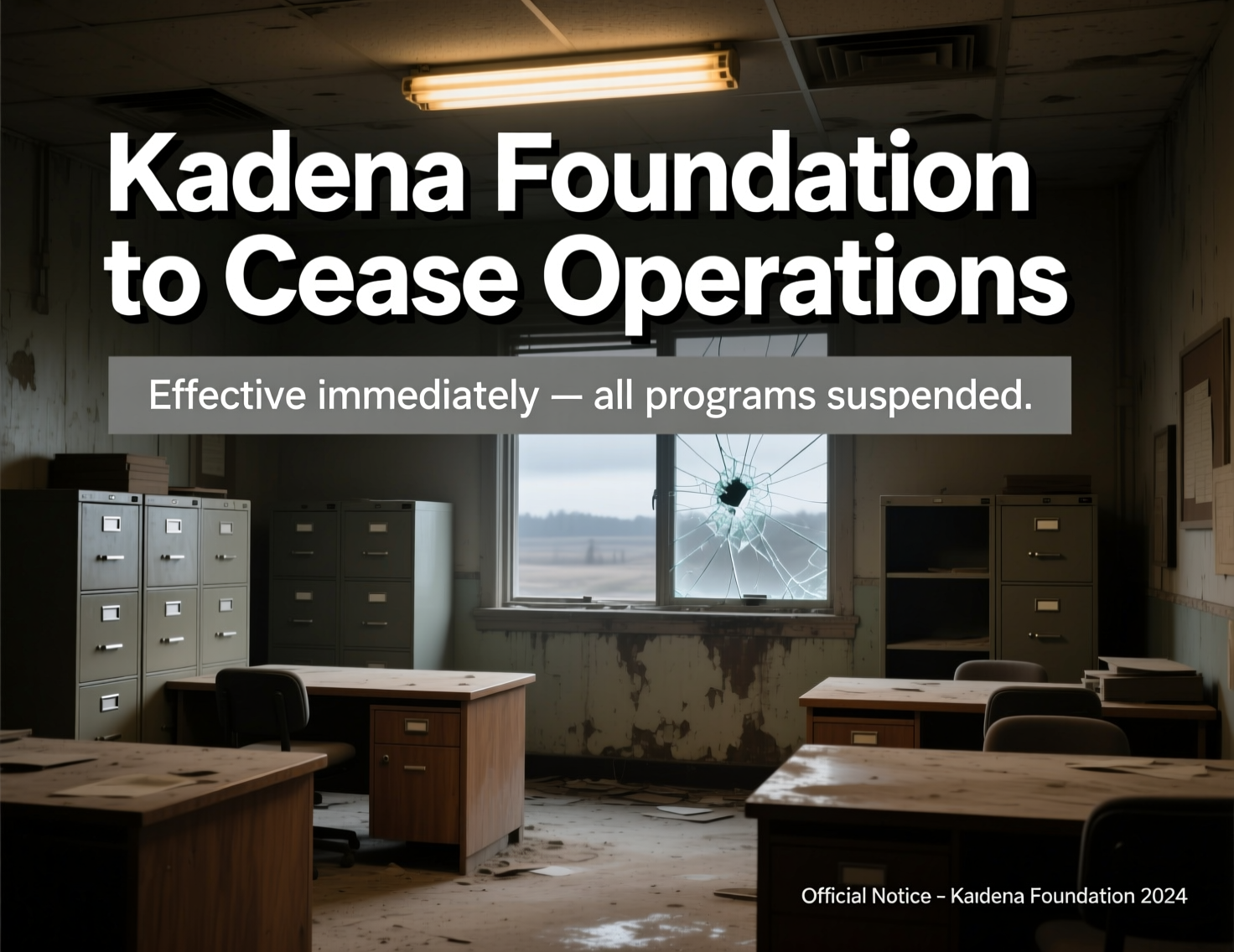

Kadena Foundation to Cease Operations, Leaving Blockchain to Run Without Core Team
The Kadena Foundation has announced that it will cease operations effective immediately, citing unfavorable market conditions and the inability to sustain ongoing development efforts. The decision marks a significant shift for the project, which had aimed to advance blockchain scalability and enterprise adoption through its hybrid proof-of-work and smart contract technology.
Despite the foundation’s dissolution, the Kadena blockchain itself will continue to function, maintained by independent miners and community contributors who remain committed to the network’s vision. However, the news has had an immediate market impact, with KDA’s price experiencing a sharp decline following the announcement. Many in the crypto community are now watching closely to see how the decentralized ecosystem evolves without the foundation’s direct involvement.
What happened
Kadena’s core entity announced it would halt operations and dissolve, ending active maintenance of the network. In an accompanying statement, the team said it was “no longer able to continue business operations,” shifting responsibility to the community. Following the news, KDA declined ~55–60% in 24 hours to below $0.10 on major trackers. Kraken+3CoinDesk+3CoinGecko+3
Network status and emissions
Despite the shutdown, the Kadena blockchain remains operational because it’s secured by Proof-of-Work miners and maintained by community developers. According to Kadena’s published token economics, mining rewards continue until 2139 and platform emissions (~83.7m KDA) unlock through Nov 2029. The foundation indicated a transition team would release a new node binary to aid continuity.

Technology context: Chainweb and Pact
Kadena’s Chainweb architecture braids multiple PoW chains in parallel for throughput while preserving Bitcoin-style security, paired with the Pact smart-contract language. Kadena’s public chain launched broadly in late 2019/Jan 2020.
Market reaction
Prices across major aggregators showed KDA near $0.09, down ~55–60% intraday. Liquidity and volatility spiked as traders reassessed long-term prospects without a core team.
Community control and risks
Without a funded core organization, roadmaps, security audits, and protocol upgrades will depend on volunteers, miners, or third-party teams. This model can sustain base-layer uptime but may slow feature development and increase governance risk. (Analysis)
Kadena Foundation to cease operations: what it means for users
Transactions, mining, and smart contracts should keep working as long as miners and infra providers remain active.
Node operators should monitor official repos and community channels for the promised node binary and any critical notices.
Dapp teams may face reduced grant support and must rely on community funding.
Migration and monitoring after Kadena Foundation to cease operations
Developers may hedge by multi-chain deployments while tracking Kadena’s hashrate, liveness, and releases.
Users should stick to official wallets/clients and be cautious with third-party binaries.
Exchanges and custodians should review listing risk and adjust monitoring. (Analysis)
Context & Analysis
Kadena’s model parallel PoW chains plus Pact differed from the industry’s pivot to PoS and modular stacks. The dissolution heightens funding and roadmap uncertainty, even with emissions locked in. Community-led maintenance can preserve uptime, but ecosystem growth may lag without institutional support and grants. (This section is labeled analysis; facts above remain sourced.)

Conclusion
Kadena’s blockchain continues to operate through its miners and community members, but the absence of the foundation has created uncertainty around governance and ongoing development. The immediate priority lies in delivering the promised node binary, maintaining stable mining participation, and ensuring coordination among third-party developers to keep the network functional.
Looking ahead, Kadena’s long-term survival will depend on how effectively independent teams can organize to manage maintenance, implement updates, and drive innovation. The community’s ability to sustain collaboration and technical progress will determine whether the project can remain viable in a rapidly evolving blockchain ecosystem.
FAQs
Q : What does it mean that the Kadena Foundation will cease operations?
A : It means the core entity is dissolving and ending active maintenance; however, the chain will continue running through miners and the community.
Q : Will the Kadena blockchain shut down?
A: No. It remains operational under independent miners and developers.
Q : Why did KDA drop more than 50%?
A : The market reacted to uncertainty surrounding governance and maintenance after the dissolution announcement.
Q : What happens to token emissions now?
A : They remain unchanged — mining rewards continue until 2139, with about 83.7 million KDA platform emissions unlocking through November 2029.
Q : Who founded Kadena and when did it launch?
A : Kadena was founded by Stuart Popejoy and Will Martino. The public chain rollout occurred in 2019 and January 2020.
Q : Is Chainweb still supported?
A : Yes, it remains open-source software; future updates will depend on community contributors.
Q : How can users track network health after the shutdown?
A : Monitor prices, GitHub releases, hashrate data, and community updates. Always verify binaries before installation for security.
Facts
Event
Dissolution of Kadena Foundation; blockchain continues via miners/communityDate/Time
2025-10-22T11:50:00+05:00Entities
Kadena Foundation; Kadena (KDA); Stuart Popejoy; Will MartinoFigures
KDA down ~55–60% to ~$0.09 (24h); ~566m KDA mining rewards to 2139; ~83.7m platform emissions to Nov 2029Quotes
“no longer able to continue business operations” Kadena team statement via announcement/XSources
CoinDesk report; Kadena token economics page; CoinGecko price page; Kadena Chainweb page. Kadena+3CoinDesk+3Kadena+3