
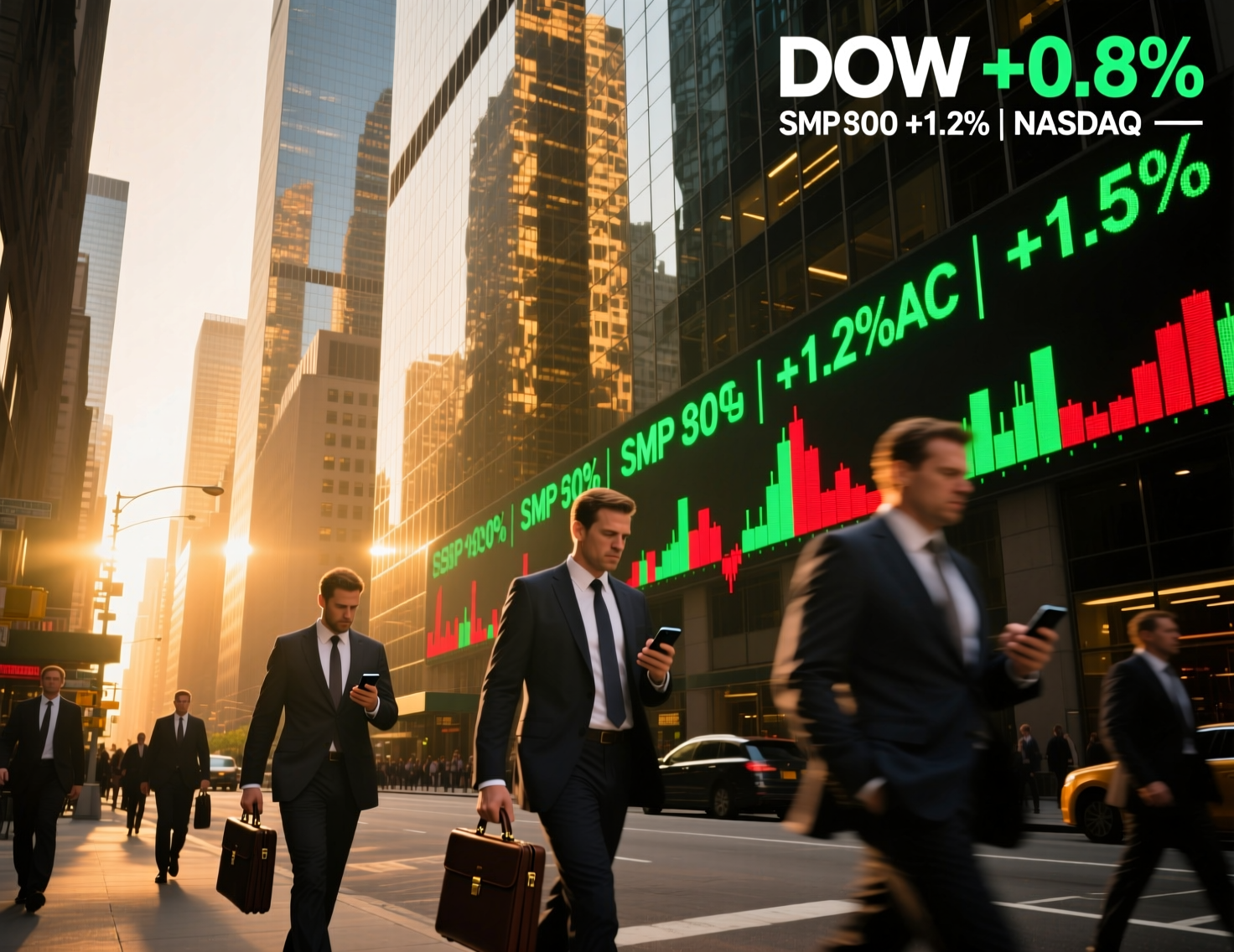

Wall Street retreats from record closing highs as economic worries mount
Wall Street pulled back from its recent record highs as the federal government shutdown entered its seventh day, limiting access to key economic data and increasing reliance on alternative indicators and policy comments. The ongoing shutdown has added uncertainty, prompting investors to tread cautiously amid mixed signals about the broader economy.
All three major indexes the Dow, S&P 500, and Nasdaq ended the session lower. Sentiment weakened further after a New York Fed survey showed rising inflation expectations among consumers. With official data releases paused, traders closely monitored remarks from policymakers and secondary market signals to gauge the economic outlook. The mood remained cautious as markets awaited clarity on both fiscal developments and future monetary policy direction.
Wall Street retreats from record closing highs
The Dow Jones Industrial Average fell 91.99 points (−0.20%) to 46,602.98, the S&P 500 lost 25.69 (−0.38%) to 6,714.59 and the Nasdaq Composite slid 153.30 (−0.67%) to 22,788.36. Consumer discretionary led declines, while staples and utilities outperformed as investors rotated defensively. Market breadth weakened on both the NYSE and Nasdaq.
Why Wall Street retreats from record closing highs mattered today
With federal data releases paused during the shutdown, traders parsed the New York Fed’s Survey of Consumer Expectations, which showed one-year inflation expectations ticking up to 3.4% and five-year to 3.0%. The backdrop reinforced caution ahead of the Federal Reserve’s next policy meeting. Federal Reserve Bank of New York

Movers & Catalysts
Tesla fell after launching lower-priced “Standard” trims of its Model Y (and Model 3), moves aimed at reigniting demand but raising margin questions among analysts. AMD extended gains after a Jefferies upgrade citing its supply deal with OpenAI, while Constellation Brands rose on a smaller-than-expected Q2 sales dip. IBM advanced on a new partnership with Anthropic to integrate Claude models across its software stack.
Crypto & AI complex
Bitcoin cooled after setting fresh records earlier in the week, pressuring crypto-exposed names including Coinbase, Riot Platforms and Marathon Digital. Meanwhile, AppLovin rebounded after broker commentary sought to temper concern over a reported SEC probe
<section id=”howto”> <h3>How to monitor markets during a federal data blackout</h3> <ol> <li id=”step1″><strong>Step 1:</strong> Track regional Fed and private-sector surveys (e.g., NY Fed SCE, ISM proxies) for near-term sentiment.</li> <li id=”step2″><strong>Step 2:</strong> Watch FOMC member speeches and minutes for guidance on rates and balance-sheet policy.</li> <li id=”step3″><strong>Step 3:</strong> Use high-frequency indicators (mobility, card spending, job postings) to triangulate growth.</li> <li id=”step4″><strong>Step 4:</strong> Follow sector leadership and breadth stats to gauge risk appetite beneath headline indexes.</li> <li id=”step5″><strong>Step 5:</strong> Cross-check moves in rates, dollar, oil and gold to confirm or challenge the equity narrative.</li> </ol> <p><em>Note: Process may vary by jurisdiction/provider. Confirm requirements before acting.</em></p> </section>
Context & Analysis
Quotes from market strategists framed profit-taking after a strong run and uncertainty in the absence of official data. Sector underperformance in cyclicals (homebuilders, airlines, transports) echoed slowdown worries, while defensive groups and gold strength signaled a bid for safety.

Conclusion
The market’s near-term direction depends largely on how long the data blackout from the federal shutdown continues and whether the Federal Reserve’s upcoming signals confirm expectations of another rate cut in 2025. Investors are watching closely for any clues that could shape monetary policy sentiment.
Beyond macro uncertainty, corporate developments are likely to steer trading activity. Earnings results and company-specific factors particularly around electric vehicle pricing and spending on artificial intelligence infrastructure remain crucial drivers. These themes could influence sector rotations and overall market tone in the weeks ahead as investors seek clearer guidance.
FAQs
Q : Why did markets fall today?
A : Indexes slipped as traders weighed a shutdown-driven data blackout and higher inflation expectations in the NY Fed’s survey.
Q : Which sectors led and lagged?
A : Consumer discretionary lagged; staples and utilities outperformed on defensiveness.
Q : What moved Tesla and AMD?
A : Tesla fell after launching a lower-cost Model Y; AMD rose on a Jefferies upgrade tied to an OpenAI supply deal.
Q : How did crypto-linked stocks trade?
A : They eased as bitcoin cooled from record highs earlier this week.
Q : Did the Fed signal anything new?
A : Investors parsed officials’ remarks amid the data blackout; attention centers on whether a second 2025 rate cut materializes.
Q : Does the shutdown change the outlook?
A : Extended shutdowns can muddy the data picture and dent confidence, increasing volatility.
Q : Where can I read more about Wall Street retreats from record closing highs?
A : See the Reuters market wrap and related official releases.