


The Future of Staking and Yield Strategies
The market is shifting fast. Base staking yields on large PoS networks have compressed, while new layers liquid staking, restaking, RWA yield wrappers, and smarter MEV capture are unlocking a fresh playbook for sustainable on-chain income.
If you want to position a treasury or portfolio for the next cycle, you need a view on The Future of Staking and Yield Strategies: where yields come from, what risks you’re underwriting, and how protocol upgrades will change the game. Today, ~30% of ETH is staked, pushing nominal network rewards toward ~2–3% while MEV and tips make up the difference for sophisticated operators.
Meanwhile, tokenized T-bills and “yielding stables” offer low-volatility complements to crypto-native income, and restaking has exploded from a niche idea to a dominant security primitive with multi-billion TVL. The question isn’t “Where are the highest APYs?” it’s which yields are durable, and how to assemble them into a diversified stack. This guide maps The Future of Staking and Yield Strategies, the risks that matter, and a practical allocation playbook for 2025–2027.
Why yields are compressing and why that’s healthy
ETH’s staked share has climbed toward ~30% of supply, mechanically lowering the per-validator issuance rate. Reference rates show recent network-wide rewards hovering around ~2.8% p.a., with MEV-boostable operators averaging higher (≈5–6%) thanks to block auctions and tips. Over time, expect equilibrium yields to drift lower as more capital stakes and MEV is competed away or protocol-enshrined. This is “good compression”: security rises, issuance falls, and real yield becomes more about execution quality than pure inflation. The Future of Staking and Yield Strategies therefore prioritizes quality of yield (source, risk, duration) over headline APR. The Block+2beaconcha.in+2
Liquid staking’s second act
LSTs remain core collateral, but market share is rebalancing. Lido notes stETH share dipping to ~23.9% even as TVL grows with price evidence of a broader, competitive LST landscape. For allocators, that means better choice, but also the need to monitor liquidity, redemption paths, and DAO risk management. The Future of Staking and Yield Strategies will reward platforms that maintain deep secondary liquidity, robust oracle design, and battle-tested redemptions during stress.
Restaking is real but treat incentives with respect
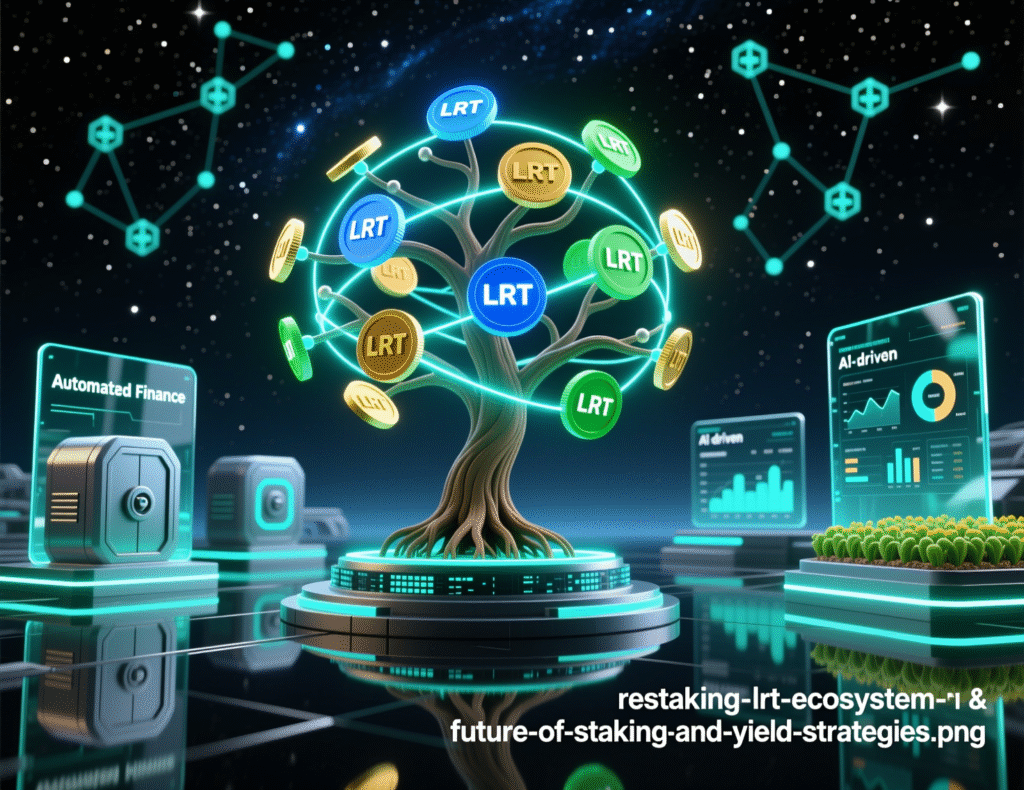
Restaking (e.g., EigenLayer) lets ETH security be rehypothecated to secure Actively Validated Services (AVSs). The category’s leader now sits near ~$20B TVL, but DefiLlama data shows a material portion of “yield” is incentive-driven rather than fee revenue—underscoring that emissions ≠ sustainable income. For allocators, the alpha is selective AVS exposure, caps per LRT, and clear liquidation/peg-risk controls. The Future of Staking and Yield Strategies favors restaking programs where AVS fees begin to replace token incentives over time.
Risk spotlight: LRT depegs happen
On Apr 24, 2024, Renzo’s ezETH depegged by as much as ~70–80% on some pools amid a liquidity stampede tied to tokenomics/airdrop dynamics triggering large DeFi liquidations. If you use LRTs as collateral, assume they can trade at a discount during stress. Controls: loan-to-value caps, circuit breakers, and diversified LRT baskets.
Real-world yields move on-chain
Tokenized T-bills and money-market wrappers have scaled into the multi-billion range, with market dashboards tracking >$8B in tokenized Treasuries alone and >$33B in RWAs (incl. stablecoins). Flagship products (e.g., Ondo OUSG / USDY) typically target ~4–5% APY, creating a low-volatility base layer for on-chain portfolios. Demand tailwinds are secular: stablecoin issuers and treasurers increasingly hold T-bills, reinforcing yields and liquidity. For global treasuries, parking operating cash in tokenized instruments while keeping duration short has become a default yield sleeve within The Future of Staking and Yield Strategies.

MEV, PBS, and the operator edge
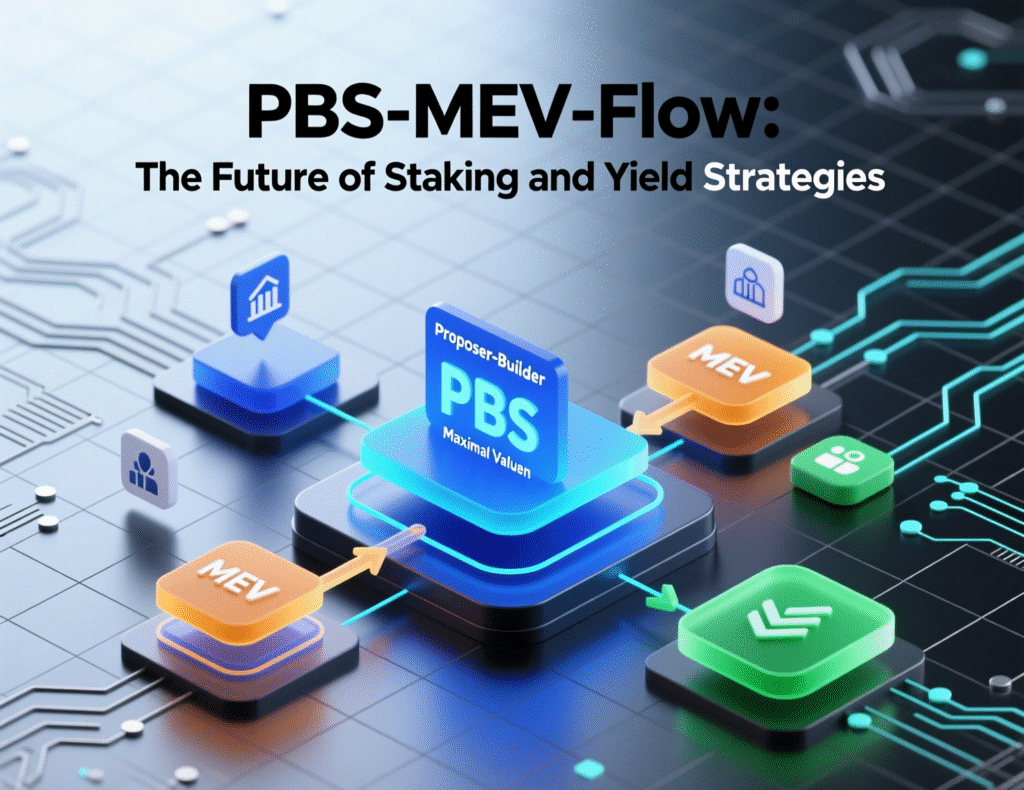
Proposer-Builder Separation (PBS) via MEV-Boost already improves validator revenue; research and core-dev work toward “enshrined PBS” aims to harden this market in-protocol, reducing relay risk and rent extraction. The upshot: operators who invest in relays, latency, and policy earn above-average returns today, but that edge may compress once PBS formalizes. In The Future of Staking and Yield Strategies, assume MEV alpha decays plan for operational excellence rather than windfalls.
Pectra changed staking product design
With Ethereum’s 2025 Pectra upgrade, EIP-7251 increased the effective balance cap (to 2,048 ETH), and EIP-7002 improved validator exit control from the execution layer—key for delegated and enterprise staking. EIP-7702 nudges account abstraction, making smart-wallet flows easier (think gas sponsorship, batched ops), which can streamline staking UX and automated rebalancing between LSTs, LRTs, and RWA wrappers. These primitives shape The Future of Staking and Yield Strategies by enabling safer exits, larger validator consolidation, and smoother retail UX funnels.
Portfolio playbook: three example stacks (not financial advice)
Conservative (treasuries/ops treasury, low drawdown)
50% tokenized T-bill wrappers (e.g., OUSG/USDY equivalents)
25% native ETH stake (pooled validator or institutional custodian)
15% blue-chip LST (stETH/rETH)
10% MEV-aware staking service
Rationale: Cash-like base yield + simple, transparent staking.
Balanced (diversified income, managed smart-contract risk)
30% tokenized T-bills
30% LST basket (stETH, rETH, sfrxETH)
20% restaking via a diversified LRT basket with caps per issuer (e.g., eETH, rsETH, ezETH)
10% directional DeFi lending (blue-chip markets)
10% MEV-aware validator exposure
Rationale: Mix of real-world and crypto-native yields; strict LTVs and peg-risk rules.
Opportunistic (for advanced teams with risk budget)
20% LRT basket (with AVS selection and time-boxed incentive capture)
20% classic LP strategies in high-volume pairs with active range mgmt (Uniswap v3)
20% liquid governance-aligned strategies (e.g., ve-token bribe capture)
20% tokenized T-bills as dry powder / risk offset
20% directional staking (Alt-L1s/Actively managed validators)
Rationale: Harvest emissions/MEV/fees while keeping a real-yield core for downside protection. Manage IL, oracle risk, and emissions cliffs explicitly.
Risk framework you should actually use
Protocol risk
Audits, bug bounties, upgrade keys, governance quorums.Validator risk
Slashing, downtime, poor MEV policy.Liquidity/peg risk
LST/LRT depegs and exit queues (see ezETH 4/24/24).Legal/regulatory
U.S. actions against custodial “staking-as-a-service”; policies continue to evolve state-by-state and federally.Counterparty/custody
segregation of assets, bankruptcy remoteness, oracle and relayer dependencies.
Document each risk with thresholds (e.g., maximum % per LRT, daily redemption capacity, slippage tolerances) and pre-commit your actions if those thresholds are breached.
Case studies (real-world snapshots)
LRT stress test
Renzo ezETH depeg (Apr 2024) caused deep discounts and liquidations—teams with LTV caps and multi-collateral setups rode it out; those treating LRTs as “risk-free” suffered. Lesson: cap LRT exposure, maintain off-DEX redemptions, expect gaps in fast sell-offs.Tokenized T-bills adoption
RWAs on public chains now exceed tens of billions (incl. stables), with >$8B in tokenized Treasuries alone, and TradFi demand (e.g., stablecoin reserve flows) creating a consistent buyer base. Lesson: low-volatility yield has durable structural support.
What this means for 2025–2027
The Future of Staking and Yield Strategies is stacked: (1) a real-yield base (tokenized T-bills, base staking), (2) selective risk overlays (MEV optimization, curated restaking), and (3) tactical cycles (emissions or points with strict risk budgets). Protocol upgrades (Pectra, potential PBS enshrinement) and shifting regulation will keep changing the relative payoffs but the winning approach is consistent: diversify sources, prefer fee-funded income over emissions, and embed automated risk brakes.
Concluding Remarks
If you’re optimizing an on-chain treasury or a crypto income product, stop chasing the highest number and start scoring yield quality: source, sustainability, liquidity, and legal clarity. The smartest portfolios in The Future of Staking and Yield Strategies combine a low-volatility base (tokenized T-bills; native ETH staking), selective growth overlays (MEV-aware validation; high-quality AVSs), and hard guardrails (LTV caps, peg-risk limits, exit-path rehearsals).
Build dashboards that track real fees vs. emissions, redemption depths, and regulatory news. Above all, accept that edge decays: operational excellence and disciplined risk management compound better than any one-off APR spike. Ready to map this to your stack? Let’s turn the frameworks here into a tailored allocation and monitoring plan for your treasury or product.
CTA: Want a customized, risk-scored yield stack for your DAO, fund, or product? Request a 1-page plan with allocations, caps, and monitoring KPIs.
FAQs
Q1 : How do I compare staking vs. restaking yields fairly?
A : Normalize by fee-funded vs. incentive-funded rewards, expected drawdowns, and liquidity. Restaking may show higher APRs today but often relies on emissions. Track AVS cash flows and redemption paths before sizing exposure.
Q2 : How can treasuries use tokenized T-bills without adding DeFi risk?
A : Use whitelisted wrappers with transparent custody, daily NAV, and direct mint/redeem. Keep duration short, segregate accounts, and cap issuer concentration. Monitor issuer AUM and on-chain holder concentration.
Q3 : How does MEV affect my staking returns?
A : MEV-boost adds extra revenue; network-wide averages with MEV are higher than bare issuance. As PBS moves in-protocol, edge may compress. Pick operators with strong relay practices and ethical policies.
Q 4: How risky are LRTs compared to LSTs?
A : Higher. You take LST risk plus AVS and program risk. Under stress, LRTs can depeg—plan for discounts and collateral haircuts.
Q5 : How should I size RWA exposure?
A: Use RWAs as a ballast: 30–50% for conservative treasuries, less for opportunistic funds. Focus on custody, chain of title, and redemption SLAs.
Q6 : How does the Pectra upgrade change staking products?
A : Higher validator caps (EIP-7251) enable consolidation; EIP-7002 improves exit control; EIP-7702 improves UX. Net-net: cleaner ops and better retail flows.
Q7 : How do regulators view staking today?
A : U.S. actions targeted custodial “staking-as-a-service” programs (e.g., Kraken settlement). Policies are evolving; consult counsel if serving U.S. users.
Q8 : What’s a realistic target return for a balanced yield stack?
A : Blend base staking (~2–3%), MEV lift (~+1–2% for good operators), RWA (~4–5%), and small restaking incentives after risk adjustments and costs. Expect variability.
Q9 : How can I monitor peg and redemption risk?
A : Track on-chain liquidity, secondary market spreads, validator exit queues, and issuer mint/redeem backlogs. Set alerts for >1% persistent discount and volume spikes. (Use DefiLlama dashboards and AVS fee trackers.)