
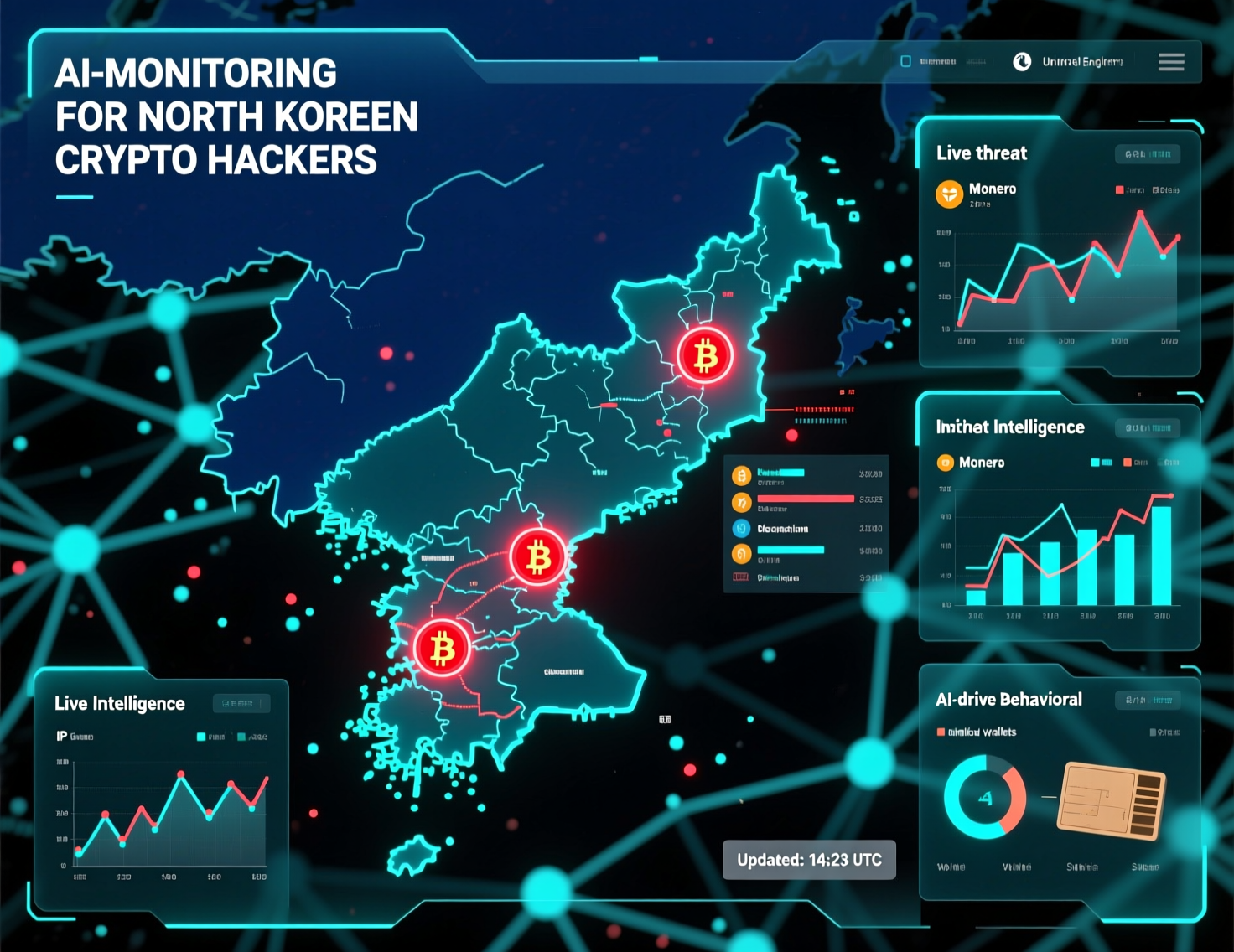

Crypto needs dual wallet management, AI monitoring of North Korean hackers
Security experts say crypto firms face escalating insider-access risks from DPRK-linked operatives and should combine tighter wallet governance with AI monitoring for North Korean crypto hackers to spot anomalies before funds move. U.S. authorities recently detailed schemes in which North Korean IT workers used fake identities to secure remote roles and siphon assets, while Hong Kong’s fresh stablecoin rules are already reshaping on-chain trading behavior.
Why AI monitoring for North Korean crypto hackers is now urgent
The U.S. Department of Justice and FBI described coordinated actions against remote DPRK IT workers embedded across 100+ U.S. companies, including blockchain startups, with at least $900,000 in crypto theft tied to developer-level access. These cases illustrate how “employees” can quietly gain source-code and key management visibility before executing drains.
Cointelegraph reports industry experts advocating real-time, AI-driven threat detection to correlate on-chain transfers with off-chain HR, device and identity signals. “The Coinbase breach was a warning. Proactive, AI-driven monitoring is how to stop the next one,” said Cyvers CEO Deddy Lavid.
Implementing AI monitoring for North Korean crypto hackers: controls & signals
Cross-link on-/off-chain: flag dev wallets newly interacting with company contracts; watch for after-hours approvals or geography anomalies.
Insider-risk analytics: build baselines for code-repo access, admin console use and signer participation; alert on deviations.
Automated kill-switches: pause outflows when model confidence crosses thresholds; require secondary human approval.
Post-incident forensics: preserve immutable audit trails for rapid attribution and regulatory reporting.
Dual control, audit trails, and CCSS alignment
Yehor Rudytsia (Hacken) recommends thorough background checks, strict role-based access, and adopting CCSS practices for wallet operations—dual control, audit trails and identity verification—plus enhanced logging and cloud reviews. Dual-control (multisig) ensures transactions require multiple independent keys, reducing single-point failure. Cointelegraph+2cryptoconsortium.org+2
Coinbase’s breach cost outlook
Coinbase disclosed in May that bribed third-party support agents helped criminals access sensitive user data; the firm projects $180–$400 million in remediation and reimbursements, affecting less than 1% of users. Although private keys weren’t exposed, the episode highlights the need for stronger insider-threat detection and vendor controls.

Hong Kong’s stablecoin regime narrows derivatives use
DBS Hong Kong CEO Sebastian Paredes said new AML/KYC requirements effectively limit stablecoins in on-chain derivatives; Hong Kong’s regime took effect Aug. 1, 2025, with HKMA operating a licensing framework and public issuer register. Firms eye broader stablecoin capabilities while monitoring derivative constraints.
<section id=”howto”> <h3>How to deploy AI-driven monitoring and dual-wallet controls</h3> <ol> <li id=”step1″><strong>Step 1:</strong> Map all wallets (hot/warm/cold) to owners, purposes and risk tiers; enforce least-privilege roles.</li> <li id=”step2″><strong>Step 2:</strong> Implement CCSS-aligned multisig (e.g., 2-of-3) with geographically distributed keys and audit logging.</li> <li id=”step3″><strong>Step 3:</strong> Integrate AI analytics that fuse HR/device identity, code-repo events and on-chain flows for anomaly detection.</li> <li id=”step4″><strong>Step 4:</strong> Set automated circuit-breakers (velocity/amount/pattern) requiring secondary approval on triggers.</li> <li id=”step5″><strong>Step 5:</strong> Institute continuous background checks and vendor vetting; rotate credentials and rehearse incident playbooks quarterly.</li> </ol> <p><em>Note: Process may vary by jurisdiction/provider. Confirm requirements before acting.</em></p> </section>
Context & Analysis
SEAL, an ethical-hacker collective, recently publicized at least 60 suspected DPRK impersonator profiles seeking crypto jobs aligning with warnings from Binance co-founder Changpeng Zhao about infiltration via employment. While not every North Korean developer is a hacker, wages can still fund the state; firms should prioritize verification over trust.

Conclusion
The next steps involve combining AI-powered monitoring with CCSS-based wallet governance, ensuring dual controls, detailed logging, and identity proofing for stronger security. At the same time, organizations must enforce stricter vetting of both employees and contractors to reduce insider risks and strengthen operational resilience.
On the regulatory side, frameworks like Hong Kong’s stablecoin licensing are setting the tone for how markets adapt. Such evolving regimes will shape not only compliance standards but also determine where on-chain risks gather, influencing global adoption patterns and the future structure of digital asset ecosystems.
FAQs
Q : What is the main goal of AI monitoring for North Korean crypto hackers?
A : To detect insider-driven anomalies early by correlating identity, device, code-repo and on-chain signals before funds move.
Q : What does dual-wallet (multisig) control achieve?
A : It requires multiple independent approvals to move funds, minimizing single-key compromise risk.
Q : How did the Coinbase breach change security priorities?
A : It highlighted insider and vendor risks, with losses estimated at $180–$400 million despite keys not being exposed.
Q : Who is warning about DPRK job-seeker infiltration?
A : The Security Alliance (SEAL) and Binance’s CZ; U.S. DOJ has also announced related charges.
Q : Do Hong Kong’s new rules affect on-chain derivatives using stablecoins?
A : Yes, DBS Hong Kong says AML/KYC requirements materially limit such use; licensing is now in effect.
Q : Is CCSS a replacement for ISO 27001 or SOC 2?
A : No, CCSS complements existing frameworks with crypto-specific controls like multisig and audit logs.
Q : What vetting steps help prevent infiltration?
A : Background checks, identity proofing, device attestation and role-based access with periodic reviews.