
Cross-Border Payments With Crypto
Moving money across borders still trips over high fees, slow settlement, and opaque FX. In Q1 2025, the global average cost to send a remittance was 6.49% well above the UN SDG target of 3%. Remittance Prices Worldwide Meanwhile, the G20’s cross-border payments roadmap targets lower cost, faster speed, broader access, and better transparency by 2027, pushing both public and private sectors toward better rails.
Against that backdrop, cross-border payments with crypto especially via fiat-backed stablecoins and Bitcoin’s Lightning Network are maturing fast. Visa expanded stablecoin settlement (USDC) and continues to broaden chain support, showing incumbents now treat tokenized cash as serious infrastructure.Humanitarian agencies like UNHCR have also moved emergency cash assistance on-chain, delivering value to wallets that can be cashed out locally.
This guide explains what cross-border payments with crypto are, how they work, when to use them, the regulatory guardrails, and how leading organizations are deploying them today. You’ll get a build-vs-buy framework, step-by-step implementation, case studies, and a compliance checklist designed for finance and product teams.
What Are Cross-Border Payments With Crypto?
At its core, cross-border payments with crypto move value across jurisdictions using public blockchains. The most common approach is stablecoins (e.g., USDC/USDT) that are pegged 1:1 to fiat currency and settle in minutes/seconds on networks like Ethereum L2s, Solana, Stellar, or Tron. In 2025, major institutions and regulators increasingly frame stablecoins as “tokenized cash” suitable for payments if compliance is done right.
Why Cross-Border Payments With Crypto Matter in 2025
Usage is real and growing
IMF work in 2025 maps ~$2 trillion in 2024 stablecoin flows, with the largest gross flows in North America and Asia-Pacific, and the highest flows vs. GDP in Africa/Middle East and Latin America.Merchants and acquirers are integrating
Visa’s stablecoin settlement capabilities piloted from 2023 and expanded since show acquirers can receive USDC for faster settlement windows.Regional share is meaningful
Chainalysis reports stablecoins averaged ~52% of smaller purchase transactions in Western/Central/Northern Europe (Jul 2022–Jun 2024), highlighting payments use versus speculation.Policy momentum
The G20 roadmap sets 2027 targets; regulators from FATF to the EU’s MiCA have codified expectations for AML/CFT, stablecoin issuance, and VASP operations.
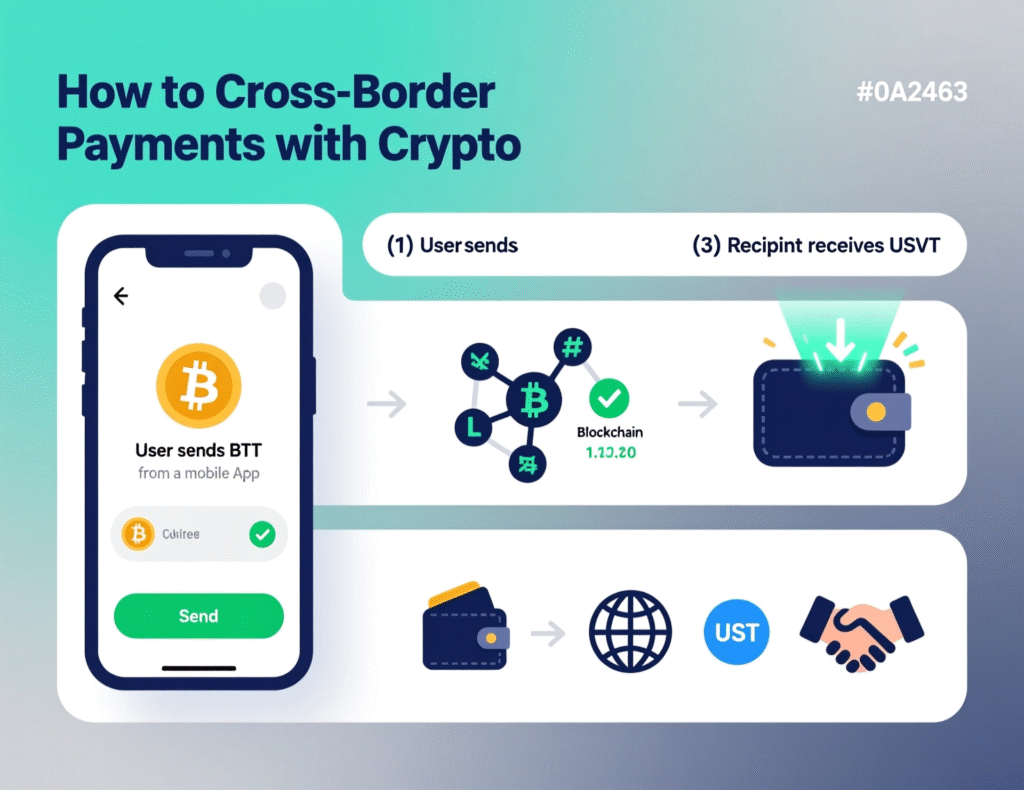
How Cross-Border Payments With Crypto Work (Step-By-Step)
KYC/KYB your sender with a compliant provider (exchange, wallet, PSP) and screen beneficiaries. Align with FATF standards and Travel Rule where applicable.
Fund in fiat (bank transfer/card) or on-chain funds.
Convert to a stablecoin (e.g., USDC).
Send on-chain over a selected network (Ethereum L2, Solana, Stellar, Tron) or via Lightning for BTC-denominated routing.
FX & off-ramp to local currency through licensed partners (e.g., MoneyGram Ramps, exchange P2P, or bank rails).
Receipt & reconciliation with instant, transparent transaction proof; sync to ERP.
Example platforms enabling cross-border payments with crypto today include MoneyGram Ramps (global cash in/out), Stripe’s stablecoin accounts/payouts (101 countries), and Lightning-based services.
Network Choices for Cross-Border Payments With Crypto
Stellar:
Designed for fiat tokens and FX order books; growing cash ramps (e.g., MoneyGram).Solana / Ethereum L2s:
High throughput, low fees; widely supported by issuers and PSPs (e.g., Visa’s USDC pilots).Tron:
Popular for low-fee USDT transfers in emerging markets; widely used by retail users. (General market context from multiple industry trackers.)Bitcoin Lightning:
Millisecond micropayments and fiat-to-fiat via BTC rails (used by Strike’s Send Globally).
Costs, Speed & FX: A Head-to-Head
Legacy wires/remittances.
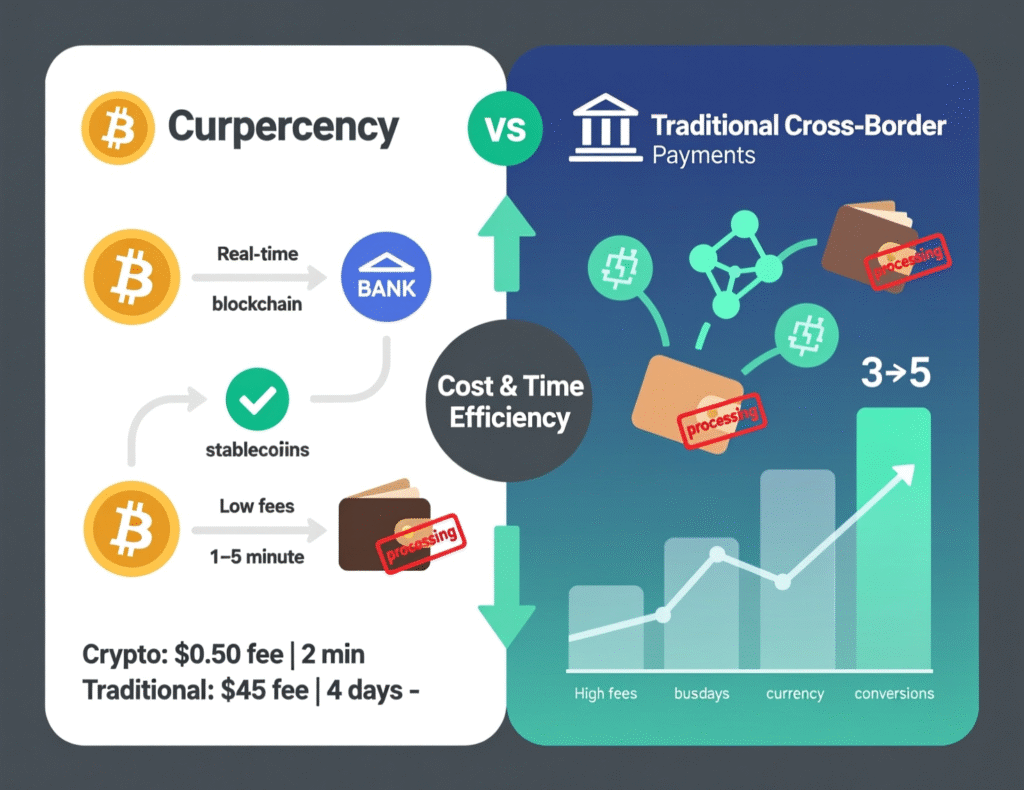
Multi-intermediary correspondent banking leads to high spreads and fees; avg. remittance cost 6.49% (Q1 2025).
Cross-border payments with crypto.
Network fees
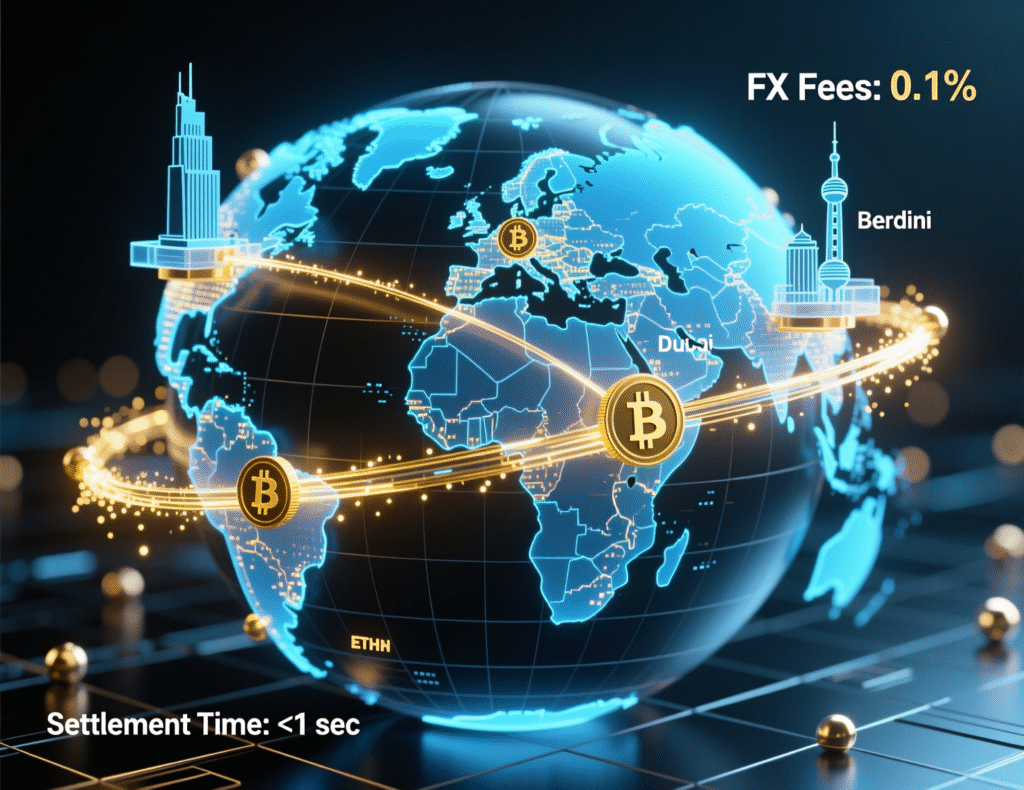
Usually cents (or sub-cents) on fast chains; Lightning routes BTC cheaply.FX
Can be done on-chain via tokenized USD ↔︎ local off-ramp or via off-chain market makers; spreads often beat retail bank FX.Settlement speed
seconds–minutes with 24/7 finality.
Regulatory compliance and off-ramp availability determine total landed cost. BIS notes tokenization can compress today’s sequential correspondent steps into a single, integrated process, improving speed, cost, and transparency.
Regulatory & Compliance Checklist for Cross-Border Payments With Crypto
FATF R.15 & Travel Rule
Ensure VASP licensing/registration, AML program, sanctions screening, and originator/beneficiary data exchange for qualifying transfers.EU MiCA (2024–2025 phasing): Stablecoin (EMT/ART) issuance, reserve, and disclosure rules; licensing and conduct for crypto-asset service providers.
G20 Roadmap alignment: Prioritize speed/cost/transparency metrics and interoperability by 2027.
Tip
Document Travel-Rule compliance, chain analytics, sanctions controls, and local licensing of off-ramps in each corridor.
Case Studies: Cross-Border Payments With Crypto in Action
UNHCR / Stellar Aid Assist (USDC on Stellar).
Refugees receive value in a compliant wallet and cash out locally demonstrating instant settlement plus last-mile access.
Visa stablecoin settlement.
Visa expands capabilities to settle with acquirers in USDC, initially on Ethereum and Solana, shortening settlement cycles for global merchants.
Strike “Send Globally” (Lightning)
USD → BTC → local currency in supported African corridors, delivering near-instant fiat payouts with low fees.
MoneyGram x Crossmint app (2025)
Launching in Colombia, MoneyGram’s new app uses USDC and Stellar to store/send USD-denominated value with global off-ramp reach via its retail network.
Risks & How to Mitigate When Using Cross-Border Payments With Crypto
Illicit finance & sanctions evasion risks
Stablecoins are sometimes misused; strong KYC, screening, and Travel-Rule data exchange are essential, alongside rapid freeze/blacklist processes.Off-ramp/regulatory risk
Ensure partners are licensed and MiCA/FATF-aligned; maintain corridor-specific compliance matrices.Operational risk
Chain congestion and issuer risk; diversify across chains/issuers and set transaction thresholds and monitoring SLAs.FX/volatility
Prefer fiat-backed stablecoins for treasury and minimize exposure duration.
Implementation Guide (for Finance & Product Teams)
Choose your operating model
Direct
Your entity holds wallets and initiates on-chain transfers.Embedded PSP
Use a provider for KYC, on/off-ramps, and Travel-Rule messaging.
Corridor design
Pick one or two high-impact corridors (e.g., US→COL, EU→MENA) and validate off-ramp partners’ licenses, liquidity, and SLAs.
Rails & tokens
Start with one stablecoin and one fast chain (e.g., USDC on Stellar/Solana) plus an optional Lightning route for micro-payouts.
Compliance controls
Integrate Travel-Rule, sanctions screening, and chain analytics; align with MiCA where applicable.
Measure outcomes
Track landed cost (network + FX + partner fee), settlement time, rejection/return rates, and payout coverage. Benchmark against the World Bank’s cost data for your corridors.
Your First Cross-Border Payment With Crypto (6 Steps)
Verify sender/beneficiary (KYC/KYB).
Load USD and convert to USDC.
Send on a low-fee chain (e.g., Stellar/Solana).
Confirm on-chain settlement (block explorer).
Recipient off-ramps to local fiat via licensed partner.
Reconcile and archive Travel-Rule records.


Concluding Remarks
The status quo for international money movement remains costlier and slower than it should be 6.49% average remittance fees are proof. Cross-border payments with crypto give finance teams a faster, cheaper, always-on alternative without sacrificing compliance provided you choose the right rails, partners, and controls. From Visa’s stablecoin settlements to humanitarian distributions and new retail-grade off-ramps, the evidence shows on-chain rails are ready for mainstream use in select corridors.
If you’re exploring cross-border payments with crypto, start with one corridor, one token, one chain, and a clear compliance checklist. Measure speed, landed cost, and reliability against your current provider. Then scale methodically.
CTA: Want a plug-and-play checklist, vendor short-list, and pilot plan tailored to your corridors? Get in touch and we’ll map your first 60-day rollout.
FAQs
Q1) How do cross-border payments with crypto reduce costs?
A : They reduce intermediaries (and their fees), compress settlement steps, and enable tighter FX spreads via tokenized USD and efficient off-ramps. Landing costs depend on corridor and partners but often undercut legacy options while meeting FATF/MiCA rules when implemented correctly.
Q2) How fast are cross-border payments with crypto?
A : Seconds to minutes on fast chains/Lightning with 24/7 finality. Delays mainly arise in off-ramps and compliance checks, not the chain itself.
Q3) How can businesses stay compliant?
A : Adopt FATF Travel-Rule data exchange, sanctions screening, AML programs, and use licensed off-ramps; align with MiCA in the EU for issuance/servicing.
Q4) What stablecoin should I use for payments?
A : Choose reputable, fiat-backed stablecoins with strong transparency and broad exchange/off-ramp support. Many PSPs start with USDC due to institutional integrations.
Q5) How do I off-ramp to cash?
A : Use licensed partners with retail presence or bank rails (e.g., MoneyGram Ramps) to convert from USDC/USDT to local currency quickly.
Q6) How does Lightning compare to stablecoins?
A : Lightning excels at micro-payouts with ultra-low fees; stablecoins simplify USD-denominated treasuries and FX. Many programs use both.
Q7) Are cross-border payments with crypto safe?
A : They can be, if you enforce Travel-Rule compliance, sanctions controls, and chain analytics and choose regulated partners. Monitor illicit-finance risks and be ready to freeze or block suspicious flows.
Q8) How do I pick a chain?
A : Prioritize corridor off-ramps, fee profile, throughput, and PSP support. Stellar/Solana/Ethereum L2s are common; Tron has strong USDT usage in some markets.
Q9) What KPIs should we track?
A : Landed cost vs. legacy, settlement time, payout coverage, reject/return rates, and compliance exceptions. Benchmark against corridor averages.