
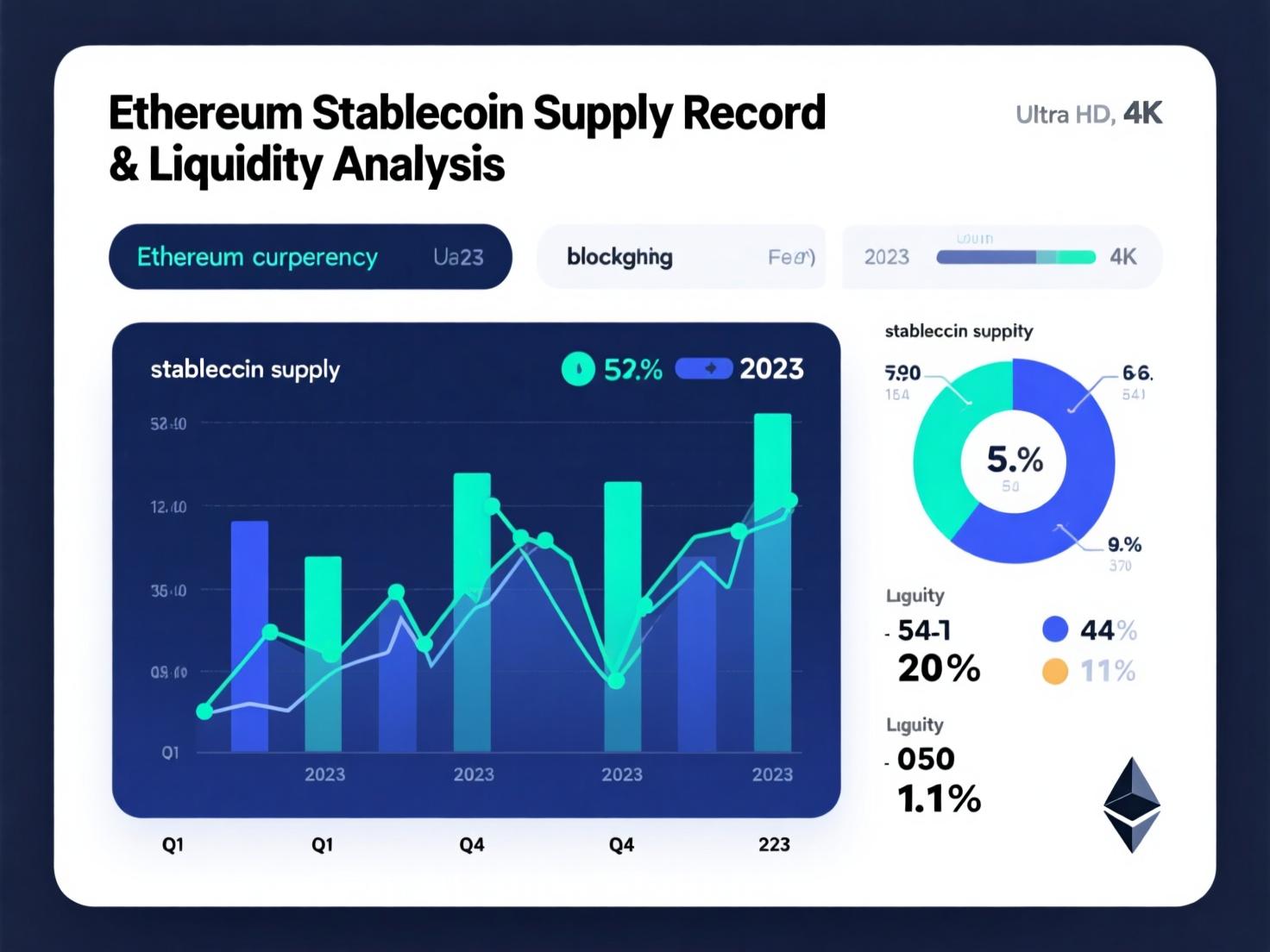
Ethereum added $1B of stablecoins almost every day last week
Ethereum witnessed a major surge in liquidity last week, adding close to $1 billion in stablecoins every single day. This rapid inflow pushed on-chain dollar liquidity to record highs, strengthening Ethereum’s role as the leading settlement layer for digital assets. The rise comes as investors increasingly view Ethereum as a preferred hub for stablecoin activity and broader financial innovation.
At the same time, the network’s real-world asset (RWA) segment showed strong momentum. Tokenized U.S. Treasuries, digital gold, and other RWA products are gaining traction, highlighting Ethereum’s expanding use cases beyond traditional crypto. However, this growth is happening alongside a heated debate on declining fee revenue, raising questions about sustainability and long-term incentives for validators and developers within the Ethereum ecosystem.
Key takeaways at a glance
- Weekly inflows: ≈$5B in new stablecoins.
- Total on Ethereum: up to ~$165B; alternative data puts it near ~$158.5B.
- Market share: ~57% (Ethereum) vs ~27% (Tron) and <4% (Solana).
- Tokenized gold on Ethereum: ≈$2.4B, at an all‑time high.
- Dominance in tokenized commodities: ~77% on Ethereum; ~97% including Polygon.
- Tokenized U.S. Treasuries share: >70% on Ethereum.
- Ether cycle context: price up ~200% since April to an ATH just below $5,000 on Aug. 24.
- New entrants: Fidelity launched the Fidelity Digital Interest Token (FDIT) on Ethereum, with >$200M TVL soon after.
Why this matters for the Ethereum stablecoin supply record
The Ethereum stablecoin supply record signals deep, dollar‑denominated liquidity fuel for DEX volume, credit markets, and settlement. When stablecoin float expands quickly, it often precedes higher on‑chain activity across payments, trading, and RWA issuance. It also strengthens Ethereum’s position as neutral settlement infrastructure for dollar assets.
Inflows, totals, and market share
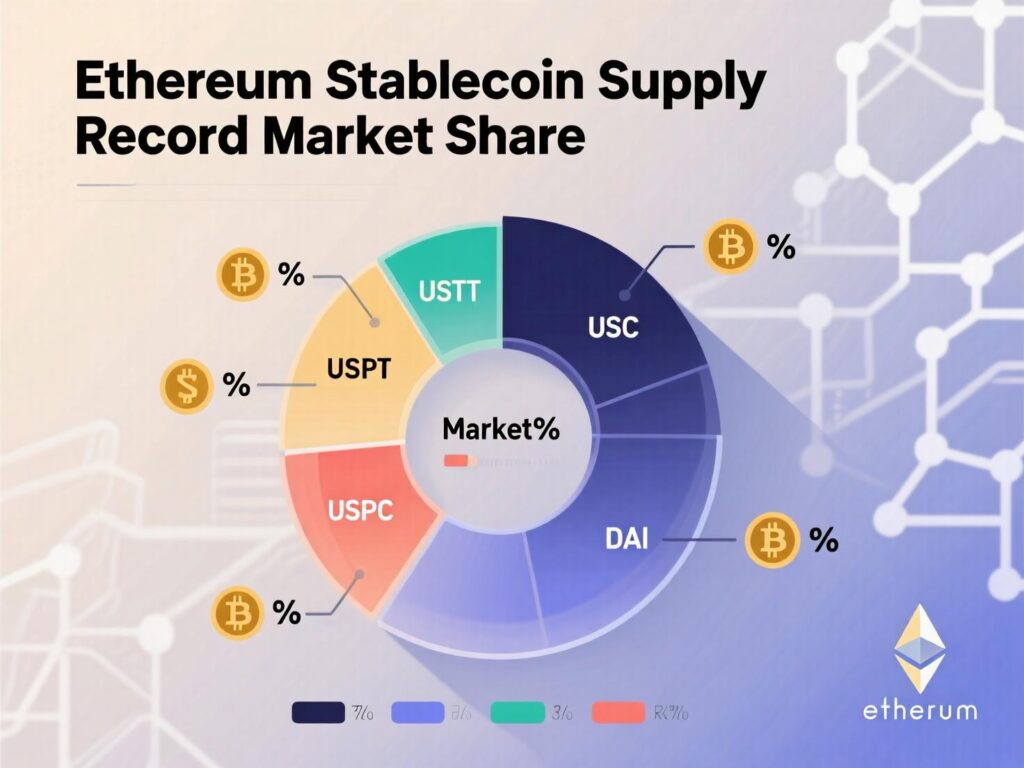
Over the last week, Ethereum absorbed roughly $5 billion in net stablecoin inflows—nearly $1 billion per day pushing total supply on the network to a new peak around $165 billion. Depending on the data vendor and methodology, the tally ranges near $158.5 billion as well, but either way the Ethereum stablecoin supply record is intact. That base underpins Ethereum’s approximate 57% stablecoin market share, towering over Tron (~27%) and Solana (<4%).
The composition behind the Ethereum stablecoin supply record
Dollars on-chain are no longer a single‑asset story. While USDT and USDC still dominate, Ethereum’s lead comes from breadth regulated fiat tokens, bank‑grade cash instruments, and increasingly, tokenized money‑market exposures and funds. The Ethereum stablecoin supply record reflects that mix, with institutions parking liquidity where tooling, custody, and compliance are most mature.
Breadth beyond dollars
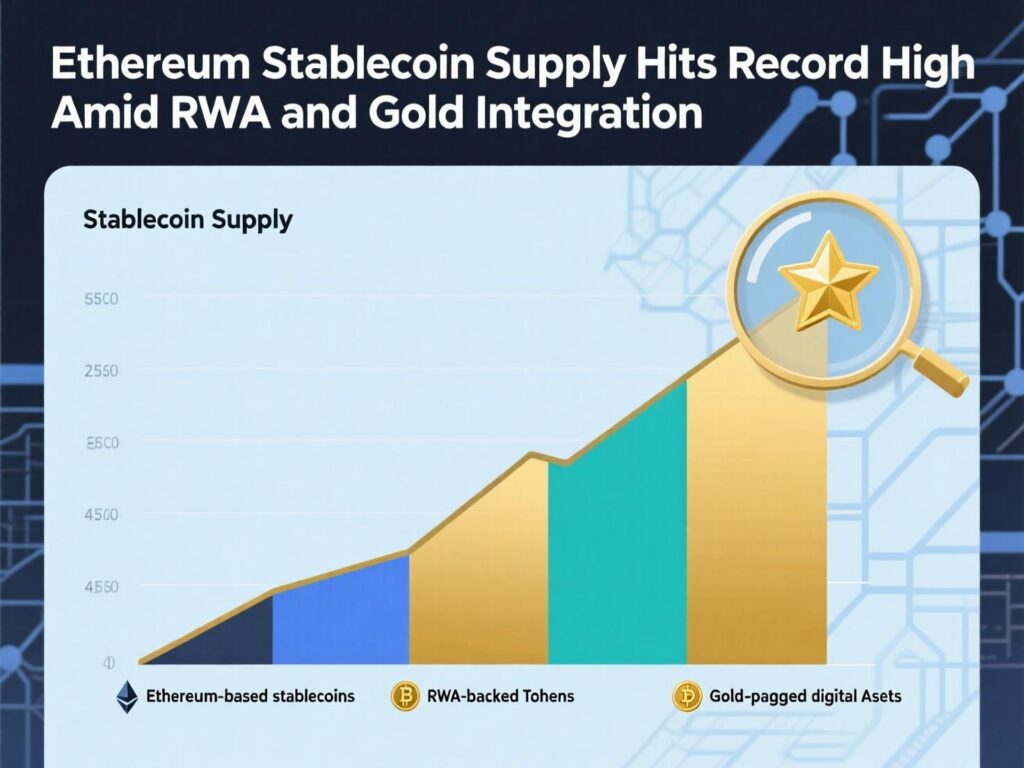
Stablecoins aren’t the only flow. Tokenized gold on Ethereum has reached roughly $2.4 billion, a fresh all‑time high. Ethereum also commands ~77% dominance in tokenized commodities (and ~97% when its Layer‑2 Polygon is included). In Treasuries—the second‑largest on‑chain RWA after private credit Ethereum captures >70% share. These figures reinforce the Ethereum stablecoin supply record as part of a larger RWA stack that spans cash, sovereign debt, and commodities.
New funds, familiar rails
Global financial brands continue to pick Ethereum for issuance. A recent example is Fidelity’s Fidelity Digital Interest Token (FDIT), a tokenized U.S. Treasuries fund deployed on Ethereum in early September and already above $200 million in assets. Each new marquee issuer widens distribution, deepens secondary liquidity, and, by extension, supports the Ethereum stablecoin supply record.
Is lower fee income bearish?
A viral post argued that Ethereum is “dying” because network revenue (fee income) fell ~44% year‑over‑year in August and ~20% month‑over‑month, landing near $39.2 million. Critics counter that this lens misreads a commodity‑like base layer whose aim is neutral, permissionless settlement—not maximizing profit.
Dencun changed the cost curve
Since the Dencun upgrade (March 2024), Ethereum intentionally pushed fees down for Layer‑2s by introducing cheaper data availability. Lower L2 posting costs reduced L1 fee revenue—but also expanded throughput and user comfort. That’s why other engagement metrics—active addresses, stablecoin float, L2 volumes—have trended up, even as top‑line revenue dipped. In short: the Ethereum stablecoin supply record and rising RWA activity tell a different demand story than fee revenue alone.
Activity still looks healthy
Recent snapshots showed ~552,000 daily active addresses (Aug. 30), up about 21% versus a year earlier. Meanwhile, obituaries declaring Ethereum “dead” keep multiplying, yet adoption data from the Ethereum stablecoin supply record to tokenized gold and Treasuries suggests the network remains a vibrant hub for digital finance.
Catalysts and risks
Catalysts
- Institutional tokenization pipelines (funds, deposits, short‑term debt) likely keep growing on Ethereum.
- Layer‑2 cost compression invites more consumer use cases without spiking fees.
- The Ethereum stablecoin supply record provides a liquidity base for credit, FX, and payments rails.
Risks
- Regulatory shifts around stablecoin reserves, disclosures, or issuer licensing could slow inflows.
- Bridge and L2 security assumptions remain a live area of engineering and governance.
- Market‑wide risk‑off moves can shrink on‑chain dollar float as issuers redeem supply.


Bottom line
Ethereum’s dollar base just set a new high. Combined with record tokenized commodities and growing on‑chain funds, the Ethereum stablecoin supply record underscores a structural shift: capital markets are moving onto credibly neutral rails. Whether fee revenue is the right health metric or not, the settlement layer that institutions keep choosing is, unmistakably, Ethereum.