
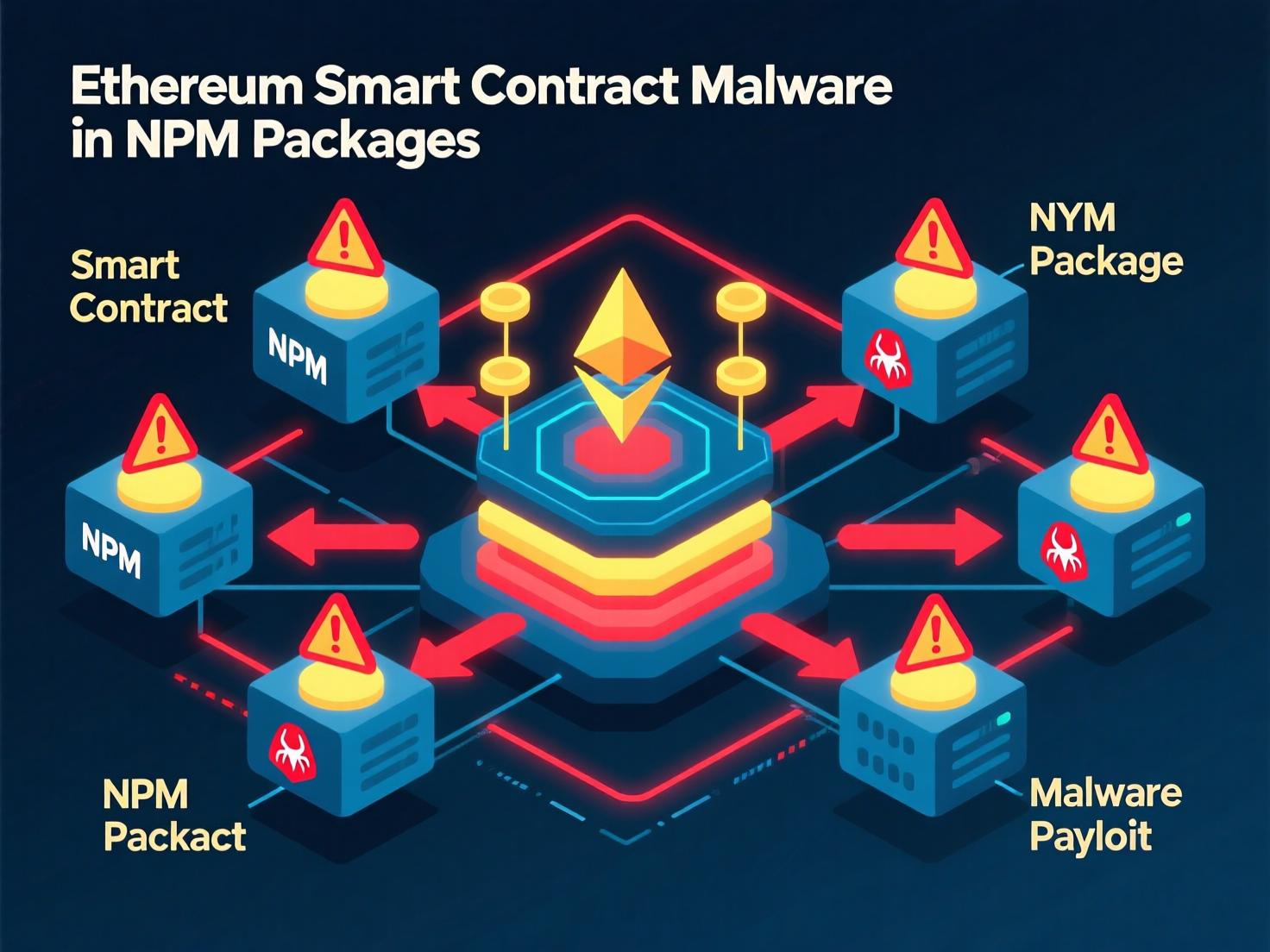

Crypto Hackers are Now Using Ethereum Smart Contracts to Mask Malware Payloads
Security researchers have discovered a new supply-chain attack hidden within npm packages, where malicious code cleverly disguised itself as routine Ethereum network traffic. Instead of drawing suspicion, these packages embedded command-and-control beacons that blended into ordinary blockchain activity, making detection more difficult for defenders. Once deployed, the malware secretly reached out to external URLs, downloading second-stage payloads to expand its control and persistence.
What makes this incident particularly alarming is the use of Ethereum smart contract communication as a cover for command-and-control activity. By leveraging blockchain traffic, attackers gained a stealthy advantage in masking their operations within legitimate-looking patterns. Security teams are now closely tracking these npm packages, viewing the campaign as a dangerous evolution of open-source supply-chain threats targeting developers and organizations worldwide.
What is Ethereum smart contract malware in npm packages?
It’s a technique where a malicious npm package looks benign, but its code queries an Ethereum smart contract to retrieve hidden data (like URLs or commands). Because the call resembles routine blockchain activity, traditional defenses are less likely to flag it, giving attackers a covert path to deliver additional payloads.
How this campaign worked
Two npm packages colortoolsv2 and mimelib2 were uploaded in July and presented as utility libraries. Under the hood, they contacted an Ethereum smart contract, parsed encoded strings that resolved to remote URLs, and instructed infected machines to download a second stage. The packages were linked to fabricated GitHub repos that posed as crypto trading tools, complete with fake commits, sock-puppet maintainers, and inflated stars to feign legitimacy.
In this case, Ethereum smart contract malware in npm packages leveraged on-chain storage as a resilient redirector: if defenders block one URL, attackers can simply update the contract data and keep the campaign alive without republishing the package.

Why Ethereum helps attackers blend in
Security tools increasingly watch for traffic to pastebins, cloud drives, or raw GitHub content. But an outbound call that reads a public smart contract can appear routine—especially on developer machines that already interact with web3 libraries. On-chain data is globally available, censorship-resistant, and versionable; it gives adversaries durability, deniability, and fewer infrastructure indicators to burn.
What developers should do right now
Verify provenance: Prefer well-established packages with signed releases; scrutinize sudden forks with “v2” style names.
Pin and inspect: Lock exact versions, diff every update, and scan post-install scripts for network calls and obfuscation.
Treat on-chain reads as egress risks: Alert on code that fetches data from contracts, especially if it immediately decodes base64/hex and reaches out to the web.
Harden CI/CD: Run dependency checks in isolated build agents with no secrets and minimal egress.
Block known patterns: Add detections for decoded URL fetches following web3 calls and watch for Ethereum smart contract malware in npm packages behavior chains.
Educate teams: Popular commits and “active maintainers” can be faked; reputation signals alone aren’t safety signals.
The bigger picture
Sophisticated actors have long abused trusted platforms—GitHub Gists, Google Drive, OneDrive to host malicious pointers. Moving those pointers into smart contracts extends the same playbook into the blockchain layer. With open-source crypto tooling in constant flux, developer ecosystems are prime real estate for supply-chain threats.

Conclusion
Attackers are evolving quickly, testing Ethereum smart contract malware hidden in npm packages. This shift shows why defenders must treat blockchain lookups with the same suspicion as any other command-and-control activity. By recognizing these interactions as possible C2 channels, teams can close detection blind spots before attackers gain persistence.
To counter these tactics, organizations should prioritize strong dependency hygiene, provenance checks, and the use of signed artifacts. Enforcing strict egress controls further reduces exposure. When such practices are normalized, it becomes much harder for adversaries to exploit on-chain redirection and quietly bypass traditional defenses.
FAQs
Q1 . What is “Ethereum smart contract malware in npm packages,” in plain English?
A1. It’s when a malicious npm package reads data from an Ethereum contract to hide C2 URLs, letting attackers update payloads without republishing code.
Q2 . How did the npm packages avoid detection?
A2. They disguised traffic as normal blockchain reads, decoded contract data into URLs, and then pulled second-stage malware, which looks less suspicious than pastebins or cloud links.
Q3 . What red flags should developers look for?
A3. Post-install scripts, base64/hex decoding followed by fetch/https calls, sudden “v2” forks, and repos with shallow commit histories or new maintainers.
Q4 . How can teams mitigate the risk today?
A4 . Pin versions, require signed releases, run builds in locked-down CI, alert on web3 calls followed by URL fetches, and restrict egress by default.
Q5 . Are only Ethereum projects affected?
A5 . No. Any JavaScript project that installs from npm could be exposed if it pulls a tainted dependency, whether or not it uses web3.