

Crypto Venture Capital in 2025
After two volatile years, crypto venture capital has re-emerged in 2025 with a more selective but far healthier market structure. Spot Bitcoin ETFs (Jan 10, 2024) and spot Ether ETFs (July 23, 2024) pulled new institutional capital into crypto rails, while Europe’s MiCA regime added predictable rules for stablecoins and service providers. Together these milestones set the stage for a pragmatic, compliance-forward cycle where sophisticated allocators prioritize infrastructure, real revenue, and clear routes to liquidity.
In this guide, we unpack what the data really shows about crypto venture capital in H1/Q2 2025, the sectors attracting outsized attention, and the practical steps founders can take to raise successfully now. You’ll also find term-structure tips (equity vs. token vs. hybrid), a diligence checklist for both sides of the table, and two brief case studies illustrating where capital is flowing—plus the risks that could reshape the next four quarters.
The State of Crypto Venture Capital in 2025 (What the numbers say)
Rebound, then reset: PitchBook estimates Q1 2025 crypto VC deal value more than doubled to roughly $6B, helped by a single, outsized $2B minority investment into Binance from Abu Dhabi’s MGX. Without that mega-round, momentum was still improved off 2024 lows.
Q2 cool-down: Multiple trackers show Q2 2025 venture slowed. Galaxy Digital tallied $1.97B across 378 deals (-59% QoQ by value), with later-stage rounds taking 52% of dollars—evidence of consolidation and up-market bias. Messari similarly observed lower venture totals as strategics stayed active.
H1 snapshot: Independent analysis (Lucidity Insights) pegs H1 2025 fundraising at $18.19B across 779 deals (YoY +253% by value), reflecting fewer but larger bets, though methodologies differ across vendors. Treat mega-rounds and methodology (token sales vs. equity) as important footnotes when comparing series.
Context: 2024 ended roughly flat in deal count and dollars versus 2023, setting 2025 up as a selective recovery year rather than a return to 2021 peaks.
Regulatory & market backdrop (the de-risking story):
Spot ETFs in the U.S. unlocked mainstream access (Bitcoin in Jan 2024; Ether in July 2024), tightening the link between TradFi flows and crypto liquidity an indirect tailwind for crypto venture capital exits and token distributions.
MiCA: Stablecoin rules have applied since June 30, 2024; broader CASP obligations from Dec 30, 2024, with a transitional path to July 1, 2026 in parts of the EU. Predictability helps EU-facing product teams and investors underwriting compliance.
ETF pipeline (late 2025): The SEC is evaluating generic listing standards for crypto ETPs, which if approved could accelerate approvals beyond Bitcoin/Ether and widen investor access.
Takeaway: 2025 isn’t a “risk-on mania.” It’s a quality-over-quantity cycle where winning teams show real traction, regulatory foresight, and believable liquidity paths.
Where Capital Is Flowing: 7 Sectors VCs Actually Fund
Core infrastructure (L2s, modular stacks, interoperability): Fewer greenfield L1s; more capital to throughput, security, and interop layers that reduce user friction. Later-stage bias supports platforms with proven PMF running at scale.
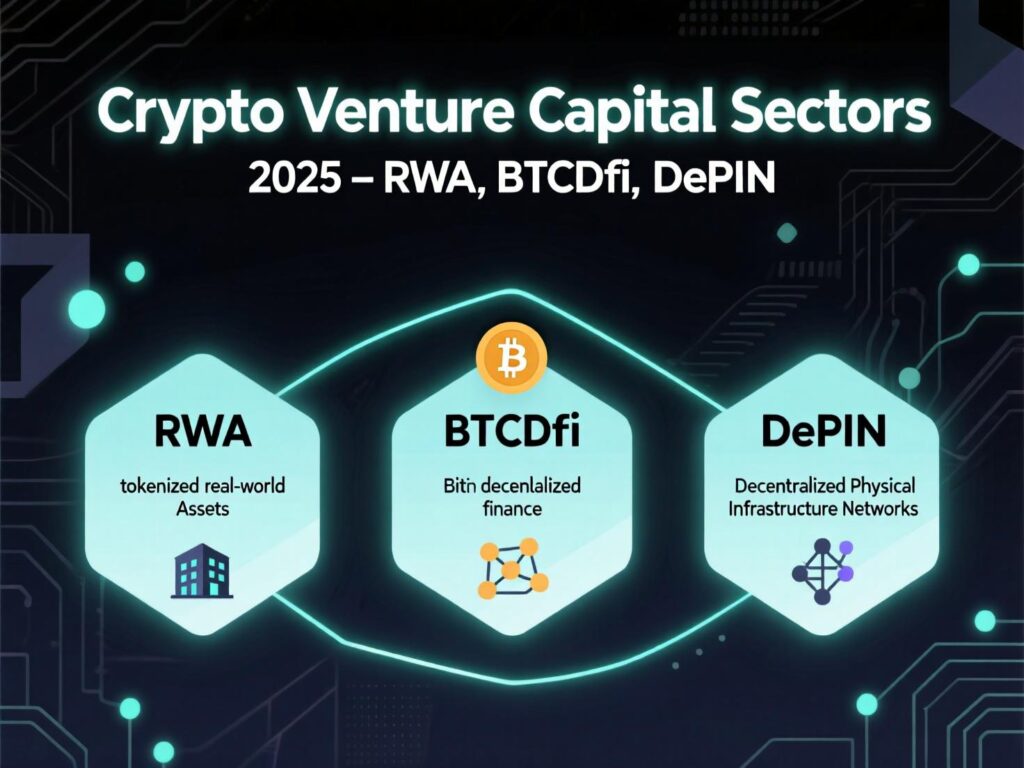
BTC-native DeFi (BTCFi): An emerging wedge. H1 2025 BTCFi funding reached $175M across 32 rounds, with growing attention on consumer apps and yield products built on Bitcoin rails.
Real-world assets (RWA) & on-chain capital markets: Tokenized treasuries, credit, and funds enabling compliant yield and distribution aligned with institutional workflows. (See also later-stage tilt in Q2.)
Wallets & account abstraction: Enterprise-grade UX, passkeys, embedded wallets, and EIP-712 signature flows that de-risk onboarding. (See a16z’s State of Crypto and ecosystem telemetry.)
Security and restaking: Economic security marketplaces, monitoring, and modular security. Later-stage dollars prefer teams with audited stacks and revenue.
DePIN & data networks: Incentivized infra (compute, storage, bandwidth) tied to measurable demand an AI-adjacent theme.
Exchanges, derivatives, and market infrastructure: Compliance-forward venues, prime services, and RWA bridges positioned to capture ETF-driven inflows and institutional routing.

Founder Playbook: Raising Crypto Venture Capital in 2025
Nail compliance early
Map your jurisdictions (EU MiCA, US securities/commodities, UK FCA, SG MAS). If you touch stablecoins in the EU, align with MiCA Titles III/IV; if you’re a service provider, plan for CASP obligations and timelines. Build this into your data room. AMF France
Be explicit about your liquidity path
Tokens vs. equity vs. hybrid: Most 2025 rounds mix equity (SAFE/price round) with token warrants or a post-TGE allocation. Present unlock schedules, supply policy, and utility with hard caps and emissions math. Include a “no surprises” clause for vesting changes.
Exit realism: ETFs may deepen secondary liquidity for majors, but crypto venture capital exits still skew to token distributions and M&A; IPOs remain rare. Cite relevant comps, not 2021 anecdotes.
Show traction (not vibes)
Investors are underwriting usage and revenue:
Live cohort charts (MAUs/WAUs), on-chain metrics (protocol revenue, TVL quality, churn), and unit economics.
Security posture (audits, monitoring), incident response runbooks, and KPI goals tied to compliance milestones.
Enterprise-ready go-to-market
Integrations with custody, KYC/AML vendors, and account abstraction tooling.
For RWA/fin-infra: documented control frameworks and legal opinions; for consumer: evidence of sustainable LTV/CAC and content moderation policies.
Round mechanics that resonate in 2025
Documentation:
SAFE + token warrant, SAFT (where appropriate), price rounds for later-stage.Valuation hygiene:
Use “milestone tranches” for riskier workstreams (e.g., compliance or validator builds).Cap table balance:
Keep room for strategic partners; avoid overly-dilutive pre-TGE allocations that impair community incentives post-launch.
LP & Founder Diligence: How to Evaluate a Crypto VC in 2025
Signal checklist
Fund strategy clarity:
Stage, sectors, geography, token/equity policy, distribution governance.Operational chops:
Portfolio support (tokenomics, listings, BD, compliance).Track record & realizations:
DPI/TVPI for equity, token distribution quality (liquidity management, unlock discipline).Governance posture:
On-chain voting history, conflict policies around market-making or internal trading.Regulatory readiness:
How they’ve handled MiCA/SEC shifts; counsel partners and compliance stack.
Brief Case Studies
Case 1 — Mega-round optics:
Binance’s $2B minority investment from MGX (Q1 2025) skews quarterly totals and underlines a reality of crypto venture capital tracking: one or two mega-rounds can mask the median founder’s environment. Investors read this as consolidation and strategic capital stepping in—less a broad seed froth.
Case 2 — BTCFi traction, small but rising:
A report shared with Cointelegraph showed $175M across 32 BTCFi deals in H1 2025, with money moving toward consumer surfaces (wallets, yield, point-solutions). For founders, “Bitcoin adjacency” helps, but user-level retention and compliance design remain the real unlock.
Risks & Scenarios for the Next 4 Quarters
Policy path risk: If the SEC’s generic ETP listing change slips or narrows, ETF-related liquidity spillovers may underwhelm. Conversely, approval could broaden asset access (beyond BTC/ETH), a mild positive for downstream builders.
Methodology noise: Vendor datasets differ (equity vs. token sales vs. strategic rounds). When quoting crypto venture capital totals, annotate what’s included.
Macro spread: Rates, risk appetite, and AI capital competition still matter AI continues to command an outsized slice of VC firepower in 2025.


Final Thoughts
2025 is the year crypto venture capital matures into its selective phase: fewer “spray-and-pray” seeds, more targeted bets on infrastructure, compliant consumer apps, and revenue-linked models. Data across PitchBook, Galaxy, and Messari show a rebound off 2024 floors with periodic slowdowns typical of a consolidating cycle.
Regulatory clarity (spot ETFs; MiCA) reduces tail risk, but founders still win or lose on traction quality, governance, and transparent token-economics. If you’re building, lead with compliance, cohort-level proof, and a credible path to liquidity. If you’re allocating, reward durable revenue, disciplined unlocks, and security practices that stand up to institutional scrutiny.
Call to action: Need a fundraising readiness audit or investor target list? Get a custom crypto venture capital go-to-market brief (KPIs, target funds, pitch narrative) tailored to your sector and jurisdiction reach out and let’s ship.
FAQs
1) How does crypto venture capital differ from traditional VC in 2025?
A . Crypto VC often blends equity with token exposure (warrants/allocations) and underwrites on-chain traction, token design, and compliance. It also considers liquidity dynamics (ETFs, CEX/DEX depth) and governance. In 2025, later-stage bias and regulatory clarity push investors toward revenue-backed protocols and compliant infra.
2) How can founders choose between equity, token, or hybrid rounds?
A . Use equity for company-building and hiring; tokens for network incentives/governance. Hybrids align both. Present vesting, unlocks, and supply caps clearly. If uncertain, start with equity + token warrant, defer TGE until product-market fit and compliance controls are proven.
3) How to validate product-market fit for crypto venture capital pitches?
A . Show cohort retention, on-chain revenue (not just TVL), cost of security, and real demand (enterprise pilots or consumer payers). Add security audits, compliance milestones, and unit economics that survive fee compression.
4) What sectors are hot for crypto venture capital in 2025?
A . Core infra (L2/modular), RWA, BTCFi, DePIN, security/restaking, wallets/AA, and derivatives/market infra. Weightings vary by stage and region; later-stage rounds dominate overall.
5) How do ETFs affect venture outcomes?
A . ETFs deepen liquidity and bring institutions closer to crypto, indirectly supporting token distribution and M&A appetite. They don’t guarantee exits; strong fundamentals and governance still drive outcomes.
6) How can non-EU teams prepare for MiCA?
A . If you serve EU users, map MiCA obligations: stablecoin interactions (Titles III/IV) and CASP licensing timelines/transitions. Document policies and service boundaries; consider EU partnerships for compliance.
7) What KPIs do VCs insist on in 2025?
A . Usage cohorts (DAU/WAU/MAU), protocol revenue quality, fraud/abuse rates, security metrics, and compliant custody/on-ramp coverage. For enterprise pipelines, signed pilots and SOC2/ISO roadmaps are persuasive.
8) How long should I budget for a 2025 raise?
A . Assume 3–6 months for a well-structured seed/Series A from first meetings to close, faster with strategic fit and warm intros. Build contingencies for compliance or audit timing.
9) How can LPs diligence a crypto fund?
A . Request DPI/TVPI and token distribution history; review governance behavior, compliance stack, and conflicts policies. Probe portfolio support functions (tokenomics, listings, BD, security).